

Egypt’s cosmetics and personal care market generated more than $900m in revenue in 2025, with projections indicating that it will expand to $1.57bn by 2032, reflecting sustained annual growth of around 7%.
The sector’s expansion is being fuelled by Egypt’s young population, rising interest in personal care among male consumers, and the growing influence of social media on purchasing decisions.
Together, these trends are transforming cosmetics and personal care products from everyday essentials into expressions of individuality, lifestyle, and overall well-being.
Against this backdrop, L’Oréal, the leading beauty company in Egypt, continues to strengthen its presence by aligning its operations with the country’s strategy to localize manufacturing and deepen domestic industrial production.
Egypt’s growth mirrors the strong momentum of the global beauty industry, which is projected to surpass €290bn in value in 2025, supported by annual growth of approximately 3.5%.
The global market is expected to serve around 4.6 billion consumers this year, with the customer base forecast to expand by more than 600 million people by 2030.
Regionally, North America accounts for the largest share of the global beauty market at 28%, followed by North Asia (27%) and Europe (24%).
The SAPMENA-SSA region—covering South Asia Pacific, the Middle East, North Africa, and Sub-Saharan Africa—represents 12% of the global market, while Latin America accounts for the remaining 9%.
As consumer preferences continue to evolve and demand for premium and innovative beauty products rises, Egypt is increasingly positioning itself as an important growth market and a strategic manufacturing hub for the regional beauty industry.
Accordingly, L’Oréal Egypt’s Cairo manufacturing plant serves as a regional production and export hub for the Middle East and North Africa (MENA). Since its opening in 2013, the facility has exported 85% of its production to 20 countries, supporting the company’s regional supply network while reinforcing Egypt’s role as a manufacturing and export base for international markets.
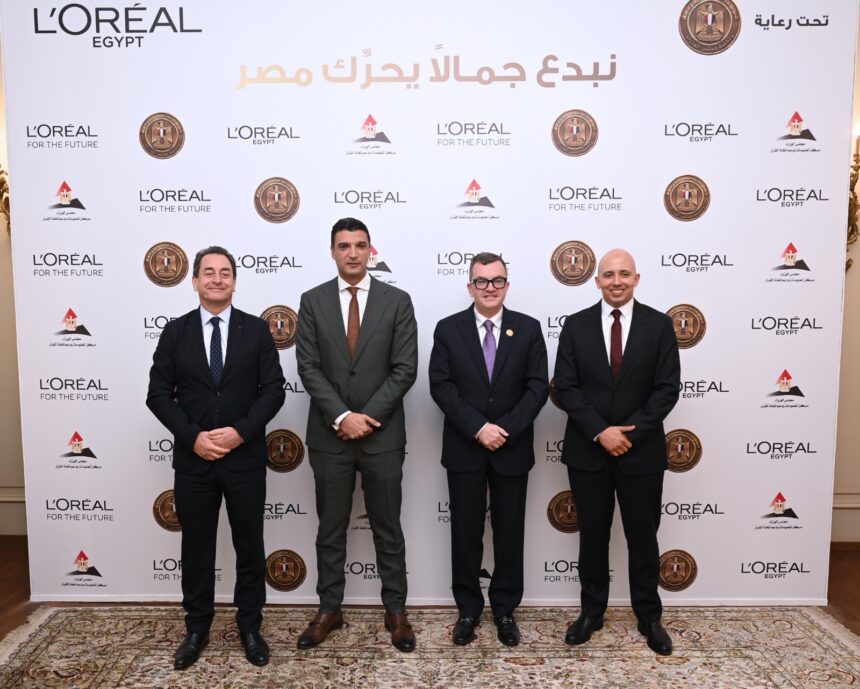
For his part, Industry Minister Khaled Hashem praised L’Oréal Egypt’s contribution to the country’s cosmetics industry, describing the company as a successful model for integrating innovation, advanced technology, and sustainable manufacturing.
He noted that since establishing its Egyptian factory in 2013, L’Oréal has transformed the facility into a regional manufacturing and export hub serving markets across the Middle East and North Africa, while supporting Egyptian exports and facilitating the transfer of modern industrial technologies.
Hashem also highlighted L’Oréal Egypt as a benchmark for sustainable industrial practices, noting that its manufacturing facility operates entirely on renewable energy and recycles 100% of the water generated during production, resulting in zero wastewater.
He encouraged other manufacturers to adopt similar resource-efficient production models, emphasizing that responsible industrial growth should combine innovation, environmental sustainability, and meaningful social and economic impact.


