

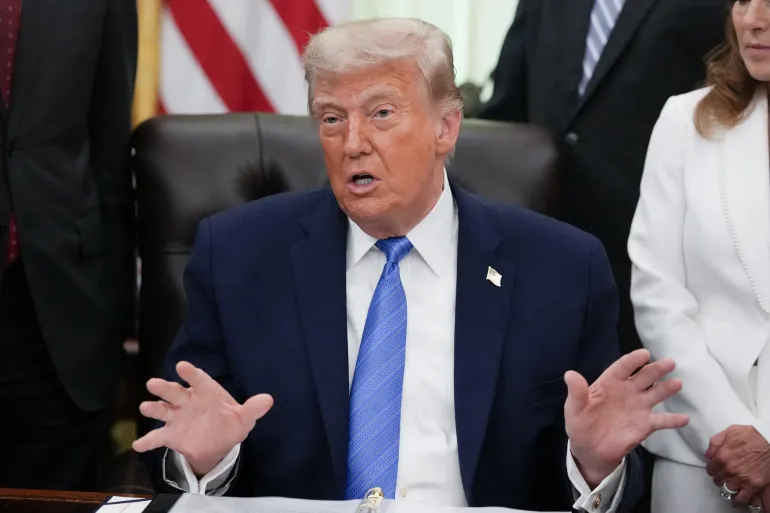
US President Donald Trump warned on Wednesday that Iran would “pay the price” for delaying a nuclear agreement, raising the prospect of further American military action even as the White House insisted that diplomatic efforts remained on track.
In a post on Truth Social, Trump said Iran had missed an opportunity to secure a deal that would have been in its interest, arguing that Tehran had waited too long to negotiate. He claimed Iran’s military capabilities had suffered a major setback and warned that the consequences of failing to reach an agreement would be severe.
Speaking by telephone to Fox News, Trump said he could authorise additional strikes targeting Iranian power stations and bridges, accusing Tehran of delaying negotiations. “They are talking too much and acting too little,” he said.
The remarks came hours after the United States launched strikes on Iranian air defence systems, radar installations and command facilities near the Strait of Hormuz. Washington said the attacks were carried out in response to the downing of a US Apache helicopter during a patrol mission over the strategic waterway on Tuesday.
Iran responded with one of its largest attacks since the latest escalation began. The Islamic Revolutionary Guard Corps said it had targeted 21 objectives at US air and naval bases across the region using missiles and drones. Axios, citing a US official, reported that at least four ballistic missiles and several drones were launched towards American facilities.
The attacks prompted heightened security measures across the Gulf region. Bahrain said its air defences intercepted Iranian missiles and drones and accused Tehran of deliberately targeting civilians. Authorities activated warning sirens twice and urged residents to seek shelter.
Kuwait announced that its forces had intercepted “hostile aerial targets”, while Jordan’s military said it had shot down five missiles launched from Iran towards the Azraq area in northeastern Jordan. Kuwait’s cabinet condemned what it described as repeated Iranian missile and drone attacks, calling them a dangerous escalation and a violation of international law.
Despite the intensifying military confrontation, both Washington and Tehran continued to signal interest in a negotiated settlement.
Trump said earlier this week that talks aimed at ending the conflict were in their final stages and could produce an agreement within days. CNN, citing a US official, reported that the latest American strikes were intended as a warning to Tehran and were not expected to derail ongoing negotiations.
Politico quoted a senior White House official as saying Trump still believed a peace agreement with Iran remained within reach despite the exchange of attacks.
“Nothing has changed regarding the path toward an agreement,” the official said.
Iranian Foreign Minister Abbas Araghchi accused Washington of choosing to “test our resolve”, warning that Iran’s armed forces would not leave any attack unanswered.
“Leave our region if you want to remain safe,” he wrote on X.
Iranian President Masoud Pezeshkian also struck a defiant tone, insisting that Tehran would neither surrender nor abandon its positions. Speaking in Tehran, he said war was not in Iran’s interest but argued that the current state of “neither peace nor war” could not continue indefinitely.
Meanwhile, diplomatic contacts continued. Iran’s ISNA news agency reported that a Qatari delegation arrived in Tehran on Wednesday for talks covering bilateral relations, regional developments and efforts to end the conflict.


