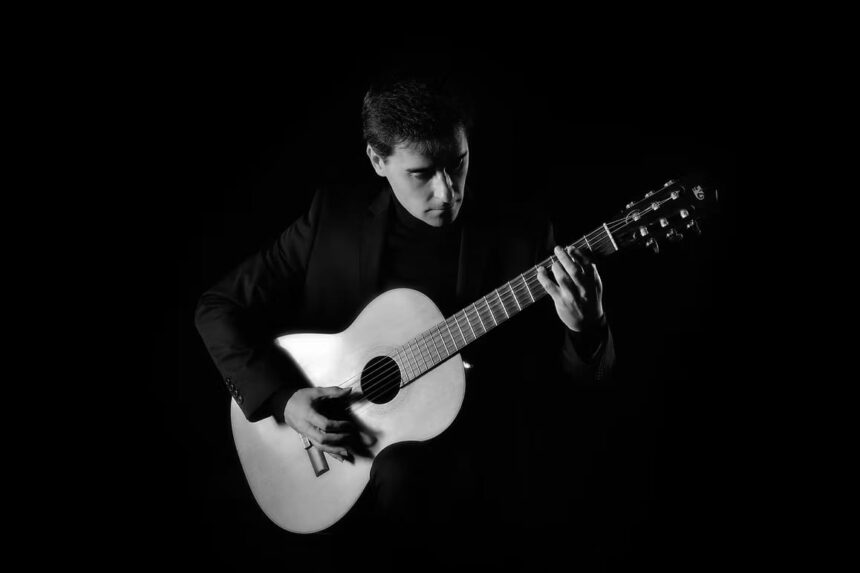
On the occasion of the 150th anniversary of the birth of Manuel de Falla, one of the most universal figures in Spanish music, the Embassy of Spain in Egypt presents the concert Alla Spagnola. This performance features the renowned Spanish guitarist Raúl Viela, who will offer a series of recitals and activities in Cairo between June 9 and 11.
The core of the musical program will highlight an outstanding selection of pieces from El amor brujo (The Bewitched Love), one of Falla’s most famous and passionate masterpieces. The program will begin on June 9 at the Jesuit Cultural Center in Cairo. On June 10, the project will continue at the prestigious Sayed Darwish Theater, located within the Academy of Arts complex. In addition, the Spanish musician will give an educational masterclass at the Academy of Arts, aimed especially at music students, young guitarists, and specialized audiences. This activity will offer attendees a unique opportunity to explore classical guitar techniques and the interpretative secrets of the Spanish national repertoire.
Considered the most influential Spanish musician of the 20th century, Manuel de Falla (Cádiz, 1876 – Argentina, 1946) established a universal artistic legacy that transformed his country’s musical identity. After brilliant academic training that culminated in first prize for piano at the Madrid Conservatory, his early ventures into zarzuela took a decisive turn upon meeting Felipe Pedrell, who inspired him to reconcile Spain’s musical past with modern compositional techniques. This vision matured during his time in Paris, where he integrated into modernist circles alongside Debussy, Ravel, and Dukas, and achieved the premiere of his opera La vida breve (The Brief Life) in Nice.
Upon returning to Spain, Falla emerged as the undisputed leader of the national avant garde thanks to masterpieces such as El amor brujo, Noches en los jardines de España (Nights in the Gardens of Spain), and El sombrero de tres picos (The Three Cornered Hat), the latter achieving great international success. His subsequent move to Granada opened a markedly experimental phase that culminated in El retablo de Maese Pedro (Master Peter’s Puppet Show), a revolutionary piece that broke away from romantic language and placed him at the forefront of the European avant garde alongside Stravinsky and Bartók. His final years were marked by a profound spiritual search reflected in his ambitious, unfinished cantata Atlántida. He continued this project in Argentina, where he went into exile in 1939 following the Spanish Civil War and lived until his death, before his remains were repatriated to the cathedral of his native Cádiz.
Raúl Viela holds a Bachelor’s Degree in History and Music Sciences from the University of La Rioja and a Master’s Degree in Musical Research from the International University of Valencia. His international career spans concerts in around twenty countries across Europe, Africa, the Americas, and Asia, where he has garnered acclaim from both audiences and critics, in addition to winning numerous international competitions. In the teaching field, he works in conservatories across Aragón, La Rioja, and Madrid, and is regularly invited to give masterclasses at various festivals. His strong commitment to the dissemination and study of musical heritage is reflected in his role as founder and director of the Gaspar Sanz Institute of Musicological Studies, through which he also directs its well established Guitar Festival.