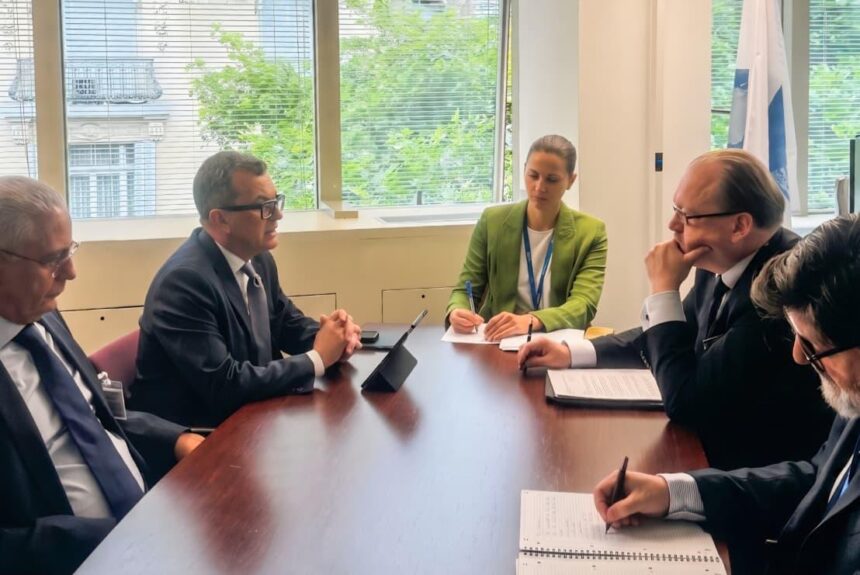
Ahmed Rostom, Egypt’s Minister of Planning and Economic Development, met with Andreas Schaal, Director for Global Relations and Cooperation at the Organisation for Economic Co-operation and Development (OECD), to discuss strengthening bilateral cooperation and launching the second phase of the Egypt-OECD country programme.
The meeting took place on the sidelines of Rostom’s participation in the OECD Ministerial Council Meeting 2026, held in Paris under the theme “Shaping sound economic policies for open markets, growth and prosperity.”
Rostom highlighted the depth of Egypt’s longstanding partnership with the OECD and expressed the country’s aspiration to expand cooperation into new areas. He noted that the joint country programme, together with Egypt’s upcoming hosting of the high-level ministerial meeting of the Middle East and North Africa Initiative on Governance and Competitiveness for Development later this year—part of Egypt’s co-presidency of the initiative for 2026-2030—form two key pillars of the partnership.
He explained that the first phase of the programme achieved tangible progress across five strategic pillars: economic growth, innovation and digital transformation, governance and anti-corruption, statistics, and sustainable development. These pillars, he stressed, are fully aligned with Egypt Vision 2030 and the country’s economic reform agenda.
Looking ahead, Rostom said the second phase will build on these achievements by continuing to implement recommendations on evidence-based policymaking, linking international expertise with national priorities, and ensuring that outcomes are sustainable. He emphasized that a more focused phase would strengthen Egypt’s role as a regional and international actor in policymaking, while supporting governance and competitiveness across the Middle East.
Rostom also underscored Egypt’s commitment to leveraging OECD frameworks to benefit African partners, particularly in capacity building and economic policy coordination. He noted that this effort would be pursued in close collaboration with continental bodies such as the African Union, COMESA, and the African Continental Free Trade Area Secretariat.