

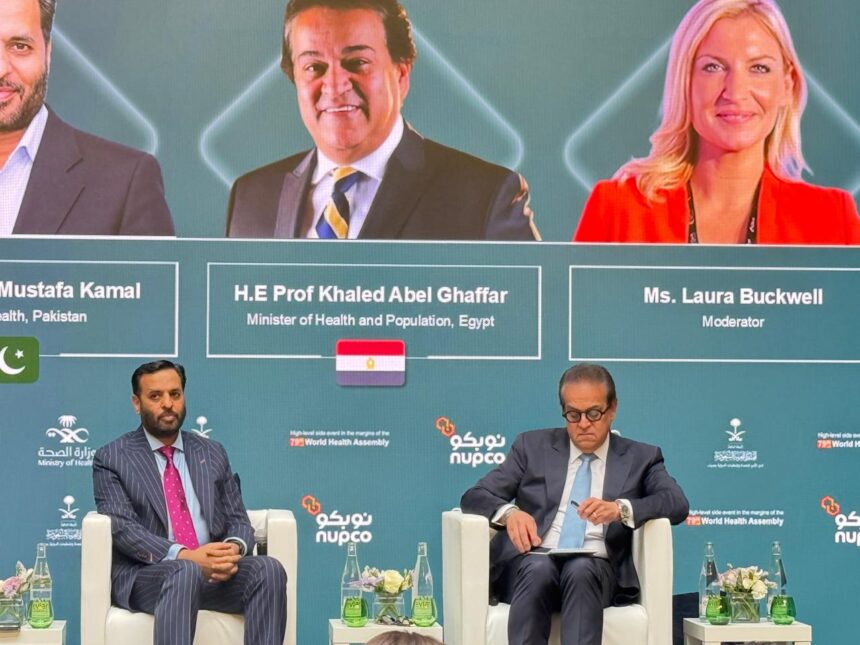
Egyptian Health Minister Khaled Abdel Ghaffar said local pharmaceutical manufacturing is essential for building resilient healthcare supply chains and reducing vulnerability to global crises.
Speaking at a healthcare supply chain event held on the sidelines of the 79th World Health Assembly in Geneva, Abdel Ghaffar said countries should shift from reactive crisis management to proactive planning to ensure sustainable healthcare services.
According to a statement from Egypt’s Health Ministry, the minister said the COVID-19 pandemic exposed major weaknesses in healthcare supply systems, including excessive reliance on imports, weak local manufacturing and limited real-time data visibility.
He said Egypt faced challenges during the pandemic related to medical imports and price fluctuations but responded with a comprehensive strategy to strengthen resilience.
The strategy was based on three pillars: digital integration through linking more than 5,000 healthcare facilities to a real-time monitoring system, expanding local pharmaceutical production to cover between 85% and 90% of domestic medicine needs, and strengthening regional cooperation.
Abdel Ghaffar said these measures enabled Egypt to maintain essential healthcare services during the pandemic, including intensive care and dialysis services, while also implementing major public health initiatives such as screening 60 million citizens and treating 5.5 million hepatitis C patients.
He added that pharmaceutical security has become a core component of national health security and stressed the importance of reducing external dependence and ensuring continuous access to medical products.
The minister said Egypt’s Drug Authority obtaining WHO Maturity Level 3 status strengthened international confidence in Egyptian pharmaceutical products and reinforced the country’s ambition to become a regional hub for medicine and vaccine production.
He also highlighted Egypt’s unified procurement system, saying it reduced the cost of hepatitis C treatment from $900 to $40 per patient.
Abdel Ghaffar called for stronger international and regional cooperation to build more resilient health systems based on integration, technology and sustainable local manufacturing.


