

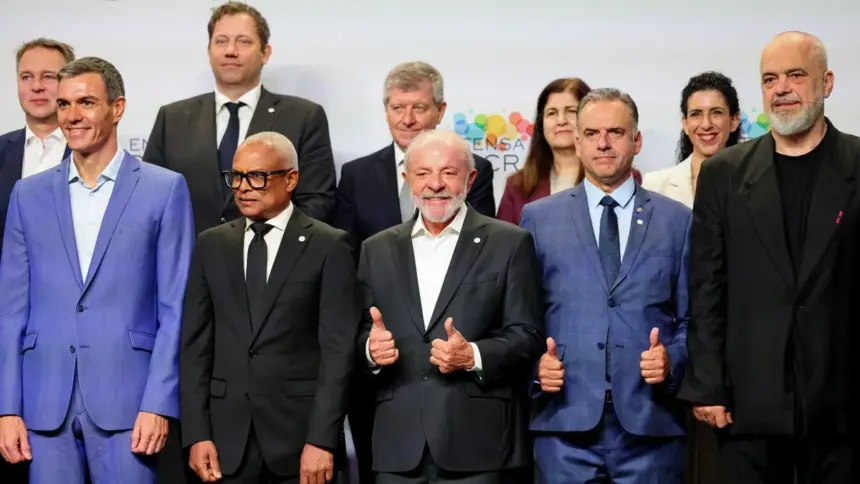
Spanish Prime Minister Pedro Sánchez and Brazilian President Luiz Inácio Lula da Silva signed 15 bilateral agreements as Spain opened a summit of approximately 12 heads of state and government to build a broad alliance countering the policies of United States President Donald Trump, according to Bloomberg.
During their first bilateral summit, the two leaders concluded pacts covering critical minerals, telecommunications, and artificial intelligence. Addressing reporters after the signing, Sánchez stated that the relationship between Spain and Brazil “goes far beyond the purely bilateral framework.”
“Peace and the values it is based on are under attack by a reactionary wave,” the Spanish leader said. “While others open wounds, we want to close and heal them.”
The meeting with the Brazilian president marked the beginning of two days of talks in Barcelona designed to present the city as a “hub for countering Trump’s policies and reviving the left-wing trend,” according to Bloomberg. Leaders from Mexico, South Africa, Colombia, and Uruguay are participating in the events and are scheduled to deliver speeches on Saturday.
The gathered leaders share an opposition to the war in Iran and a mutual criticism of what they describe as an interventionist US foreign policy operating outside the framework of international institutions, which they deem ineffective.
Standing alongside Sánchez, Lula da Silva highlighted this shared stance. “I fully understand when you say: No to war,” the Brazilian president said. “The United Nations is very weak today. The countries that created it do not respect it,” he added, questioning, “Why have democratic institutions stopped working?”
Through the summit, Sánchez seeks to rally these nations to push for a “necessary reform of the multilateral system.” This includes advocating for changes within the United Nations to grant a greater voice to Global South countries such as Brazil.
The Spanish Prime Minister has emerged as one of Trump’s most prominent critics within the European Union. Sánchez was among the first leaders to oppose intervention in Iran, labelling it “illegal,” and he subsequently blocked the use of Spanish airspace and two US military bases in Spain from supporting the strikes. In response, Trump threatened to sever all trade agreements with Spain.
This rift is further compounded by tensions over defence spending. The Spanish government has refused to raise its defence expenditure to 5% of its gross domestic product, a target pushed by the United States within NATO. Spain is the only member state that has not committed to this goal, maintaining that its spending will not exceed 2.1%.
Earlier this week, Sánchez outlined his vision for a revised multilateral order during a visit to Beijing. Speaking at Tsinghua University on Monday, he stated that “the West must give up part of its representation quotas in favour of global stability and winning the trust of the countries of the South.”
The following day, Chinese President Xi Jinping responded by reinforcing these propositions, stating that Spain and China must “cooperate closely, oppose the world’s descent into the law of the jungle, and jointly defend true multilateralism.”
Sánchez is applying this same diplomatic logic with China and the leaders assembled in Barcelona, aiming to strengthen the EU’s relationships with economic and strategic partners outside the US, which is increasingly viewed as a less reliable ally.
Areas of cooperation discussed at the Barcelona summit include climate change, critical minerals, artificial intelligence, and free trade. Both Sánchez and Lula welcomed the signing of the Mercosur agreement earlier this year—following two decades of negotiations—between the EU and Argentina, Brazil, Paraguay, and Uruguay.
This aligns with the EU’s broader trade strategy, which included concluding a free trade agreement with India in January. The European Commission is currently negotiating to adopt or update other agreements, an approach that stands in contrast to the tariff war pursued by Trump.
Reflecting on the international political landscape, Lula da Silva concluded: “Progressives are becoming fewer. Democracy needs international spokespersons, but our ranks are expanding, because the world needs hope.”