When Omani mediators entered a secure room in Muscat earlier this month, they carried a single envelope containing a fresh proposal from Washington regarding Iran’s ballistic missile programme. Across the table, Iranian Foreign Minister Abbas Araghchi did not reach for it. Instead, according to sources familiar with the exchange, he refused to even open the document, signalling a frost that has now settled over months of back-channel diplomacy.
That brief, silent rejection in Oman has since been superseded by the thunder of hardware. As the United States orchestrates its largest military deployment to the Middle East since the 2003 invasion of Iraq, the window for a diplomatic resolution to Tehran’s nuclear ambitions is visibly narrowing. With two aircraft carriers now on station and a self-imposed 15-day deadline looming, the narrative has shifted from the nuances of uranium enrichment to the logistics of a kinetic “limited strike”.
The central tension of this moment—the “Why now?” of the current crisis—stems from a perceived collapse of deterrence. While Tehran claims it will present a new draft agreement to the administration of President Donald Trump within days, officials in Washington and across Europe increasingly view a military collision as more likely than a diplomatic breakthrough. For President Trump, the stakes are anchored in a desire to avoid the appearance of a retreat following a massive military investment, while for Tehran, the red lines regarding domestic enrichment remain non-negotiable.
The Shadow of 2003: A Region on the Edge
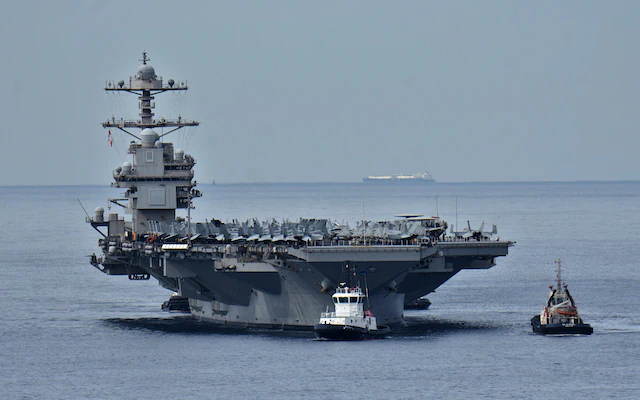
The scale of the current American build-up has fundamentally altered the diplomatic landscape. US officials, speaking on condition of anonymity, confirm that the deployment of carriers, warships, and advanced aircraft is designed to provide Washington with the capability to launch significant offensive strikes while simultaneously shielding regional allies and Israel.
President Trump has been characteristically blunt, warning that unless a comprehensive deal is reached within the next two weeks, “very bad things” will occur. This ultimatum has forced regional capitals into a state of high alert. “The differences between Washington and Tehran are becoming insurmountable,” two Israeli officials told Reuters, noting that the probability of near-term military escalation is now “significant.”
The memory of the “12-day war” in June 2025, which saw joint US-Israeli air strikes on Iranian military and nuclear facilities, hangs heavy over current deliberations. Unlike that engagement, however, the current build-up suggests a broader scope. European governments are reportedly pressing Washington for clarity: is the objective to degrade nuclear capabilities, deter further escalation, or pursue the high-risk path of regime change?
Diplomatic Red Lines and Symbolic Enrichment
Despite the martial posturing, the technical core of the dispute remains the level of uranium enrichment permitted on Iranian soil. Washington’s primary demand has remained firm: no enrichment. However, signs of flexibility have emerged from the White House.
According to reports from Axios, the Trump administration may be prepared to consider a proposal allowing for “symbolic enrichment,” provided it closes every conceivable pathway to a nuclear weapon. While Araghchi noted that Washington did not explicitly repeat the “zero enrichment” demand during recent Geneva talks, the refusal to discuss the missile programme remains a total impasse.
“Neither side is willing to back down from their red lines,” observed Alan Eyre, a former US diplomat and specialist in Iranian affairs. “Trump cannot mobilise this level of force and then return with a mediocre deal. He fears a loss of prestige. If he strikes, things will escalate with terrifying speed.”
The Israeli Contingency and Strategic Targets
In Jerusalem, the calculus has already shifted toward active combat readiness. Sources indicate that the Israeli government believes a deadlock has been reached and has begun preparations for “potential joint military action” with the US. While no final decision has been made, the upcoming visit of US Secretary of State Marco Rubio to meet Prime Minister Benjamin Netanyahu on 28 February is expected to finalise the operational framework for any upcoming strike.
Defence analysts, including David Des Roches, suggest that any opening gambit would likely involve the systematic dismantling of Iranian air defences followed by strikes on the Islamic Revolutionary Guard Corps (IRGC) Navy. However, the most provocative options remain on the President’s desk. Sources close to the White House suggest that one contingency plan presented to the Pentagon involves targeting Supreme Leader Ali Khamenei and his son, Mojtaba, who is widely seen as a potential successor.
The Internal White House Debate
Despite the aggressive rhetoric, the path to war is not yet unified within the West Wing. Some advisers have urged patience, arguing that the mere presence of US forces provides maximum leverage that has not yet been fully exhausted.
There is also the domestic political lens: aides are wary of the impact a major conflict could have on undecided voters ahead of the November midterm elections, where economic stability remains the primary concern. “The President hasn’t decided to strike yet,” a senior adviser noted. “He might wake up tomorrow and decide it’s time, or he might never do it. He is keeping every option open.”
The risk, as European and regional officials warn, lies in the “fog of war.” While starting a military operation is a matter of orders, controlling its strategic outcome—particularly in the absence of a clear political alternative within Iran—remains a gamble of historic proportions.