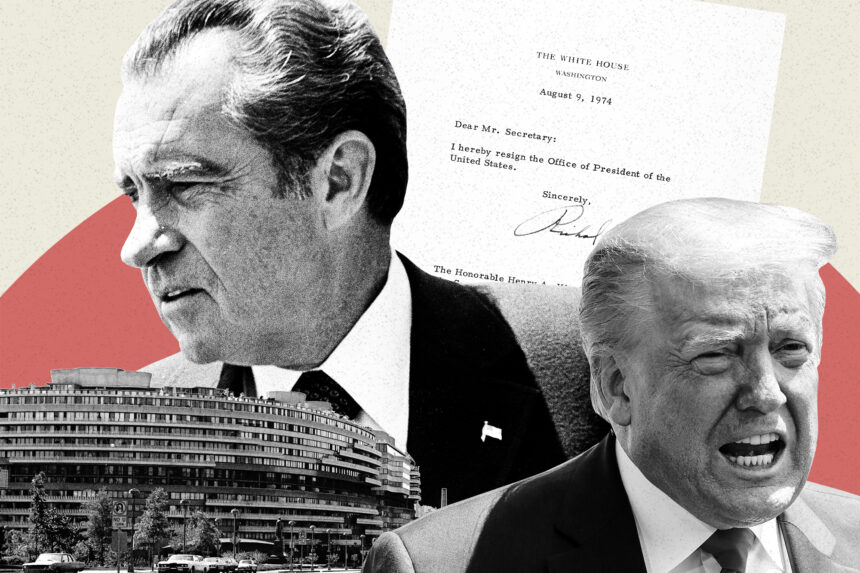
Moral scandals have long shaped Western politics, but for decades they functioned as tests of institutional strength and the credibility of ethical discourse. Leaders from Richard Nixon to Bill Clinton, alongside prime ministers and ministers across France, Italy, Germany, Sweden, and the United Kingdom, faced crises that shook the foundations of power and public trust. Yet the response consistently reflected a guiding principle: ethics were not merely personal matters—they were essential to political legitimacy.
Watergate exemplifies this principle. Nixon’s administration attempted to conceal the break-in at the Democratic National Committee headquarters, triggering congressional inquiries, judicial scrutiny, and ultimately his resignation. Even the highest office was subject to accountability. Decades later, the Clinton–Lewinsky affair reinforced this lesson. While the scandal revolved around a personal relationship, lying under oath violated public integrity. Congress investigated, impeachment proceedings unfolded, and the world saw that power conferred no immunity from ethical or political responsibility. In that era, moral discourse was coherent because rhetoric aligned with action, and public values were applied consistently.
Europe largely mirrored this approach. Ministers and prime ministers resigned over corruption, financial mismanagement, or personal misconduct. Jacques Chirac, for example, faced legal proceedings years after accusations of misusing public funds, demonstrating that wrongdoing—even at the highest levels—could not escape scrutiny. Sexual harassment and misconduct scandals in Sweden and the United Kingdom similarly showed that courts could hold officials accountable regardless of status. Ethics were enforced, and moral rhetoric was reinforced by tangible action.

This stands in stark contrast to later developments. The Epstein case revealed the fragility of moral discourse when entangled with wealth and influence. Epstein’s network implicated powerful political, media, and financial elites. Despite the gravity of the allegations, early judicial responses were lenient, subsequent federal investigations lacked transparency, and public accountability remained fragmented. The global audience witnessed a striking dissonance: moral principles were loudly proclaimed, yet enforcement faltered for the well connected. Accountability appeared to shift—or disappear—depending on proximity to power.
The rise of Donald Trump further transformed this already fragile ethical framework. His presidency redefined the relationship between morality and authority. Scandals no longer prompted apologies or resignations; instead, they became instruments to mobilise supporters against “the establishment,” while personal conduct was relegated to a secondary concern in broader cultural and political battles. Ethics shifted from a shared public value to a strategic tool, where the central questions were no longer “Is this wrong?” but “Who benefits?” and “Who is behind it?” Traditional accountability mechanisms weakened, and the media, judiciary, and even truth itself became targets of suspicion. Scandals were reframed as assaults on political bases rather than breaches of public trust.
Trump’s influence rippled beyond the United States. In Europe, some political elites began treating scandals as temporary media storms to be weathered through counterattacks, rather than as crises requiring genuine accountability. The Epstein case further exposed this disparity: compared with past scandals of far lesser gravity, investigations were opaque, selective, and incomplete. Unlike the cases of Nixon or Clinton—where scrutiny reinforced ethical norms—Epstein revealed how power could shield wrongdoing and erode institutional moral authority.
The lesson is clear: global society has not rejected ethics, but it has rejected selective enforcement. Before Trump, scandals threatened legitimacy and reinforced accountability; after him, they often bolstered power, and the boundary between right and wrong became increasingly fluid—particularly for elites. Ethical rhetoric weakened, accountability became conditional, and trust—once earned through consistent action—eroded steadily.
Ultimately, Trump did not destroy ethical values; he exposed their fragility when institutions fail to enforce them. The challenge today is not merely preventing scandals, but restoring the meaning of ethics in a world where leaders can survive without accountability or apology. The arc from Nixon and Clinton to Chirac and Epstein, culminating in Trump’s transformative effect, underscores a timeless truth: moral authority derives not from declarations alone, but from consistent, visible, and impartial application—even when the powerful are implicated. Without this, ethics risk becoming elegant rhetoric devoid of consequence, and public trust remains the true casualty of political life.
Dr. Marwa El-Shinawy – Academic and Writer