

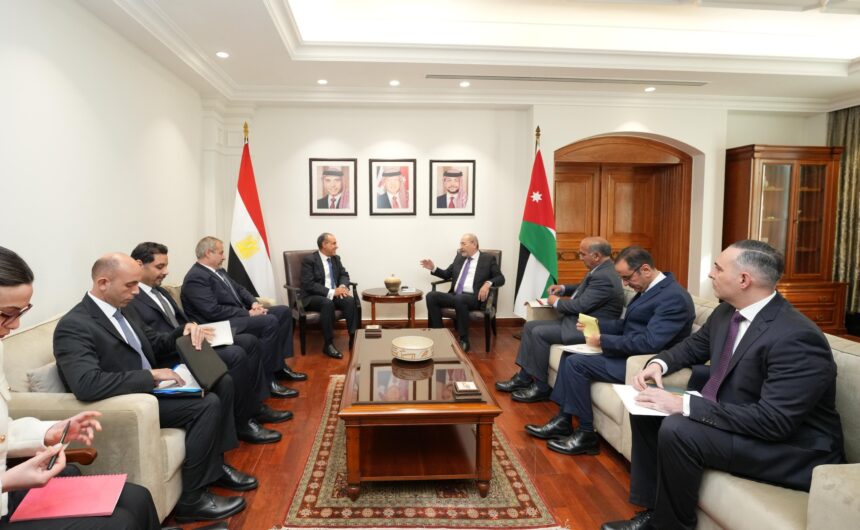
Egypt and Jordan on Tuesday called for the full implementation of the Gaza ceasefire agreement and the comprehensive peace plan proposed by US President Donald Trump, affirming support for a transitional “Peace Council” to oversee the process.
During an official visit to the Jordanian capital, Egyptian Foreign Minister Badr Abdelatty held talks with Jordan’s Deputy Prime Minister and Minister of Foreign Affairs and Expatriates, Ayman Safadi. The two ministers stressed the necessity of adhering to all terms of the ceasefire in Gaza and ensuring the immediate, sustainable, and unhindered delivery of aid into the strip.
The ministers welcomed the formation of the Palestinian National Committee to manage the Gaza Strip and the announcement of the second phase of the comprehensive peace plan. They confirmed their commitment to supporting the mission of the “Peace Council,” launched by President Trump, as a transitional body as outlined in the conflict resolution plan and adopted by UN Security Council Resolution 2803.
Abdelatty and Safadi called for the return of the Palestinian National Authority to assume its responsibilities in Gaza, emphasising the need to maintain Palestinian territorial unity between the West Bank and Gaza. They stated that a clear political horizon must lead to an independent, sovereign Palestinian state based on the June 4, 1967 borders, with East Jerusalem as its capital, in accordance with international legitimacy and the two-state solution.
The two officials issued a warning against “illegal Israeli measures” in the occupied West Bank, which they said risk further escalation and undermine efforts for regional calm. They described the two-state solution as the only path to achieving lasting security and stability in the region.
Regarding bilateral relations, the ministers highlighted the close ties between President Abdel Fattah al-Sisi and King Abdullah II. They discussed ongoing coordination to enhance economic and investment cooperation and to build upon existing mechanisms to serve the mutual interests of both countries.

