

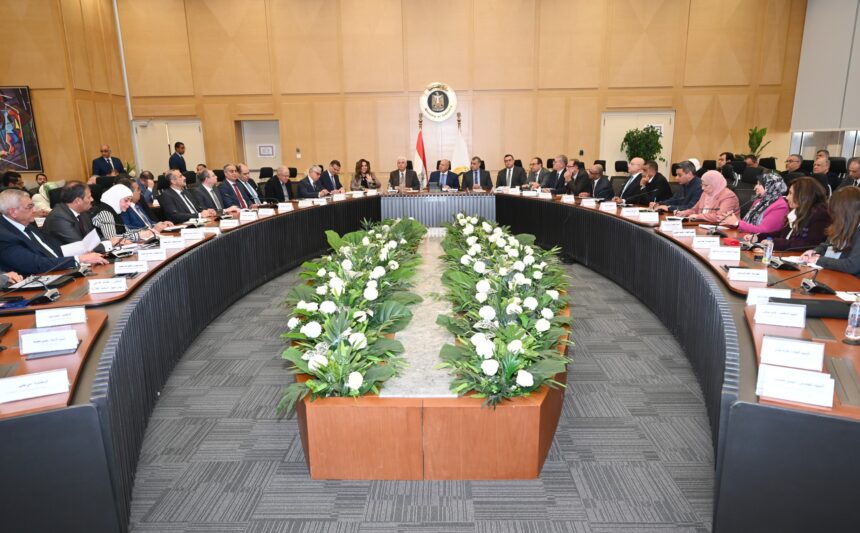
Deputy Prime Minister for Industrial Development and Minister of Industry and Transport Kamel Al-Wazir chaired the 37th meeting of the Ministerial Group for Industrial Development, attended by senior ministers and government officials.
The meeting approved the issuance of three new licences to establish cement factories, each with a single production line, in addition to expansion projects at several existing cement plants. The move is intended to meet domestic demand, ensure the availability of cement at reasonable prices, and support the stability of Egypt’s construction and building sector.
Al-Wazir said the new licences form part of the government’s broader strategy to strengthen industrial production capacity and prepare for potential large-scale demand in the coming period, particularly in light of regional reconstruction plans, including the rebuilding of Gaza. He noted that the projects are expected to be completed and enter commercial production within one year.
The ministerial group also approved requests from the Suez Canal Economic Zone (SCZone) to establish two new industrial projects with total investments of $1.29bn. The first project involves the manufacture of chemicals, including pesticides, chlorine and alkalis, with investments of $1bn on an area of 320,000 square metres. The second project focuses on vehicle tyre production, with investments estimated at $291m on 380,000 square metres. Both projects will be referred to the Supreme Energy Council for approval of the required electricity and natural gas allocations.
During the meeting, officials reviewed the case of an industrial company whose production was suspended following a power outage, based on a technical report issued by the electricity meter inspection committee. Al-Wazir said the Ministry of Electricity would be contacted urgently to resolve the issue and facilitate the resumption of operations.
He also directed that a representative from the Ministry of Electricity be added to the unified inspection committee overseeing factories, to improve governance of inspection procedures and address investors’ challenges more efficiently. A smaller subcommittee may also be formed to handle urgent cases requiring immediate intervention.
The meeting further discussed a complaint submitted by strawberry farmers, manufacturers and exporters regarding a requirement by the Egyptian Agricultural Quarantine that farms be registered only if seedlings are sourced from companies holding intellectual property rights. While the regulation aims to protect the quality and reputation of Egyptian agricultural exports, concerns were raised about its impact on producers.
It was agreed to form a technical committee comprising representatives from the Ministries of Industry and Agriculture, the Federation of Egyptian Industries and the Egyptian Intellectual Property Authority to prepare a report and propose balanced solutions that safeguard all stakeholders without harming national interests or export credibility.
Additionally, the ministerial group reviewed measures to settle natural gas consumption arrears owed by ceramic manufacturers. Discussions covered the assessment of outstanding debts, payment compliance rates, the impact of gas costs on factory operations, previously granted incentives, mechanisms to ensure financial discipline, and procedures to secure sustainable gas supplies and stable industrial activity.


