

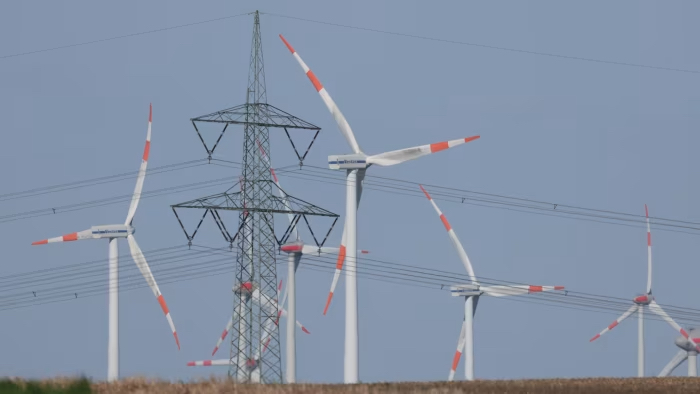
The European Union is preparing a centralized plan to prioritize energy investments and bridge infrastructure gaps across the bloc, seeking to tackle grid bottlenecks that threaten climate goals and cost billions of euros annually.
Brussels is working on a “comprehensive central scenario” to urge member states to better coordinate energy infrastructure across borders and sectors, identifying specific “gap-filling” projects to meet unmet needs.
Dan Jørgensen, the EU Energy Commissioner, told the Financial Times that the slow construction of electricity grids represents the “biggest risk” to the bloc’s decarbonisation and energy security objectives.
“In Europe, it is a huge problem, and we are losing billions of dollars a year due to energy curtailment and bottlenecks,” Jørgensen said.
Losses caused by congestion in the European energy grid reached €5.2bn in 2022 and could rise to €26bn by 2030, according to figures from ACER, the EU agency for the cooperation of energy regulators.
Under the draft document, set to be presented to EU countries on Wednesday, the European Commission will work with member states and transmission system operators to identify areas most in need of investment.
Jørgensen described the move as a “paradigm shift” in infrastructure planning.
“This is not a zero-sum game, where the EU gets more power and therefore member states get less power. Actually, by giving the EU new powers here, we will enable member states to do more and better as well,” he said.
The EU has struggled to complete its “Energy Union”, first proposed in 2015, with Jørgensen noting the irony of the current internal market.
“Paradoxically, we have an internal market that works better for selling tomatoes or toothpaste than for energy, because energy is so important right now for our competitiveness, for our security, and of course, everybody wants to fight climate change,” he said.
The Financial Times noted that the rapid expansion of renewable sources such as wind and solar—which are more volatile than traditional gas or coal plants—has increased the urgency for grid modernization.
According to a report released last month by German think-tank Agora Energiewende, the EU could save more than €560bn between 2030 and 2050 if member states coordinate their energy infrastructure planning.
Officials said the need for greater intervention from Brussels was reinforced by a major blackout in the Iberian Peninsula last April and soaring electricity prices in Greece last summer.
Brussels plans to launch an EU-wide scheme to simplify and accelerate permitting procedures, which currently take years and hamper projects with heavy administrative burdens.
However, Nicolás González Casares, a Spanish Socialist MEP who led negotiations on the EU electricity market last year, expressed “grave concern” that the Commission’s new approach risks bypassing environmental protections.
“The energy transition will only succeed if it is fast, but also fair and sustainable,” he told the Financial Times, warning against creating legal uncertainty by assuming tacit approval for projects to speed up construction timelines.
The new approach will be tested on eight proposed “energy fast tracks”, including connections across the Pyrenees, cables linking Cyprus to the European mainland, and hydrogen pipelines in southern and southwest Europe.
The Commission will also publish guidelines for member states on prioritizing projects critical to connecting the energy grid across the bloc, attempting to reduce delays that in some cases extend for years.


