

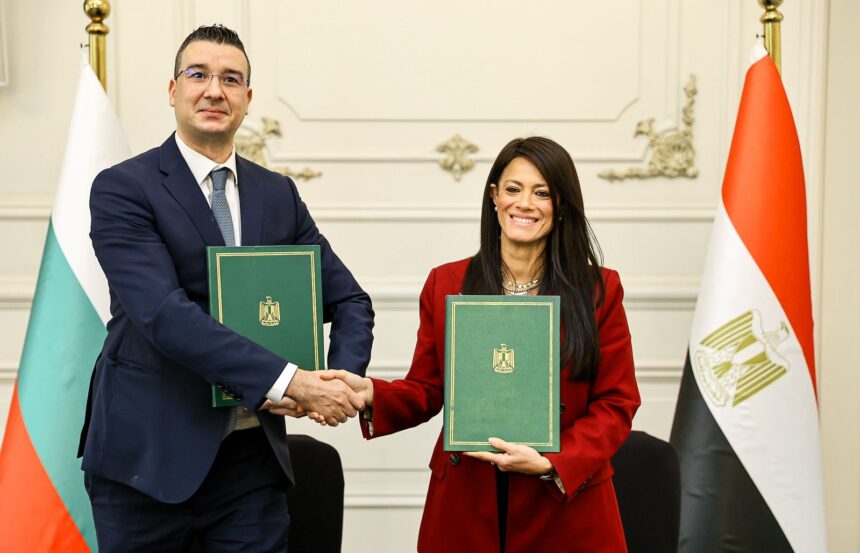
Egypt and Bulgaria have signed a protocol to strengthen cooperation across 19 strategic sectors, including renewable energy, industry, and investment, aiming to bolster economic relations ahead of the centenary of diplomatic ties between the two nations.
The agreement was finalised at the conclusion of the Egyptian–Bulgarian Joint Committee for Economic, Scientific, and Technical Cooperation in the New Administrative Capital. The meeting was co-chaired by Egypt’s Minister of Planning, Economic Development, and International Cooperation, Rania Al-Mashat, and Bulgaria’s Minister of Economy and Industry, Peter Dilov.
Trade exchange between the two countries reached nearly $1bn in 2024, according to figures released following the signing. The new protocol seeks to expand this figure by facilitating trade, investment, and partnerships across goods and services sectors, involving ministries and chambers of commerce from both sides.
“The Committee Protocol includes a wide range of strategic sectors that advance shared interests, particularly in industry, investment, and deepening engagement with the business community,” Al-Mashat said.
She noted that the agreement coincides with the upcoming 100th anniversary of diplomatic relations in 2026 and aims to leverage the capabilities of both nations to open broader prospects for cooperation.
Both sides agreed to encourage greater private sector engagement through forums, exhibitions, and business-to-business meetings. The protocol specifically invites Bulgarian companies to explore investment opportunities in the Suez Canal Economic Zone, positioning the zone as a gateway for Bulgarian exports to African markets.
Key areas targeted for joint projects and ventures include engineering, electronics, chemical industries, and military production. The agreement also prioritises high-value sectors such as automotive manufacturing, pharmaceuticals, and technology.
In the energy sector, officials emphasised strengthening partnerships in electricity, renewable energy, and petroleum and mineral resources. Discussions highlighted Egypt’s capabilities in the green economy transition and the promotion of private-sector participation.
The protocol further expands cooperation in agricultural research, including genetic engineering and organic agriculture, as well as transport, cybersecurity, environmental protection, and tourism.
Both parties reaffirmed their commitment to elevating cooperation to reflect the strategic partnership between the European Union and Egypt.


