

Anyone who follows Ashraf Abdel Baky’s artistic journey quickly realises he is far more than a popular entertainer; he is a creative force who revived the pulse of Egyptian theatre, reignited the audience’s connection to the stage, and opened long-awaited doors for young talent. His recent tribute was a reminder of the impact he carries, not only through his body of work, but through the spirit he has instilled and his firm belief that risk-taking is fundamental to artistic creation.
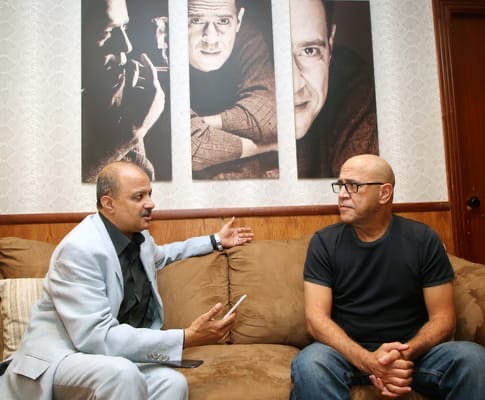
At the Very Short Films Festival (VS-FILM), Abdel Baky appeared as if returning to his starting point—to the stage that shaped him, that he loved, and to which he has devoted his life. He never speaks of his career as “history,” but as a journey still unfolding, built more on discipline than luck, more on patience than applause. In this spirit, Abdel Baky sat down with Daily News Egypt for an in-depth conversation about his beginnings, his experiments, his artistic philosophy, and the deeper truth behind the laughter that gives audiences an extra breath of life.
Let’s begin with your journey in theatre. How do you describe those early years?
The truth is, theatre has always been my first home. I performed in nearly 80 amateur plays before joining the Higher Institute of Theatrical Arts. Those early experiments were the foundation of everything—teaching me discipline, respect for the stage, and a deep understanding of the audience.
And what was your first professional milestone on stage?
My first professional work was the play Khashab El-Ward. Then came Teatro Masr, which was a bold step and eventually paved the way for Masrah Masr, a format completely new to audiences: a one-hour show, fast-paced, light, and full of humour. The idea was inspired by the technological changes around us and the disappearance of many old artistic forms.

What was the core idea behind Masrah Masr’s format?
Plays used to last three hours or more. I thought: why not present a one-hour performance—light, improvisational, and built on teamwork?! The aim was to bring theatre closer to people, not the other way around.
Some initially objected to presenting theatre in this new form. How did you handle that?
Of course there was opposition—that’s normal when introducing something new. But the television broadcasts played a major role in bringing theatre into people’s homes. Once audiences saw the format, they embraced it. Thankfully, the experiment succeeded and created an entirely new generation of comedians.

Many people associate you with the Masrah Masr stars. Do you see yourself responsible for their current choices?
Not at all. I’m not anyone’s guardian. They are talented artists, fully responsible for their own decisions. That’s why I always ask audiences not to link me to any work they present today. Their projects are good, and from my perspective, they know exactly what they are doing.

Let’s move to cinema. How did your journey on the big screen begin?
It began in the late 1980s with Jahim Tahta Al-Ma’a, directed by the great Nader Galal. My very first scene was with the legendary Adel Adham—and I was terrified. I immediately felt the vast difference between theatre and cinema and thought, “Why is everything so exaggerated?” But that moment became a major turning point in my career.

You said during the seminar that an artist must evolve. How do you view this now?
An artist who doesn’t evolve simply stands still. You must constantly renew yourself, listen, and observe what’s happening around you. We cannot rely solely on past experiences and assume they are enough. We must always remain present and creatively fresh.

You recently moved into producing short films. What drew you to this field?
Short films offer extraordinary creative freedom. They’re not tied to market expectations or box-office pressures. I felt the new generation needed someone to encourage them—to offer a platform to express what they carry inside. I wanted to be part of that. And I truly discovered talents who deserve a real chance.


Do you believe short films can reshape Egyptian cinema?
Absolutely. The short film is the real laboratory of cinema. It is where future directors and writers are formed. My involvement in producing short films is an attempt to support that spirit. Cinema needs new blood and genuine passion—not just a camera.

What did your tribute from the VS-FILM Festival mean to you?
A tribute always carries great value, but what means even more is that it came from a young and innovative festival. I’m genuinely happy with the award from the festival’s second edition, as well as the honour from the Suez governorate. I thank everyone involved in the festival and the governorate for their sincere efforts to support cinema and the arts.

After all these years, how do you see your impact on today’s artistic landscape?
I believe the most important thing I’ve done is open the door for an entire generation of young artists. I supported their talent and introduced a new model of theatre. Success isn’t only in what you personally achieve—sometimes it lies in those who follow you and carry the path forward. And I’m extremely proud of that.


