The regional atmosphere around Venezuela has shifted in a sharp and unmistakable way. The United States is visibly tightening its grip on the Caribbean, and Washington’s posture now suggests that military action, whether limited or symbolic, has edged closer to becoming a real scenario.
The pretext revolves around allegations linking President Nicolás Maduro to drug networks operating near US borders. Yet behind the official narrative lies a far more personal objective: neutralizing Maduro himself and bringing him under American legal jurisdiction. The pattern is not unfamiliar; Washington has previously used similar justifications to capture leaders it deemed problematic.
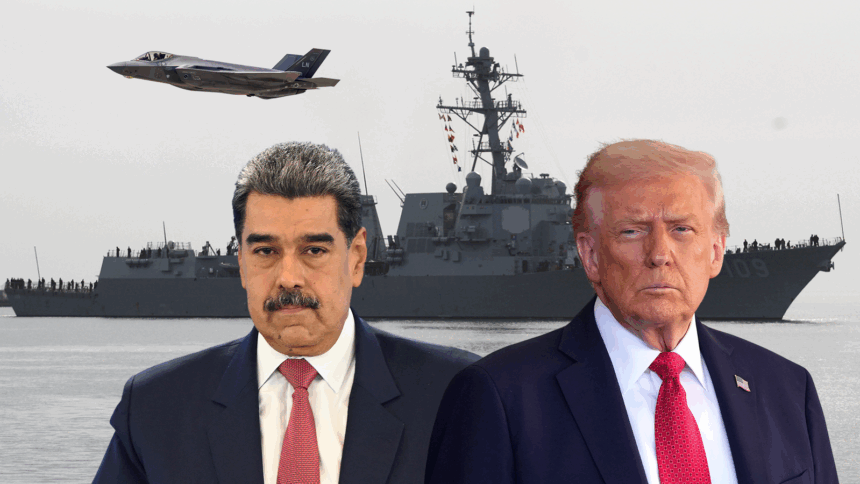
Signals coming from the White House only amplify the sense of escalation. President Trump has framed Venezuelan airspace as effectively off-limits, a declaration widely read as preparation for a more confrontational phase. US aircraft have flown missions near the country, and the Navy has deployed a powerful strike group to Caribbean waters—its largest presence there in many years.
The symbolism of this deployment is difficult to ignore. It reflects a shift in Trump’s foreign-policy instincts toward settling scores within the Western Hemisphere. Analysts believe that the current campaign targeting drug cartels could expand beyond Venezuela, potentially drawing in neighboring states and reshaping the region’s strategic landscape.

Washington’s history in the Caribbean casts a long shadow. The United States has intervened repeatedly—sometimes under the banner of restoring democracy, sometimes under claims of protecting American interests. What makes the current moment unsettling is not the scale alone, but the unpredictability of the man directing it.
Trump’s recent conduct has deepened this uncertainty. Within days, he has attacked political figures only to embrace them publicly, welcomed individuals previously labeled as national-security threats, and contradicted his own positions without hesitation. Even his promise to end foreign wars has morphed into a policy posture that appears increasingly confrontational.
The renaming of the Pentagon to the “Department of War” captured this transformation in a single symbolic act. It was soon followed by sharper rhetoric toward multiple countries and talk of reviving long-abandoned practices related to nuclear capabilities. These moves raised alarms inside Washington and abroad, not only for their implications but for the impulsive manner in which they were announced.
Against this backdrop, the buildup around Venezuela becomes even more volatile. With Trump’s approval ratings slipping and his decision-making style growing more erratic, the possibility of a sudden, headline-seizing military action no longer seems far-fetched.
What remains constant is the one factor shaping every policy calculation:
Donald Trump moves on impulse, not predictability.
Prof. Hatem Sadek – Helwan University