
Writing in December 1934, Egyptian intellectual Ahmed Hassan al-Zayyat grappled with anxieties of modernisation. “The radio has defeated the poet in every coffeehouse, just as the machine has defeated man in every field of work! In every one of these coffeehouses stands a machine of this marvellous invention, enticing popular tastes with art, training ears resistant to music, awakening unheeding minds to knowledge, and endearing literature to souls unconcerned with it… Yet despite all this, I am deeply saddened by the death of the storyteller, and profoundly grieved by the loss of the poet.”
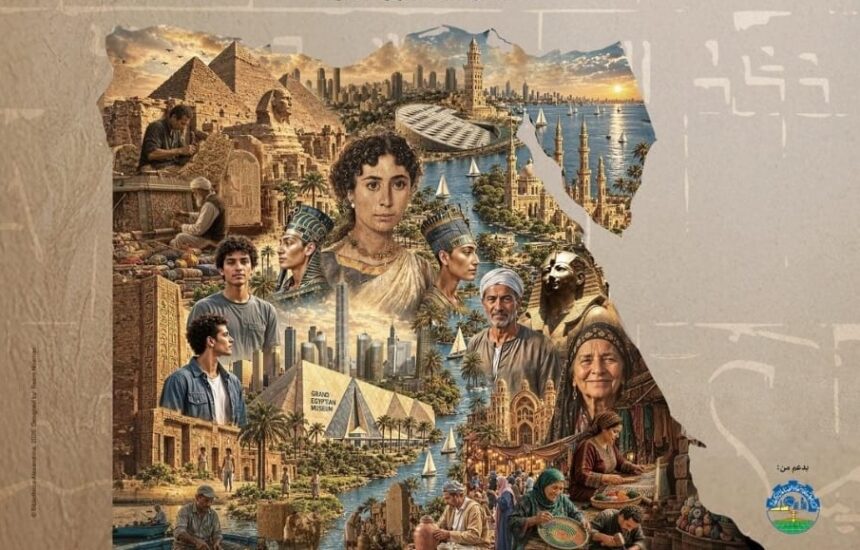
Across the ages, Egyptians have repeatedly set the rhythm and tone of human expression, adapting new technologies to share knowledge, tell stories and shape culture. The National Identity Conference tuned that conversation to its latest frequency with “Identity in the Digital Age” as a central theme encompassing artificial intelligence, misinformation, social media and the pressures of rapid technological change. From 21 to 23 September 2026, officials, academics, artists and around 450 young Egyptians from all 27 governorates came together at the Bibliotheca Alexandrina, culminating in the presentation of the National Identity Charter, “Deep Roots and Renewed Vision.” The Charter describes Egyptian identity as “enduring in its foundations while evolving in the ways it is expressed,” presenting continuity and change not as opposing forces but complementary dimensions of Egypt’s identity.
The Charter returns repeatedly to consensus and mutual trust, presenting them as foundations of social cohesion and national identity. There is much to be said for this conception of cohesion, particularly in its emphasis on a shared sense of belonging. Yet the language of consensus raises an important question for a document that places such emphasis on diversity. Consensus need not mean agreement on every question, and a plural society may be held together less by uniformity of belief than by agreement on the principles that allow differences to coexist. The Charter itself acknowledges that Egyptians have diverse individual identities and that national identity must embrace this diversity. Its challenge, then, is to distinguish between a shared national framework and a requirement of shared conclusions: between agreeing on the rules of belonging and agreeing on what belonging must look like. Mutual trust can strengthen that framework while allowing citizens to hold different cultural and social understandings within it. Read alongside Article 50 of the 2014 Constitution, which describes Egypt’s cultural heritage as a national and human wealth encompassing its diversities and calls for the protection of cultural pluralism, the Charter invites a useful question: can consensus be understood not as the absence of disagreement, but as a shared commitment to living with it?
The document’s recognition of Egypt’s rural, urban, coastal, Bedouin and desert communities as integral components of Egyptian cultural diversity reflects a commitment to inclusion and to ensuring that all Egyptians are visible within the national narrative. The Charter’s specific reference to Bedouin communities is particularly noteworthy because they are the only distinct cultural community explicitly named within its discussion of Egyptian cultural diversity. This raises a broader principle of identity-making: recognition can sometimes have the effect of emphasising the very distinctions it seeks to transcend. The designation of particular communities as distinct categories can, even when intended to affirm their place within the nation, create tension within the broader national “we”. The Charter’s emphasis on equal and inclusive citizenship provides an important common framework, while its recognition of Bedouin cultural heritage and way of life illustrates the importance of giving cultural particularity its proper place within a common national identity.
The opposite problem is also worth keeping in view: the absence of categories can make communities invisible for purposes of measurement and public policy. The current debate in the United States over whether and how race and ethnicity should be collected in the census illustrates this distinction. The US Census Bureau has argued that such data are important for understanding disparities, civil-rights enforcement and representation but a current federal proposal would remove race and ethnicity questions from the decennial census altogether. If adopted, that would raise a different form of recognition problem—not the symbolic othering that can accompany classification, but the loss of statistical visibility needed to identify particular communities and their circumstances. Recognition need not mean either emphasising difference or making it invisible; the more useful distinction is between recognising cultural difference as part of an inclusive national identity and measuring difference where doing so is necessary to understand and address inequalities.
The Bibliotheca Alexandrina Charter’s recognition of the role of mothers in transmitting stories, proverbs, songs and practices reflects a key social reality: in many households, mothers have carried a substantial share of the work of intergenerational transmission. Yet describing an existing division of labour can also risk making it seem natural or expected. The Charter rightly calls for greater support for families, but the preservation of cultural identity should not become a responsibility attached disproportionately to mothers simply because they have historically carried much of it. Fathers, grandparents, schools, teachers, cultural institutions, media organisations and public bodies can all help shape how children encounter Egypt. The more we appreciate the contribution of mothers, the more important it becomes to understand cultural transmission as a shared responsibility.
The Charter notes that “the contemporary digital age is fraught with risks” and calls for “critical awareness and digital literacy, particularly among younger generations.” Education, entertainment, promotional content and personal expression appear on the same screen, while the usual signifiers that help us distinguish between them are becoming blurred. Although young people often have greater practical fluency with the internet, knowing how to use a platform is not the same as being a conscious user of it. Digital literacy, therefore, increasingly requires an element of epistemic literacy: the ability to evaluate the information encountered online, including its source, context, credibility and why it was produced. As AI makes fabricated content more convincing, these judgements become more important. This is an intergenerational challenge, requiring adults as well as young people to navigate an information environment shaped by AI-generated content, deepfakes and other forms of synthetic media.
Building on this, Egypt should also adopt and enforce transparent practices across the wider information environment, including traditional media, requiring disclosure of the use of AI in news, advertising, music, images, videos, text and other published content. The Charter’s call to involve youth in designing and implementing cultural programmes is significant, but that participation should be fair and inclusive, ensuring that all young people have meaningful access to digital and cultural spaces and opportunities to discover and develop their creative abilities. We must additionally ensure that children have safe spaces offline where they can engage their imagination and express themselves without judgement, receive sound advice, reliable support and clear knowledge.
Egypt’s constitutional framework provides a strong foundation for integrating national identity within education. Article 19 states that education aims to build character, nurture talents, promote innovation and cultivate values of citizenship, tolerance and non-discrimination, while Article 24 positions Arabic, religious education and national history as core subjects for all pre-university students. The National Identity Charter similarly identifies collective memory, language and cultural heritage as fundamental pillars of identity, while calling for greater awareness of Egypt’s long history and diverse civilisational influences. In alignment with this vision, the Ministry of Education’s August 2024 policy integrated Arabic and history into the graduation requirements for international curricula students, with each subject accounting for 10 percent of the overall grade.
When the requirements were introduced, their impact varied depending on where students were in their education. Students in the earlier years of their schooling could incorporate the new subjects from the outset, whereas those already approaching graduation had less time to adjust to subjects that had not previously been part of their curriculum. More fundamentally, formal assessment is only one part of education. A standardised examination can establish whether a student has retained enough information to pass, but it cannot measure what they genuinely understand, their curiosity, or their ability to interpret and make meaningful use of what they have learned. A locally grounded curriculum allows students to engage with the culture, history, language and heritage they physically inhabit. There is little reason to assume that the love life of Henry VIII, or the intricacies of the Battle of Hastings—whose account has itself recently been subject to scholarly reconsideration—should be more relevant to the education of a young Egyptian than their own extraordinary, tangible historical inheritance. All students should learn about other societies and cultures while gaining a fuller understanding of the nation to which they themselves belong. Egypt is the country most immediately associated with history itself, and its civilisation remains a source of fascination and study throughout the world—its achievements, language and culture have shaped all that followed. Wherever their education or future takes them, a strong knowledge of Egypt gives them a deeper sense of the identity they carry with them and of the country they represent.
Language may be one of the clearest expressions of the Charter’s understanding of identity. It describes Arabic as “the official language, the principal pillar of Egypt’s shared culture, and the means of communication and expression among Egyptians,” while recognising that its colloquial dialects “form part of the richness of Egyptian culture.” The Charter is right to insist on “mastering foreign languages without allowing them to replace the mother tongue, diminish the status of Arabic, or stigmatize those who are educated in Arabic”. An education in Arabic is a point of pride; the concern should be whether the schools, facilities and teaching standards that deliver it are adequately funded and properly supported. An accent, dialect or varying fluency should never detract from the effort and courage involved in communicating and learning in any language, or distract from the substance of what is being said.
The relationship between language and identity takes on new significance as AI reconfigures the infosphere. Egypt’s national Arabic language model, Karnak, and Karnak Chat, launched in August 2026, represent an effort to ensure that these technologies can understand Modern Standard Arabic, Egyptian colloquial Arabic and cultural context. Alongside this, digitising archives, literature, oral histories and artistic works ensures that more of Egypt’s cultural memory remains available to the systems through which future generations will encounter knowledge. There is also a less obvious possibility: AI can strengthen national identity by giving countries new ways to preserve, access and share their own cultural and linguistic resources. Egypt’s National AI Strategy 2025–2030 reflects an effort to develop these capabilities within Egypt and apply them to areas of national and cultural importance. In this sense, technological change need not only test cultural continuity; it can also give that continuity new means of transmission. The radio once seemed to make the storyteller unnecessary. Instead, the story found another way to travel. Nearly a century later, machines have become far more capable of carrying, producing and transforming language, even as the distinctions between the person who creates, the machine that produces and the audience that receives grow quieter. The Charter asks what must endure as the forms around it change. Identity, after all, does not belong to the past; each generation inherits the conversation, finds a new medium for it, and leaves something of its own for the next to answer.
Nadine Loza is a development strategist, opinion columnist, and Founding Director of the Egypt Diaspora Initiative.