

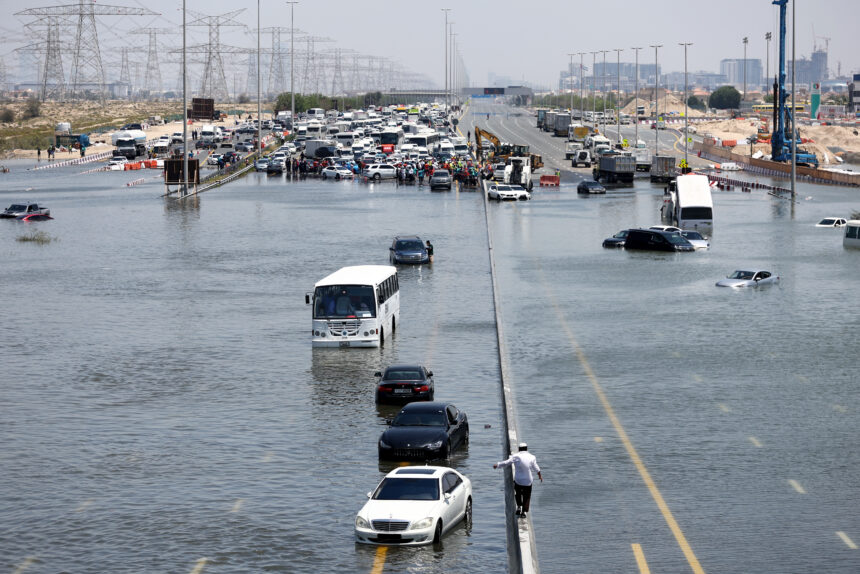
Before torrential rains flooded Dubai in April 2024, disrupting transport and causing widespread infrastructure damage, some artificial intelligence (AI) weather models had already detected signals of the exceptional event up to eight days in advance, despite having no comparable rainfall event in Dubai in their training data.
A new study, published in Science Advances, found that two AI-based weather forecasting models, GraphCast and AIFS, successfully predicted the timing, location and intensity of the exceptional rainfall up to eight days ahead. A third model, FuXi, also forecast the event but substantially underestimated the amount of precipitation.
A Successful Test
Qiang Sun, a researcher at the School of Atmospheric Sciences at Nanjing University and lead author of the study, says the rainfall presented a challenging test of AI’s ability to predict rare and unprecedented weather events in specific regions, as the models had not encountered a comparable event in Dubai during training.
The severe storm struck in mid-April 2024. Data from the European Centre for Medium-Range Weather Forecasts (ECMWF) reanalysis project, which the researchers used as a reference, indicated approximately 60 millimetres of rainfall over 12 hours, averaged across a 100-by-100-kilometre area surrounding Dubai. This was nearly twice the highest rainfall recorded in the region in the models’ training data, which did not exceed 33 millimetres over the same period.
“In some locations near Dubai, rainfall exceeded 100 millimetres in just 12 hours, surpassing the amount the city typically receives in an entire year,” Sun adds.
The researchers estimated that an event of this rarity has an average return period of approximately 154 years, although the estimate carries considerable statistical uncertainty because such events are extremely uncommon.
The storm caused widespread flooding and infrastructure damage. The study reports estimated insured losses of $3bn and five deaths, underscoring the importance of reliable early warnings when cities in arid regions face extreme rainfall that their infrastructure may not be designed to withstand.
What surprised the researchers was not simply that the models predicted the storm, but how they appeared to achieve this.
The team found that the models probably did not rely on Dubai’s relatively modest historical rainfall events to extrapolate the intensity of the 2024 storm. Instead, experiments suggested that they drew on severe rainfall events associated with similar atmospheric conditions in other parts of the Northern Hemisphere, applying patterns learned from those cases to Dubai.
The researchers describe this mechanism as “spatial transfer”.
Questions Remain About AI’s Capabilities
To test this explanation, the researchers modified GraphCast’s training data by reducing the intensity of comparable extreme rainfall events recorded outside Dubai while leaving the city’s historical data unchanged. They then tested the model’s ability to forecast the April 2024 storm again.
When deprived of examples of intense rainfall from other regions, the model’s forecast for Dubai fell to just over 30 millimetres in 12 hours. However, it continued to predict the general movement of the weather system correctly.
This result provided strong evidence that the model’s original success depended on learning from geographically distant events with similar meteorological characteristics.
Sun believes this capability could be particularly valuable in regions with limited climate records. In principle, AI models could draw on comparable events elsewhere in the world to improve forecasts in places with relatively sparse historical rainfall observations, including parts of Africa.
However, he cautions that the findings do not mean AI can predict every extreme weather event that has never occurred before.
The study found that GraphCast and FuXi still struggled to reproduce the highest rainfall totals, even when comparable extreme events were available in their global training datasets.
The researchers partly attribute this limitation to AI models’ ability to capture large-scale atmospheric patterns more readily than the small-scale, sharply defined features that can determine the intensity of extreme rainfall.
Consequently, forecasts may smooth out rainfall patterns and underestimate peak precipitation, particularly at longer lead times.
The study also has several other limitations. It relied primarily on ECMWF reanalysis data as a reference, although the researchers acknowledge that these data may not fully capture the highest observed rainfall totals.
Furthermore, the study did not directly compare the AI models’ performance with that of traditional physics-based weather forecasting systems. It noted, however, that ECMWF’s operational forecasting model had also predicted the event with good accuracy.
The experiment involving modifications to the training data was conducted in full only for GraphCast because of technical and computational constraints. The analysis of AIFS was limited to specific tests, while the researchers were unable to carry out some of the same analyses on FuXi.
The findings therefore require further testing across a wider range of AI models and extreme weather events to establish how reliably spatial transfer can improve forecasts of unprecedented rainfall and other severe weather phenomena.


