
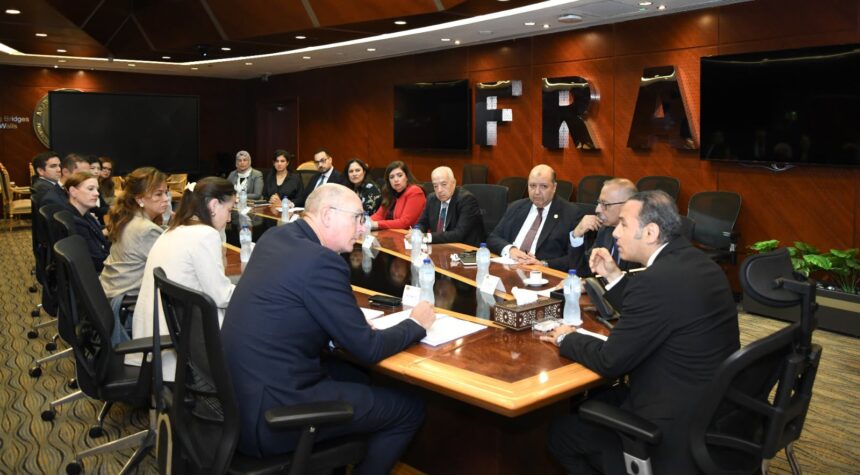
Financial Regulatory Authority (FRA) Chairperson Islam Azzam received Mark Bowman, Vice President for Policy and Partnerships at the European Bank for Reconstruction and Development (EBRD), and his accompanying delegation to discuss cooperation between the bank and Egyptian institutions to support development efforts and expand the EBRD’s investments and operations in the Egyptian market.
The two sides held an extensive consultative meeting attended by FRA Deputy Chairperson Tarek Seif, FRA Assistant Chairperson Mahmoud Gibril, Senior Adviser to the FRA Chairperson Reda Abdel Moaty, several FRA officials, and members of the European delegation. The meeting addressed the latest developments in coordination between the two sides across several areas.
At the start of the meeting, Azzam stressed the importance of the partnership with the EBRD and its significant impact on projects supporting the national economy, particularly in the non-bank financial sector, as well as its continued support for financial inclusion and sustainable growth efforts.
Azzam briefed the EBRD delegation on the latest regulatory developments undertaken by the FRA across the activities under its supervision, including capital markets, insurance, and non-bank finance, particularly the introduction of a new regulatory framework for short selling.
The framework is aimed at stimulating trading on the Egyptian Exchange, broadening and deepening the capital market, and improving pricing efficiency. Azzam said the FRA was overseeing the final steps towards launching the centralised securities lending system and completing the technical integration between Misr for Central Clearing, Depository and Registry (MCDR) and brokerage firms, ahead of the mechanism’s official launch within the next few weeks.
He added that the market-maker mechanism would be among the FRA’s priorities during the coming period as an important tool for enhancing trading stability and increasing market liquidity. Market participants operating through the mechanism will be exempt from stamp duty, while the FRA is considering granting them additional incentives to stimulate institutional investment, alongside the listing and offering of a number of major state-owned companies on the Egyptian Exchange.
Azzam also reviewed a number of decisions recently taken by the FRA to align risk management practices at insurance and financing companies with international standards, particularly the Basel III principles, which are intended to strengthen institutions’ financial solvency and enhance their ability to withstand economic changes.
In this context, the meeting discussed ongoing cooperation to pave the way for implementing the international Solvency II standards in Egypt’s insurance sector. The framework is based on more precise risk-assessment standards to evaluate the quality of risk management and the efficiency of internal control systems, while enhancing transparency and disclosure.
Participants also discussed prospects for continued cooperation on developing the Egyptian Exchange’s regulatory environment following the launch of the financial derivatives market last March. The EBRD delegation presented a number of proposals for transforming the Egyptian Exchange into a joint-stock company, drawing on the bank’s previous experience in supporting similar transformations in several countries in the region.
For its part, the EBRD delegation praised the FRA’s continued efforts to develop its supervisory and regulatory capabilities, enabling non-bank financial activities to flourish in an environment that balances the stability of companies and markets with the protection of customers’ rights.
The delegation also praised the modernisation process led by the FRA to create new and secure investment channels governed by the highest standards of corporate governance and subject to comprehensive regulatory oversight.
The two sides agreed to continue coordination and consultations to support the development of the non-bank financial sector and increase its attractiveness to private-sector investment, contributing to inclusive and sustainable economic growth in line with Egypt Vision 2030.