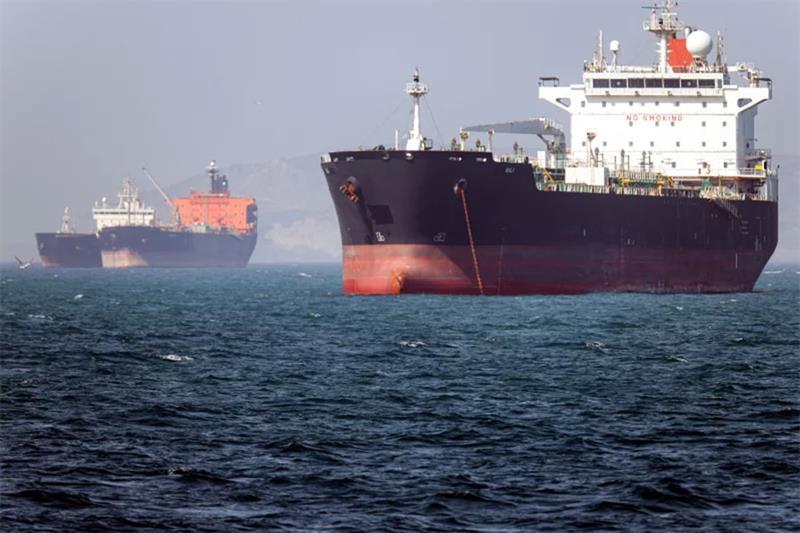
US President Donald Trump’s announcement that Washington will implement a “tanker for tanker” strategy marks a significant new phase in the confrontation with Iran, while also serving as a powerful instrument of pressure aimed at bringing Tehran back to the negotiating table on Washington’s terms. At the same time, the strategy has clear historical and political parallels with the “Tanker War” that unfolded during the Iran Iraq War in the 1980s, albeit within a new context and under very different strategic balances.
In the 1980s, Iranian and Iraqi forces targeted commercial vessels and oil tankers in an attempt to exert economic pressure and disrupt one another’s exports. Today, however, the emerging strategy is based on direct reciprocal targeting, once again placing the movement of oil through the Strait of Hormuz at the heart of the security threat.
Any physical threat to oil tankers immediately increases maritime insurance premiums and freight costs, pushing oil and gas prices higher as markets grow increasingly concerned about potential disruptions to supplies passing through the Strait of Hormuz, which carries roughly one fifth of global oil consumption.
The first Tanker War ultimately ended with international intervention and the deployment of US naval escorts to protect commercial shipping under Operation Earnest Will. The current confrontation, by contrast, places US forces in a direct and potentially decisive clash with Iran’s deterrence capabilities and its attempts to disrupt maritime traffic.
This direct military escalation falls under the umbrella of the updated “maximum pressure” policy pursued by the Trump administration. Sanctions targeting Iran’s oil sector and financial networks are designed to intensify economic pressure, while the “tanker for tanker” strategy seeks to deprive Tehran directly of financial and material resources by constraining its commercial shipping fleet.
The central objective of increasing the security and military costs imposed on Iran is not necessarily to launch an all out war, but rather to compel the Iranian leadership to accept a new deal incorporating stringent restrictions on its nuclear and ballistic missile programs, as well as its regional influence.
Through this move—seen as a military extension of the latest sanctions package against Tehran—Washington is attempting to alter the rules of engagement and strip Iran of its maritime leverage, including its ability to threaten navigation or seize vessels, thereby reducing its room for maneuver ahead of any anticipated round of negotiations.
Yet the reality is that the prospects for the success of the “tanker for tanker” strategy will depend on a delicate balance between the effectiveness of economic and military pressure on the one hand, and the structural obstacles embedded in Iran’s political doctrine on the other.
Among the factors likely to determine success or failure is the scale of Iran’s economic exhaustion and rampant inflation. Iran’s economy remains heavily dependent on oil export revenues to secure foreign currency and finance government expenditure. Intercepting tankers and imposing a direct maritime blockade would cut off vital sources of revenue, intensifying domestic pressures stemming from the depreciation of the national currency and fears of renewed popular unrest.
Reciprocal targeting would provide Washington and its allies with a degree of justification for military action, including the protection of commercial shipping and the interdiction of Iranian tankers. This US naval and technological superiority would expose Tehran to escalating military and economic costs that it would struggle to sustain over the long term.

Such a strategy could also affect Iran’s “shadow allies,” China and Russia, while weakening its regional proxies and reducing Tehran’s ability to open parallel fronts designed to disperse American pressure.
On the other hand, several factors could undermine the success of Trump’s new strategy. The Iranian leadership considers capitulation to direct pressure and compliance with American demands at the height of an escalation to be a clear demonstration of weakness, both domestically and internationally. This could push Tehran toward a strategy of “active resistance,” aimed at raising the costs of the conflict for Washington and for global markets.
Tehran may calculate that attacks on tankers and disruption of shipping through the Strait of Hormuz would trigger sharp increases in oil prices and maritime insurance costs. Such increases could generate substantial political and economic pressure on the Trump administration and the global economy, potentially forcing Washington to moderate the escalation.
Iran also retains extensive smuggling networks and alternative routes that it has developed over decades to circumvent sanctions. Through its “shadow fleet,” as well as alternative transportation and concealment methods, Tehran has been able to maintain a portion of its oil exports, providing it with additional breathing space and time to maneuver.
Yet at the height of the confrontation, as each side attempts to impose its agenda on the other, events may unfold that were never incorporated into either side’s calculations.
Tanker attacks may be carried out using a tactic of targeting the engine room in order to disable a vessel while avoiding direct penetration of its crude oil storage tanks, thereby reducing the risk of a major environmental catastrophe. However, despite the precision of modern weapons, the possibility of human and technical error in a complex maritime operational environment remains significant, making the risk of an oil spill a very real prospect with every attack.
Smart munitions and drones, for instance, may be vulnerable to electronic countermeasures or jamming, while human operators may miscalculate the coordinates required to hit an engine room accurately. Such errors could result in the main oil tanks being struck instead of the vessel’s stern.
Engine rooms themselves also contain fuel tanks holding operational fuels, including heavy fuel oil and diesel, as well as substantial quantities of lubricating oils. Moreover, damage to the engine room could cause a vessel to lose propulsion and maneuverability, increasing the risk of collision with the seabed or other maritime infrastructure and potentially resulting in oil leakage and contamination of Gulf waters.
Targeting an engine room may, in theory, reduce the likelihood of a catastrophic explosion. Nevertheless, the margin for operational error, combined with the Gulf’s complex geographical and maritime conditions, turns this strategy into an environmental and economic gamble with potentially far reaching consequences.
Overall, the prospects for this strategy successfully forcing Iran to make rapid concessions appear limited. The more likely scenario is a transition into a prolonged “war of attrition,” in which Tehran will seek to absorb the initial shock and respond incrementally, potentially driving global energy prices higher before eventually moving—under the weight of economic strangulation and pressure from regional intermediaries—toward accepting a formula for indirect negotiations or a new negotiating framework.
Such an arrangement would allow Iran to preserve its “dignity” and political face, while securing some relief from sanctions without appearing to have capitulated to direct American military pressure.
Dr. Hatem Sadek, Helwan University