

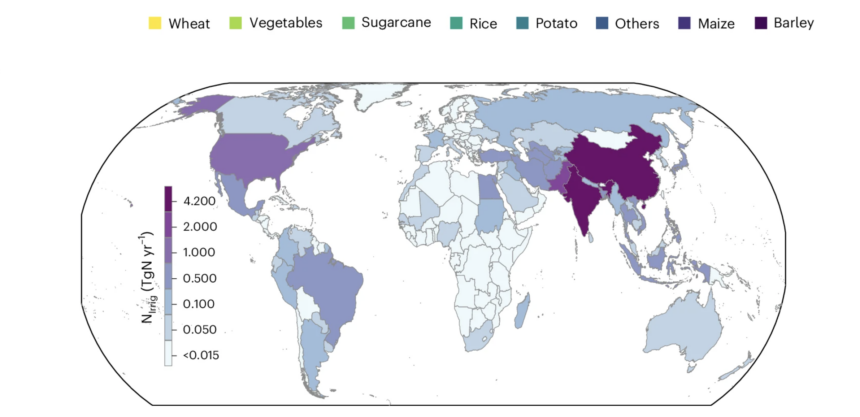
A new study has found that irrigation water does more than deliver water to crops. It also carries substantial amounts of nitrogen into farmland, supplying the equivalent of about 13% of the synthetic fertiliser used globally on croplands.
The study, published in Nature Sustainability, suggests this “hidden” nitrogen source is often overlooked in fertiliser calculations, even though accounting for it could help farmers reduce fertiliser use, cut costs and limit pollution of soil and water.
Researchers compiled more than 1,300 field observations from 104 studies and used machine-learning models to estimate how much nitrogen reached irrigated croplands through irrigation water between 2010 and 2019. Globally, they estimated that irrigation supplied nearly 14 million tonnes of nitrogen each year.
According to J. Serra, a researcher at the Department of Agroecology at Aarhus University in Denmark and the study’s lead author, the central idea is simple: farmers use water to irrigate their crops, but that water may already contain nitrate. This nitrate can originate from previous fertiliser use, agricultural runoff, leaching into groundwater or pollution in surface-water sources. In practice, irrigation can therefore become a source of unintended nutrient inputs.
The study found that the median nitrogen input from irrigation water in field observations was 19 kg of nitrogen per hectare per year. However, the amounts varied significantly. In 10% of observations, irrigation water delivered more than 100 kg per hectare per year — enough to significantly affect fertiliser management decisions on farms.
Vegetable production systems recorded some of the highest values, while rice, wheat and maize together accounted for around 70% of the nitrogen delivered globally through irrigation water. This is partly because these crops occupy extensive irrigated areas worldwide.
The study’s maps show major hotspots stretching from North Africa to South Asia, including the Nile Delta, Western and Central Asia, and India. Other hotspots were identified in Southeast Asia, eastern China and Japan, as well as parts of the US Great Plains. In areas such as the Nile Delta and Pakistan, the issue is driven by two factors: high irrigation demand and high nitrogen inputs.
The findings could change how farmers and policymakers approach fertiliser management. If irrigation water is already supplying a meaningful share of a crop’s nitrogen requirements, farmers may be able to reduce synthetic fertiliser use without affecting yields. This could lower production costs, reduce nitrate losses to rivers and groundwater, and improve nitrogen-use efficiency.
The study estimates that if nitrogen supplied through irrigation water is accounted for as a recovered nitrogen source, global dependence on synthetic fertiliser could fall from 75% to 67%.
However, the researchers do not present this as a simple solution. Nitrate-rich irrigation water can be beneficial only if its nitrogen content is measured and properly managed. If farmers continue applying the same amount of fertiliser without accounting for nitrogen already supplied through irrigation, the result could be excess nitrogen, increased pollution and longer-term risks to water quality and public health.
The authors call for nitrate testing of irrigation water to become part of agricultural advice and fertiliser planning. They also advocate low-cost monitoring tools, farmer training and stronger links between water and fertiliser policies. In their view, irrigation water should be considered not only a water source but also a potential nutrient source.
The study has several limitations. Some regions, including Sub-Saharan Africa, Latin America and Southeast Asia, were underrepresented in the field data. There are also no high-resolution global maps of nitrate concentrations in groundwater and surface water, requiring the researchers to rely on proxy indicators. The estimates may underestimate nitrogen inputs for some permanent crops, such as olives and citrus, and may overestimate them in systems where nitrate is being recycled within the same system.
The research was funded by the Pioneer Center for Research in Sustainable Agricultural Futures, Portugal’s Fundação para a Ciência e a Tecnologia, European Union Horizon Europe projects and other European research grants. The authors declared no competing interests.


