A new study suggests that inflammatory bowel disease (IBD) in tropical countries cannot be understood by geography alone. Being located between the Tropics of Cancer and Capricorn does not mean that countries share the same climate, health systems or disease burden.
The study, published in Tropical Medicine and Health, analysed IBD across 96 tropical countries and territories between 1990 and 2023, using data from the Global Burden of Disease Study 2023. IBD mainly includes Crohn’s disease and ulcerative colitis, two chronic conditions that can cause recurrent diarrhoea, abdominal pain, gastrointestinal bleeding, weight loss and long-term disability.
For decades, IBD was often viewed as a disease concentrated in Western countries, particularly North America, Western Europe and Australia. But over the past three decades, the disease has become increasingly recognised across Asia, Africa, Latin America and the Caribbean. The shift may reflect several overlapping changes, including urbanisation, increasingly industrialised diets, wider antibiotic use, population ageing and improved diagnostic capacity.
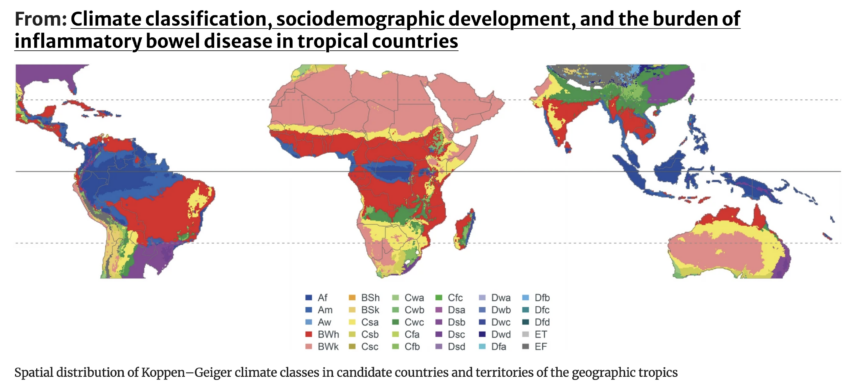
According to Sijie Gong of Longyan First Affiliated Hospital of Fujian Medical University and one of the study’s equal first authors, the tropics should not be treated as a uniform region. Within the tropical belt are rainforests, monsoon zones, savannas, deserts, plateaus and mountain systems, each with different patterns of rainfall, humidity and temperature, as well as differences in dietary habits, microbial exposure and access to health care.
To capture this diversity, the researchers used the Köppen–Geiger climate classification, which groups regions according to temperature and precipitation patterns rather than relying solely on latitude. Their analysis found that countries with a higher proportion of land characterised by a tropical climate tended to have lower age-standardised incidence, prevalence and non-fatal disability associated with IBD. However, the climate measure was not clearly associated with mortality or premature mortality.
In simple terms, climate may help explain differences in recorded chronic IBD cases, but it does not fully explain where patients die or experience the greatest health burden. The study points to other factors, including socioeconomic development, diagnostic capacity, access to colonoscopy and pathology services, and the availability of long-term treatment.
The study found a striking divide. Countries with higher levels of social and demographic development generally reported higher incidence and prevalence of IBD but lower mortality. This does not necessarily mean that IBD is more dangerous in wealthier settings. Rather, it may indicate that patients are more likely to be diagnosed, recorded and kept alive for longer with continued access to care.
In lower-resource settings, the opposite problem may occur. A country may appear to have relatively few IBD cases, while some patients remain undiagnosed. In regions where intestinal infections, parasitic diseases and intestinal tuberculosis are common, patients experiencing chronic diarrhoea, bleeding or weight loss may be repeatedly treated for infection before IBD is considered.
The study shows that the absolute burden of IBD has increased substantially across the tropical countries studied. Between 1990 and 2023, the number of new cases increased by about 133,000, while the number of people living with IBD rose by more than 1.24 million. Deaths increased by about 13,000, while total years of healthy life lost rose by more than 435,000.
Much of this increase, Gong and colleagues explain, was driven not simply by changes in disease risk but also by population growth and ageing. More people are living in tropical countries, and more are reaching older ages, when chronic diseases require longer-term follow-up. This means health systems may face a growing number of IBD patients even if age-standardised rates remain stable or mortality continues to decline.
The forecasts are mixed. The researchers project that age-standardised mortality and premature mortality associated with IBD may continue to fall through 2050. However, incidence, prevalence and non-fatal disability are expected to remain broadly stable. This suggests that the next challenge may not only be saving lives, but also helping patients live longer with fewer relapses, less pain and lower treatment costs.
The study argues that priorities should differ according to national circumstances. In places with high diagnostic rates and low mortality, health systems may need to focus on long-term disease control, relapse prevention and reducing the cost of care. In places with low reported diagnosis but higher mortality, the priority may be more fundamental: training primary-care doctors, improving referral systems, expanding endoscopy and pathology services, and distinguishing IBD from infectious bowel diseases.
The authors also suggest that climate-aware health planning could help. Arid and hot regions may require greater attention to water safety, air pollution, vitamin D status and diet. Rainforest and monsoon regions may need stronger systems for distinguishing infections from chronic intestinal inflammation. Mountain and plateau areas may face additional barriers related to distance from specialist care.
The study has important limitations. It is an ecological analysis based on country-level data, so it cannot establish that climate causes differences in IBD burden. Data are also limited in some low-income tropical countries, which could lead to underestimation. The study could not consistently compare Crohn’s disease and ulcerative colitis separately across all countries, and it lacked patient-level data on diet, treatment, microbiome, place of residence, pollution exposure and diagnostic delays.