

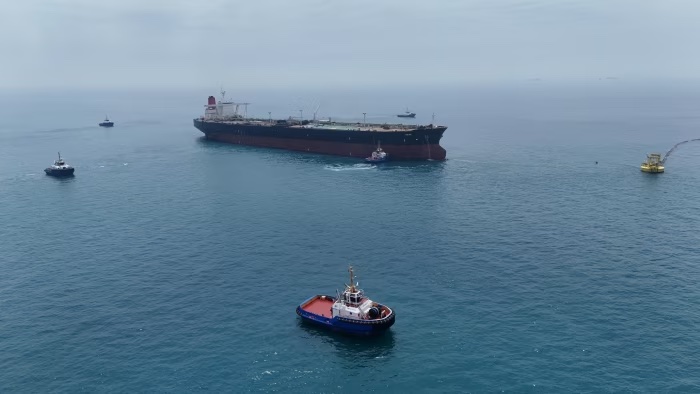
US forces destroyed or permanently disabled three Iranian oil tankers on Saturday in retaliation for ballistic missile attacks on American warships, a move that has driven Middle East crude prices to near $100 a barrel amid supply disruption fears.
“If you fire at two of our ships, we will impose a greater economic cost on you, by taking three of your ships out of service,” said Brad Cooper, commander of US Central Command (CENTCOM).
He added: “We will not hesitate to defend American forces, and if necessary, we will destroy the Iranian oil fleet.”
CENTCOM stated that the strikes were a direct response to Iran’s Revolutionary Guard launching ballistic missiles at a US aircraft carrier and a guided-missile destroyer in regional waters. The American warships evaded several attacks, and no US personnel were injured, the command confirmed.
Releasing video footage of the targeting operations, a CENTCOM statement read: “After the failed Iranian attacks, US forces permanently disabled the Revolutionary Guard crude oil tanker M/T Downy off the coast of Kharg Island, and the tanker M/T Stark 1 near Jask (in the Gulf of Oman).”
“US forces also completely destroyed the crude oil tanker M/T Kylo, also known as Noxen, in the Gulf of Oman,” the statement added.
CENTCOM described the three Iranian tankers as part of a “shadow fleet” valued at billions of dollars.
The escalating tensions between the US and Iran have threatened regional supplies and triggered a surge in global oil markets. Refineries in India and China, the world’s largest oil importers, are intensifying their purchases of Middle East crude from the spot market, driving prices further upward.
Refiners in both countries are presenting more competitive bids for Arabian Gulf barrels, competing directly with buyers in South Korea and Japan.
Benchmark Dubai crude futures have risen to approximately $100 per barrel, marking the highest level since May. Meanwhile, price premiums for Oman and Murban crudes jumped amid market fears of supply disruptions caused by Iran and its proxies, including the Houthis in Yemen.


