

Along the fields of Egypt’s Nile Delta, narrow irrigation canals known as “mesqas” carry water from larger canals to individual farms. For generations, these open channels have supported agricultural production, but they often distribute water unevenly and lose part of it through seepage and evaporation.
To improve irrigation efficiency, Egypt’s Irrigation Improvement Program has sought to replace traditional mesqas with pressurised underground pipelines and pumping stations. While these systems provide more reliable water delivery, rapidly rising construction costs have made nationwide expansion increasingly challenging.
A new study published in Water Science suggests that redesigning these systems and involving farmers in part of the construction process could reduce implementation costs by as much as 40%.
Researchers Mohamed ElFetyany and Ahmed Medhat Ismail Abd ElHamid of Egypt’s National Water Research Center developed a framework that combines hydraulic engineering with an analysis of inflation to identify more cost-effective approaches to irrigation modernisation.
Using Egypt’s official Consumer Price Index, the researchers estimated that an improved mesqa system costing EGP 10,000 per feddan in 2016 would cost around EGP 34,270 per feddan by 2025. One feddan is equivalent to approximately 0.42 hectares.
The study then examined whether all elements of the conventional design remain necessary under current conditions.
The proposed framework replaces larger pumps, typically delivering 60 or 90 litres per second, with smaller units producing 30 or 45 litres per second. It also recommends sizing underground pipelines according to the actual flow rate and water velocity rather than applying a fixed design rule that can result in oversized and more expensive pipes.
Under the proposed design, pumps would operate for up to 20 hours a day instead of the conventional 16 hours, while each mesqa would serve a smaller, more manageable command area. Hydraulic modelling indicated that the redesigned system would still provide sufficient water volumes and operating pressure.
The researchers also identified significant savings through changes to construction methods. Instead of importing all filling material required after pipeline installation, contractors would provide only the minimum amount needed around the pipes, while farmers—through Water User Associations—would gradually complete the remaining embankment work using locally available soil.
According to the study, these combined changes would reduce the estimated cost of an improved mesqa from EGP 34,270 to EGP 20,560 per feddan, representing a saving of EGP 13,710, or roughly 40%.
Across a typical irrigation command area of 5,000 feddans, the estimated savings could reach approximately EGP 68.5m.
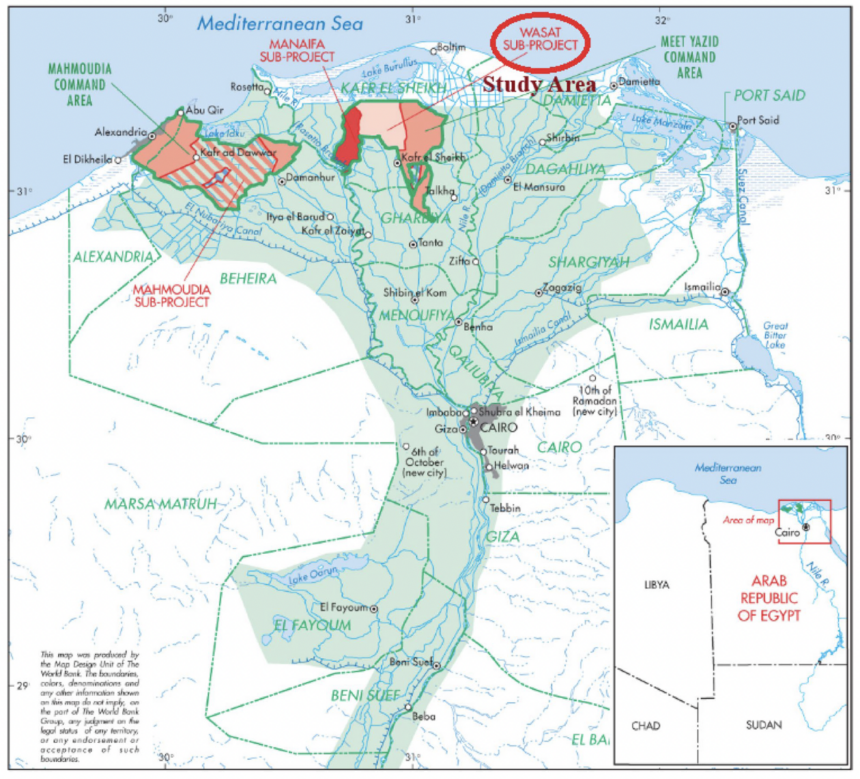
The researchers evaluated the framework using eight representative mesqa designs covering around 40,000 feddans in Kafr El Sheikh Governorate. A sensitivity analysis found that potential savings would remain between 36% and 40%, even if farmer participation declined to 50% or inflation varied by 15%.
However, the authors caution that the proposal remains a modelling framework rather than evidence from a completed large-scale field trial.
Its success depends on several assumptions, including the continuous availability of water in secondary canals and the ability of Water User Associations to organise labour, complete earthworks, and maintain irrigation equipment over the long term.
The study also notes that relying on smaller pumps could increase maintenance requirements because more pumping units would need servicing and spare parts. In addition, the researchers acknowledge that using the general Consumer Price Index may not fully reflect inflation in construction materials or imported equipment.
The authors conclude that pilot projects and long-term field monitoring are needed before the proposed design can be adopted on a wider scale. The study received no specific funding from public, commercial, or non-profit organisations.


