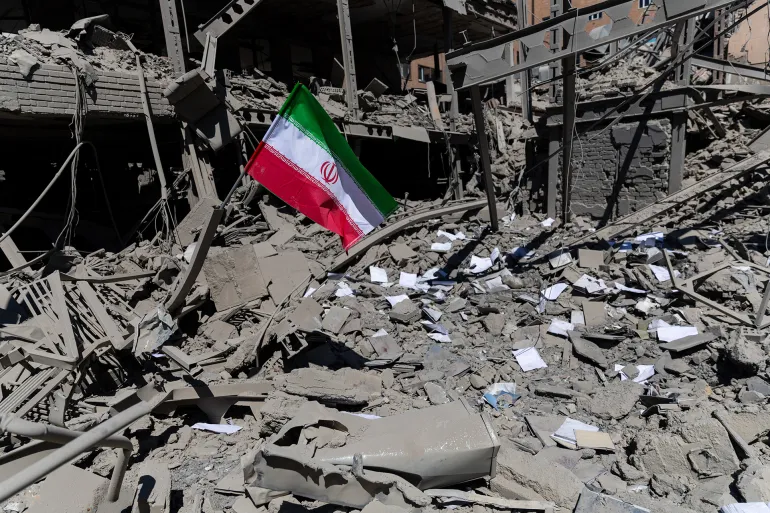
The military confrontation between the United States and Iran widened on Sunday after Tehran said it had struck US bases in Jordan, Kuwait, and other countries, while Washington launched another wave of attacks inside Iran and missile and drone threats placed several regional states on high alert.
A senior political official in Iran’s Islamic Revolutionary Guard Corps (IRGC) said Iranian forces had carried out “powerful strikes” against US bases in Jordan, Kuwait and elsewhere. He added that Washington was trying to restore conditions in the Strait of Hormuz to those that existed before the war but would fail.
Jordan’s Armed Forces said they intercepted and destroyed three Iranian missiles targeting the kingdom, while a fourth landed in a remote area without causing casualties or damage. Air-raid sirens sounded in Amman and other regions, and explosions were reported around Aqaba and the neighbouring Israeli city of Eilat as air defence systems engaged the incoming missiles.
Israeli media reported that US air defence systems intercepted missiles fired from Iran towards Aqaba and that missile fragments fell in Eilat. Israel’s military warned that the effects of the launches could extend into southern Israel.
In Kuwait, the military said its air defences responded to Iranian missile and drone attacks and urged residents to follow official safety instructions. The Ministry of Electricity and Water said a power generation and desalination facility had been attacked for the second time in two days, causing a fire and disrupting some generation units.
Iranian state television said the military had targeted US assets at two bases in Kuwait. The Tasnim news agency also reported that missiles had been launched towards targets in Kuwait and Erbil in Iraq’s Kurdistan Region.
Bahrain said its air defences intercepted and destroyed Iranian aerial attacks. Authorities activated warning sirens and instructed residents to move to the nearest safe locations.
The attacks came after US Central Command (CENTCOM) announced it had completed another round of strikes inside Iran. CENTCOM said the operation targeted coastal military observation posts, air defence facilities, naval capabilities, and missile and drone storage sites.
The command said it had struck IRGC forces linked to attacks that killed US troops in Jordan on July 17.
The US military also announced the deaths of two additional service members, bringing the total number of American military personnel killed since the conflict began to 16. One service member remains missing.
The New York Times, citing US officials, reported that Washington was deploying additional F-16 fighter jets from Germany and F-35 aircraft from Britain to the Middle East, along with more aerial refuelling tankers, indicating preparations for a potentially broader military campaign.
Inside Iran, local media reported strikes near Shadegan and Hajiabad, as well as an explosion in the southwestern city of Abadan. Iran’s Atomic Energy Organisation said the United States had attacked the Darkhovin nuclear facility under construction in Khuzestan, describing the strike on a site monitored by the International Atomic Energy Agency (IAEA) as a violation of international law.
Iran’s Health Ministry said US attacks since the beginning of July had killed 50 people and injured 517 others. Tasnim also reported that Iranian forces shot down a US MQ-9 drone over Ahvaz, while the Iranian military said its air defences destroyed another hostile drone in southern Iran.
Risks to commercial shipping through the Strait of Hormuz also intensified. The IRGC said two vessels had been involved in separate incidents and that two others turned back after receiving Iranian warnings. It added that its forces remained in full control of the strategic waterway and warned that vessels attempting to use routes not authorised by Tehran would face danger.
US Energy Secretary Chris Wright said Washington was working to guarantee the free flow of oil and gas through the Strait of Hormuz “with or without Iranian cooperation”. He said the American President Donald Trump still preferred a diplomatic solution but that the United States would continue protecting commercial shipping if Tehran rejected negotiations.
Diplomatic efforts continued alongside the fighting. Qatar’s Emir, Sheikh Tamim bin Hamad Al Thani, discussed de-escalation with Turkish Foreign Minister Hakan Fidan and Iraq’s prime minister. The officials called for dialogue and the implementation of the US-Iran memorandum of understanding, including provisions guaranteeing freedom of navigation through the Strait of Hormuz.
Jordanian Foreign Minister Ayman Safadi also held talks with his counterparts in Türkiye, Kuwait and Bahrain, urging an end to the escalation and the implementation of the US-Iran ceasefire agreement. The ministers condemned the Iranian attacks as violations of national sovereignty and a threat to regional stability.
In Israel, officials said the country could join the conflict alongside the United States if Iran continued attacking regional states. Defence Minister Israel Katz warned that Israel would respond “without restrictions” if Tehran targeted the country, saying Iranian missile launchers would be among the first military objectives.