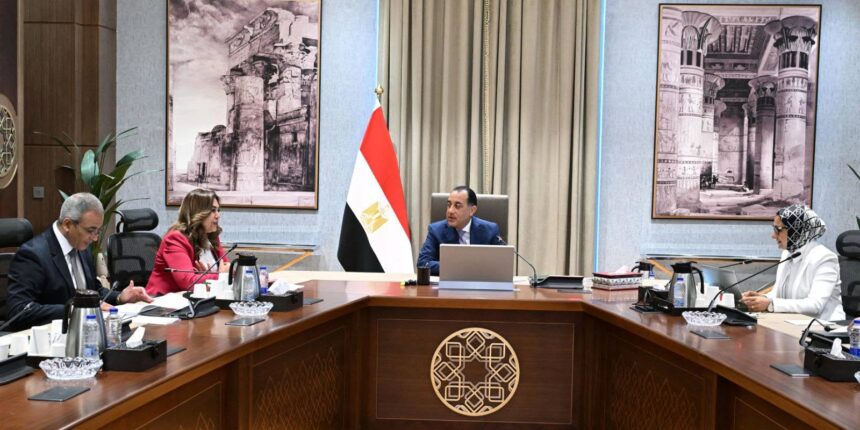
Egypt’s Prime Minister Mostafa Madbouly convened a meeting on Tuesday to review the progress of service and development projects in New Valley Governorate, as part of the government’s ongoing efforts to accelerate project implementation and improve public services nationwide.
The meeting was attended by Manal Awad, Minister of Local Development and Environment, and Hanan Magdy, Governor of New Valley.
Madbouly said the meeting forms part of the government’s regular follow-up of development and service projects across Egypt’s governorates, aimed at speeding up implementation rates and enhancing the quality and efficiency of services delivered to citizens.
For her part, Awad highlighted New Valley’s distinctive development potential, noting that the completion of all projects under the Decent Life initiative in Farafra district represents a successful model of implementation. She added that continuous coordination is taking place between the governorate and relevant ministries to support development efforts across all sectors.
During the meeting, Magdy presented the governorate’s strategic vision for building an integrated desert economy that preserves groundwater resources while maximising returns through industry, tourism, and renewable energy.
She explained that the governorate’s mission is to transform New Valley into a national hub for sustainable industries, eco-tourism, clean energy, and smart desert communities, creating a leading Egyptian model for balanced regional development.
The governor noted that New Valley enjoys a range of competitive advantages and investment opportunities, including significant solar energy potential, untapped mineral resources, and high-value export crops such as dates and potatoes. She also pointed to the governorate’s strategic location as a gateway linking Egypt with Africa.
According to Magdy, the development strategy is built on four main pillars: manufacturing industries, mining and extractive industries, solar and clean energy, and tourism diversification.
Regarding manufacturing and value-chain development, she said the governorate is working to transform local agricultural products—including dates, potatoes, and wheat—into higher-value agro-industrial products through specialised industrial complexes. Agricultural waste is also being recycled into organic fertilisers and animal feed.
She reviewed investment indicators in the agricultural sector, the governorate’s land allocation map for investors, and planned agricultural expansions. A comprehensive digital database of land designated for agricultural development is currently being prepared, while approximately 600,000 feddans are targeted for reclamation. An interactive agricultural map is also being developed to support planning and attract investment.
Magdy highlighted several agro-processing projects being implemented in cooperation with the Upper Egypt Development Authority, including a dates packaging and processing complex, a handicrafts industrial complex in Marzouq village in Balat district, and a 450-feddan land reclamation project in Abu Tartour.
Additional initiatives include a farm waste recycling plant, the development of a dates-processing complex in partnership with the private sector, and feasibility studies for a 100-feddan food industries complex. She also noted the signing of a cooperation protocol between New Valley and Aswan governorates to strengthen economic integration and expand investment opportunities.
The governor further reviewed the automation of the Land Reclamation Fund, describing it as the first investment fund of its kind in Egypt. The project aims to digitise administrative procedures, strengthen digital infrastructure, and improve operational efficiency through a newly established electronic portal that streamlines services and reduces processing times.
Addressing the second pillar of the development strategy, Magdy outlined plans for mining and strategic industries, including fertiliser and export-oriented chemical production complexes, specialised mining industries, and advanced glass and precision technology manufacturing. Preparations are also underway to establish an international applied technology school for mining to support technology localisation and develop a skilled workforce.
The third pillar focuses on expanding solar power generation and supporting agricultural and industrial development through the provision of low-cost clean energy. The strategy also seeks to attract energy-intensive industries and build human capital through a specialised applied technology school for new and renewable energy. Magdy noted that solar energy projects implemented at schools, mosques, and government irrigation wells have already contributed to reducing conventional electricity consumption.
On tourism development, the governor said the strategy aims to maximise returns from New Valley’s environmental, therapeutic, and heritage assets. She stressed the importance of leveraging the governorate’s diverse tourism resources and newly developed infrastructure to position it as a year-round destination. Particular attention is being given to medical tourism, supported by the region’s sulphur springs and hot underground wells.
Magdy also reviewed progress in state land regularisation and the operation of the spatial monitoring system, which recorded 534 land-use changes, with immediate action taken to address violations.
In addition, she outlined the governorate’s investment plan, which finances development programmes in electricity, roads, local administration, environmental improvement, urban development, and economic development.
Regarding the Decent Life initiative, Magdy said all 321 projects included in the first phase in Farafra district have been completed, with procedures currently underway for their operation and handover.