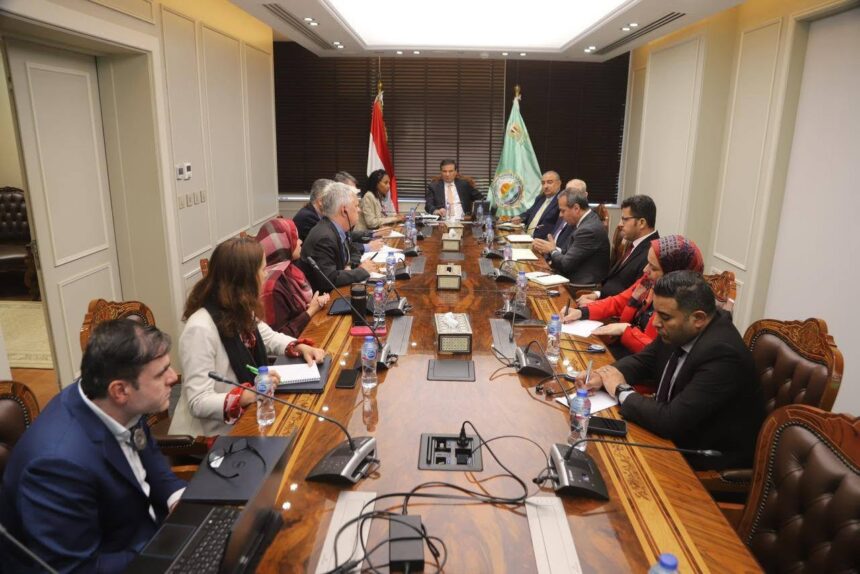
Egypt’s Minister of Agriculture and Land Reclamation, Alaa Farouk, met with Meskerem Brhane, the World Bank’s Regional Director for Sustainable Development for the Middle East and North Africa, Afghanistan, and Pakistan, to discuss ways to strengthen cooperation in support of food security, sustainable agriculture, and rural development.
The Tuesday meeting forms part of Egypt’s broader efforts to deepen international partnerships and enhance development cooperation with global financial institutions.
Farouk stressed that continuous coordination between the Ministries of Agriculture and Water Resources and Irrigation plays a key role in evaluating development interventions and reviewing the technical and economic feasibility of proposals submitted by international organisations. These efforts aim to strengthen agricultural infrastructure, improve the livelihoods of small-scale farmers, increase agricultural productivity, and enhance national food security.
For her part, Brhane said the World Bank is conducting a series of intensive consultations with key government stakeholders, particularly the ministries of agriculture and irrigation, which she described as essential partners in implementing food security strategies and sustainable development programmes.
The discussions focused on expanding cooperation in line with the shared objective of supporting sustainable rural and agricultural development, while advancing the World Bank’s broader cooperation programme in Egypt. The programme covers several interconnected sectors, including agriculture, food systems, climate resilience, environmental sustainability, and water management.
The two sides reviewed progress on a number of regional and international initiatives, as well as ongoing and proposed World Bank-financed projects. These include programmes aimed at strengthening agricultural resilience, supporting sustainable local grain production, and advancing climate-smart transformation across the agri-food sector.
Particular attention was given to the World Bank Group’s “AgriConnect” initiative, a global development platform designed to help 300 million smallholder farmers transition from subsistence farming to market-oriented surplus production. The initiative seeks to establish integrated agricultural ecosystems through stronger cooperatives, improved market access, expanded financing opportunities, and enhanced digital tools for farmers and development partners. As part of the initiative, the World Bank Group has committed to doubling its financing for agribusiness.
AgriConnect is built around three core pillars: positioning food production as a driver of rural employment and development; strengthening food-related value chains, processing industries, and cold storage infrastructure; and ensuring food systems can meet growing demand amid climate change and increasing water scarcity.
Farouk also outlined opportunities for cooperation under Egypt’s “Productive Village” initiative, which seeks to capitalise on each village’s comparative and productive advantages to stimulate local economic development. The initiative aims to integrate projects implemented by the Ministries of Agriculture and Irrigation while modernising agricultural cooperatives and water user associations to improve resource efficiency and encourage the adoption of climate-smart technologies.
The discussions further explored ways to modernise agricultural cooperatives, expand digital extension and advisory services, and strengthen public digital infrastructure. Other priorities included upgrading irrigation and drainage systems, supporting research and development across agricultural value chains, and addressing skills shortages in the agriculture and agribusiness sectors through training, extension, and research programmes.
The two sides also examined mechanisms to improve farmers’ access to finance through insurance schemes, credit guarantees, warehouse receipt systems, and expanded lending programmes. In addition, they discussed policy reforms and government commitments aimed at accelerating structural changes that encourage greater private-sector investment in food and agriculture.
Farouk emphasised that food and water security remain among Egypt’s highest development priorities under the directives of the political leadership, noting that the country’s strategic partnership with the World Bank is a key pillar in supporting small farmers and advancing rural development.
He added that cooperation under the Productive Village initiative aims to maximise the value of local resources in Egyptian villages while transforming agricultural and water user associations into more dynamic institutions capable of supporting farmers and facilitating the adoption of modern technologies.
Farouk noted that enhanced coordination between the Ministries of Agriculture and Irrigation, alongside international development partners, contributes directly to improving irrigation efficiency, optimising water use, and safeguarding Egypt’s production of strategic crops in the face of mounting climate challenges.