

US President Donald Trump said the United States and Iran were “very close” to reaching an agreement to end the conflict, but ruled out any advance easing of sanctions or the unfreezing of Iranian assets as part of a potential deal.
In remarks to NBC News, Trump said he was not insisting that Lebanon be included in a short-term agreement with Iran and confirmed that US forces would remain in the region until a final accord with Tehran is secured.
He said Washington would work with Iran, should an agreement be reached, to recover and destroy highly enriched uranium stockpiles.
“If Iran behaves well and does a good job, then we will start talking,” Trump said.
The US president warned that if negotiations fail, Washington would take further steps to weaken Iran’s military capabilities to ensure US forces could safely secure the uranium. He added that Iran had accepted a provision prohibiting it from possessing nuclear weapons, which had been incorporated into the proposed agreement, but said he was seeking additional safeguards to prevent Tehran from circumventing the deal.
Trump said one of the main obstacles to a rapid settlement was the need for what he described as a “radical change” in Iran’s long-standing stance towards the United States. He characterised Iran’s new leadership as “more rational and intelligent” and said Mojtaba Khamenei had become involved in the process of approving the agreement.
He also said he would be open to direct talks with Iran’s supreme leader if requested, although he noted that no such conversation had taken place. Trump declined to reveal whether he knew the supreme leader’s location but said there was a “very high chance” that he did. He further claimed that Iran’s supreme leader had been “very badly wounded”.
Trump asserted that the United States had “completely destroyed” Iran’s military capabilities and estimated that the country retained only 21% to 22% of its pre-war missile stockpile.
He also claimed that Iran was losing between $400m and $500m per day due to a naval blockade, which he said Washington imposed after Tehran attempted to establish one of its own.
While rejecting the characterisation of the blockade as an act of war, Trump acknowledged that others might view it differently.
“If someone wants to call it war, I suppose they can,” he said, describing US actions as a “military manoeuvre” rather than a major conflict.
Trump’s comments came amid intensified diplomatic activity across the region.
Pakistan’s Interior Minister Mohsin Naqvi met Iranian Foreign Minister Abbas Araghchi on Sunday and delivered a written message from Prime Minister Shehbaz Sharif to Iran’s leader Mojtaba Khamenei, according to a brief statement from Iran’s foreign ministry.
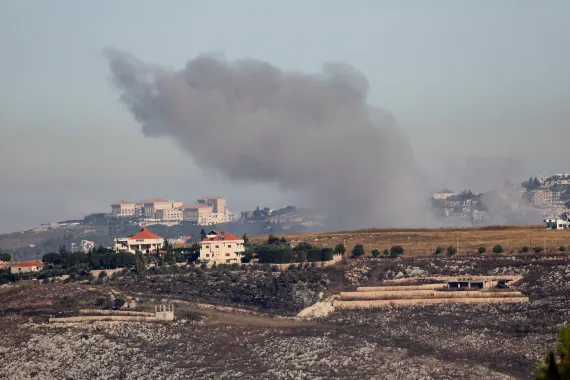
Meanwhile, tensions escalated in Lebanon after the office of Israeli Prime Minister Benjamin Netanyahu announced that the Israeli military, acting on instructions from Netanyahu and Defence Minister Israel Katz, had carried out strikes on Hezbollah positions in Beirut’s southern suburbs.
Israeli aircraft launched an attack on the area on Sunday, with the Israeli military stating that the operation targeted Hezbollah infrastructure.
Hezbollah said it responded by firing a salvo of rockets at a concentration of Israeli military vehicles and personnel in the southern Lebanese town of Rashaf.
In separate statements, the group said it also targeted an Israeli force positioned inside a building at Talet al-Salaa near Qantara using an Ababil attack drone and struck an Israeli communications vehicle at the same location with another drone. Hezbollah claimed both attacks achieved direct hits.
Israeli news outlet Walla, citing unnamed sources, reported that Israeli forces had begun limited ground operations on the outskirts of Nabatieh aimed at locating armed fighters and explosive devices.
According to the report, the head of Israel’s Northern Command is pushing to destroy Hezbollah military infrastructure in the Nabatieh area, which military officials reportedly view as strategically and symbolically important to the group.
Walla also cited military assessments suggesting that the loss of Nabatieh—described as one of Hezbollah’s principal strongholds in Lebanon—would deal a significant blow to the organisation.
In Tehran, Ebrahim Rezaei, spokesperson for the Iranian parliament’s National Security and Foreign Policy Committee, warned that Iran would respond forcefully to the Israeli strike on Beirut’s southern suburbs.
“The rabid dog must be disciplined and put in its place,” Rezaei wrote on X, adding: “Watch the skies of the occupied territories tonight.”


