

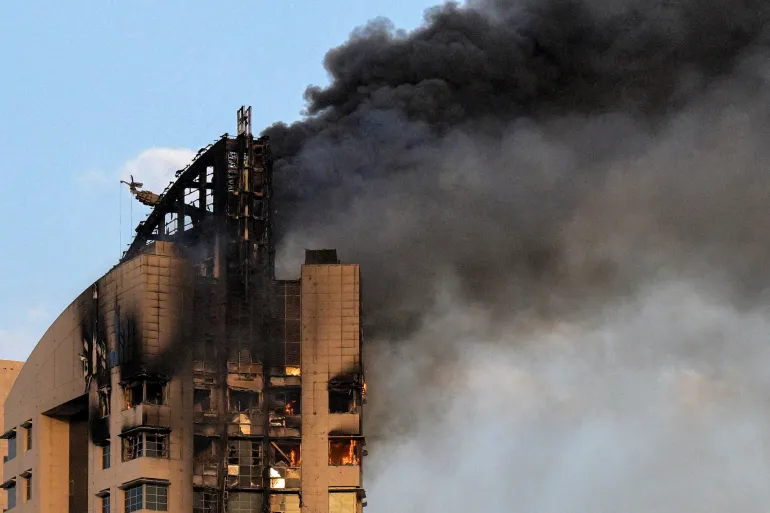
The confrontation linked to the U.S.–Israeli war on Iran intensified across the region on Monday, marked by escalating threats, reported strikes, missile and drone interceptions, and heightened military alerts on multiple fronts.
Tehran reiterated that it is not engaged in direct negotiations with Washington, stating that it has only received messages through intermediaries indicating U.S. interest in talks. Iranian Foreign Ministry spokesperson Esmail Baghaei said U.S. rhetoric on diplomacy “should be treated with caution,” citing what he described as inconsistent positions from Washington, while maintaining that Iran’s stance has remained clear. He added that proposals relayed via intermediaries were “excessive and unreasonable.”
In remarks reported by Reuters, Donald Trump warned that the United States could target key Iranian infrastructure—including power stations, oil facilities, and Kharg Island—if no agreement is reached. He also indicated that Washington was engaged in “serious discussions” aimed at ending its military operations in Iran. Separately, The Wall Street Journal reported that U.S. officials are considering a potential operation to secure enriched uranium from Iran, a move that could involve a sustained military presence on Iranian territory.
Iranian officials responded with intensified rhetoric. Esmail Qaani said the region was entering a “new order,” warning that coordinated actions by allied groups across the region have reshaped the strategic balance.
Ebrahim Zolfaghari, the spokesperson for Iran’s Khatam al-Anbiya wartime headquarters, said Tehran would not initiate conflict but would determine its outcome in the event of aggression. He added that U.S. forces and bases in the region, along with Israeli infrastructure, remain within Iran’s potential target scope.
On the ground, Iran’s Revolutionary Guards announced a new wave of operations under what it described as “Operation True Promise 4,” targeting military and strategic sites linked to U.S. and Israeli forces across multiple locations. The Iranian army also reported drone strikes on defence-related facilities in Israel, including sites associated with Elbit Systems.
In Israel, local media reported damage to petrochemical facilities in Haifa Bay following missile fire from Iran and Lebanon.
The spillover effects of the conflict have extended across neighbouring countries. Jordan’s military said it intercepted several missiles and a drone over its territory within 24 hours, while emergency services responded to falling debris that caused minor injuries.
In the Gulf, Qatar condemned what it described as Iranian strikes targeting infrastructure in Kuwait, including a camp, a power station, and a desalination facility. Saudi Arabia reported intercepting multiple drones, while Kuwait’s National Guard said it had downed several unmanned aerial vehicles near protected sites.
Turkey also confirmed heightened defence activity, with its defence ministry stating that a ballistic missile entering its airspace had been intercepted through NATO systems in the eastern Mediterranean. Ankara said it remains on high alert against any threats to its territory. Iran, however, denied launching missiles toward Turkey.
On the nuclear front, the International Atomic Energy Agency said Iran’s Khondab heavy water complex had ceased operations after sustaining significant damage in recent Israeli air strikes. The site—linked to the Arak heavy water reactor—was described as non-operational, though it reportedly did not contain declared nuclear material at the time.
At the United Nations, Iran’s permanent representative Saeed Iravani submitted a formal complaint to Secretary-General Antonio Guterres and the Security Council, accusing the United States and Israel of targeting civilian industrial infrastructure, including major steel facilities. Tehran called for international condemnation and accountability, arguing that the strikes violated international law.
Overall, the rapid escalation underscores the growing risk of a broader regional conflict, as diplomatic channels remain uncertain and military actions continue to expand across multiple theatres.

