

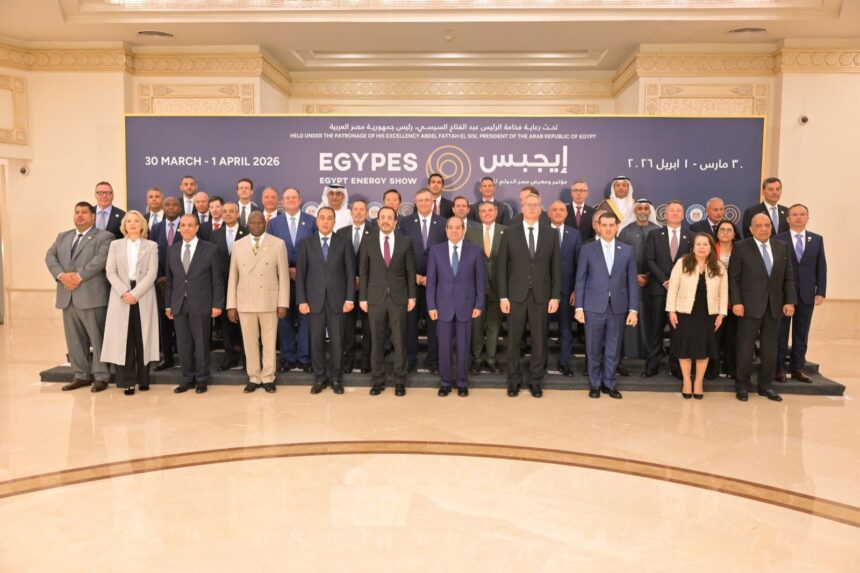
President Abdel Fattah Al-Sisi inaugurated Egypt Energy Show (EGYPES 2026) on Monday, reaffirming Egypt’s commitment to advancing energy transformation through strategic partnerships and practical implementation.
Held under the theme “Effective Plan for Cooperation in Field of Energy Efficiency,” the event brought together Nikos Christodoulides, alongside ministers, heads of international organisations, and senior executives from leading global energy companies.
During the opening session, Karim Badawi highlighted the continued support of President Al-Sisi, describing it as a key driver behind recent achievements in the petroleum sector.
Badawi noted that this year’s edition of EGYPES comes at a critical juncture marked by mounting regional and global challenges. He emphasised that Egypt is advancing an integrated energy strategy focused on boosting production, attracting investment, and keeping pace with rapid shifts in global energy markets.
He added that these efforts are underpinned by strong political backing, institutional coordination, and expanded partnerships with major international companies, supporting domestic energy security while reinforcing Egypt’s position as a regional energy hub.
The minister also pointed to Egypt’s strategic geographic location as a core competitive advantage, enabling the country to maximise value-added industries, particularly in petrochemicals and fertilisers. He noted that Egypt has become a leading producer of fertilisers—especially urea—with annual output exceeding 7.6 million tonnes.
Badawi further highlighted Egypt’s integrated petroleum infrastructure, including advanced refineries, strategic ports on both the Mediterranean and Red Seas, and efficient transport networks. He cited the SUMED pipeline as a model of Arab cooperation, linking the Red Sea to the Mediterranean from Ain Sokhna to Sidi Kerir.
He added that these capabilities are strengthening regional and international cooperation, particularly with plans to connect the Cronos and Aphrodite gas fields to Egypt’s liquefaction facilities in Idku and Damietta. This, he said, will optimise infrastructure utilisation, diversify supply sources, and enhance both domestic supply and export potential.
On the financial front, Badawi revealed that arrears owed to foreign partners have been significantly reduced from $6.1bn in July 2024 to around $1.3bn currently, with full settlement targeted by the end of June. This progress, he noted, reflects renewed investor confidence and is expected to drive further inflows.
The minister also announced that the sector recorded 83 new oil and gas discoveries and added 363 wells to production. Investments in exploration and production reached $6.5bn during the 2024/2025 fiscal year, alongside new seismic surveys and the launch of an international bid round in the Red Sea.
Looking ahead, Egypt plans to drill 101 exploratory wells this year with investments of $1.3bn, as part of a broader strategy targeting 484 wells by 2030. Parallel efforts are also underway to expand refining capacity to increase local output of key petroleum products, including gasoline and diesel.
Badawi concluded by reaffirming the ministry’s commitment to boosting domestic production, fostering a stable and attractive investment climate, and strengthening partnerships that support Egypt’s long-term development goals, while commending sector employees for their contributions to these achievements.


