Egypt’s first high-speed electric rail line will act as a “Suez Canal on rails” by providing a land link between the Red Sea and the Mediterranean, Transport Minister Kamel al-Wazir said on Wednesday.
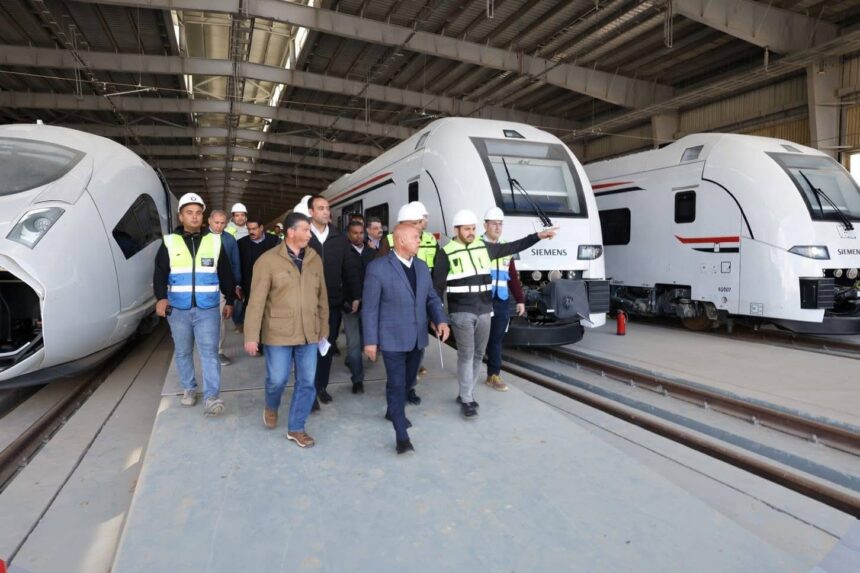
During an inspection of the project’s first line, which connects Ain Sokhna, Alamein, and Matrouh, al-Wazir reviewed progress at the October Gardens workshop. The facility, spanning 578 acres, is one of the largest maintenance and operation centres for trains in the region, according to a ministry statement.
The workshop is being developed by two consortia. A partnership between Orascom and Al Rowad is handling civil, architectural, and infrastructure works, while a second group comprising Siemens, Orascom, and Arab Contractors is responsible for track installation, signalling, power supply, and control systems.
The facility includes 46 buildings, featuring a 67,000-square-metre heavy maintenance building and a control centre described by the ministry as one of the largest in Africa and the Middle East. The workshop is designed to store up to 50 trains and locomotives and will manage the operation and maintenance of all three planned lines in the network.
Regarding infrastructure progress, the National Authority for Tunnels (NAT) reported that 88.3 km of track has been installed in the East Nile sector, with a further 18 km in the West Nile sector and 27 km in the North sector. Sections of the route have been handed over to the Siemens-led consortium for ballast laying and the installation of catenary masts.
Al-Wazir, accompanied by Deputy Minister for Electric Traction Wagdi Radwan and NAT Chairman Tarek Goweili, also reviewed station finishing works and passenger flow plans. The minister directed that work at the site continue around the clock to meet quality standards, citing the workshop’s role in ensuring safe and effective operations.
The ministry stated the project is a component of Egypt’s shift toward sustainable green transport, aligned with the National Climate Strategy and Egypt Vision 2030. Al-Wazir added that the network is expected to improve supply chain efficiency, attract investment, and support urban development by linking new areas to existing cities.