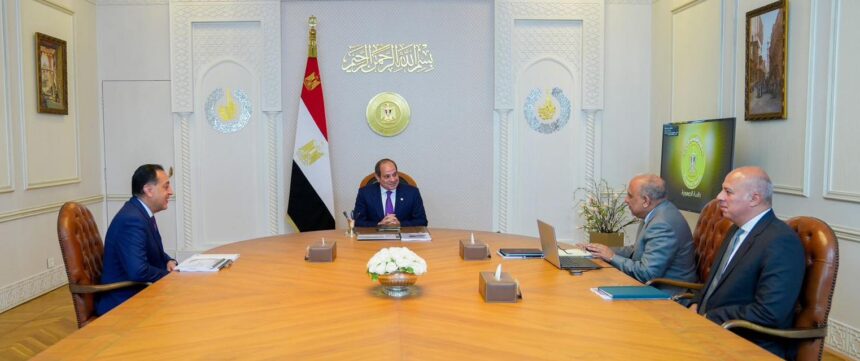
Egyptian President Abdel Fattah Al-Sisi reviewed the government’s preparations to secure electricity supplies during the upcoming summer season, as peak demand on the national grid is forecast to rise by 6-7%.
The review took place during a meeting with Prime Minister Mostafa Madbouly and Minister of Electricity and Renewable Energy Mahmoud Essmat, according to a statement from the presidency.
Essmat outlined the ministry’s plan to reinforce generation capacity ahead of peak consumption months, including the addition of approximately 3,000 megawatts (MW) of new solar energy projects this year. Authorities are also working to introduce 600 MW of battery storage capacity before summer, which would bring Egypt’s total storage capacity to around 1,100 MW, strengthening the grid’s ability to manage peak loads and integrate renewable energy.
Al-Sisi emphasised the importance of maintaining grid stability and ensuring uninterrupted electricity supply for households, industry and vital services. He called for accelerating renewable energy projects while improving the operational efficiency of existing power plants and transmission networks.
The meeting also reviewed progress on electricity infrastructure upgrades. Officials reported the completion of 34 new transformer substations over the past year, in addition to expansion works at 40 existing substations, alongside the development of new transmission and distribution lines to enhance network reliability.
Regional interconnection projects were also discussed, notably the Egypt-Saudi Arabia electricity interconnection. The first phase of the project is expected to supply 1,500 MW to the Egyptian grid, providing additional support during the high-demand summer of 2026.
Al-Sisi further stressed the need to secure sustainable energy supplies to support economic growth, expand reliance on renewable sources, reduce dependence on fossil fuels and localise the manufacturing of electrical equipment, in line with the state’s broader energy and industrial development strategy.