

In recent months, what was once a relatively minor economic story about Canada’s evolving trade relations with China has erupted into a major flashpoint in global geopolitics. At the centre of this storm is U.S. President Donald Trump, whose forceful public remarks claim that China is “successfully and fully controlling Canada” and that such a shift poses an existential threat to U.S. economic interests. Trump has characterised the situation in dramatic terms, suggesting that closer ties between Ottawa and Beijing could lead to China “devouring Canada completely,” affecting its companies, social structure, and way of life.
But to understand whether there is any substance behind these claims, one must look beyond hyperbolic rhetoric and into the actual trade dynamics and strategic interests at play. What Trump’s statements reveal — intentionally or not — is less a reality of Chinese dominance and more a broader struggle for influence in the global economic order between Washington and Beijing, with Canada caught in the geopolitical crossfire.
First, the actual trade relationship between Canada and China, while significant, remains modest in scale compared with Canada’s ties to the United States. In 2024, Canadian exports to China totalled about $21.1bn, accounting for only a small fraction of Canada’s overall exports. By contrast, the United States accounted for more than 75% of Canada’s merchandise exports, amounting to hundreds of billions of dollars — a figure that dwarfs Canadian sales to China by a wide margin.
These numbers provide critical context: China is a notable trade partner, but far from Canada’s dominant export market. Imports from China are larger than exports to China — reflecting Canada’s reliance on Chinese manufactured goods — but still comprise just over 10-12% of Canada’s total imports in the first half of 2025.

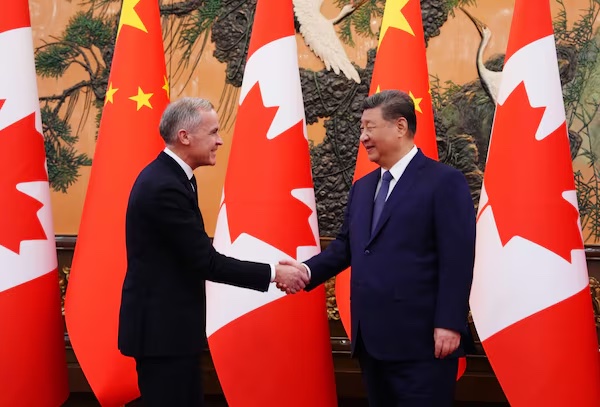
When Canadian Prime Minister Mark Carney visited Beijing and announced steps to ease mutual tariffs — such as lower duties on electric vehicles from China in exchange for China reducing tariffs on Canadian agricultural products — these were specific, sector-focused adjustments, not a comprehensive free trade agreement that would fundamentally shift Canada’s economic orientation. Carney repeatedly stated that Ottawa has no intention of pursuing a full free trade deal with China, partly because it must remain compliant with the United States–Mexico–Canada Agreement (USMCA), which requires consultation with partners before entering accords with non-market economies like China.
Trump’s response — a threat to impose 100% tariffs on Canadian exports to punish Ottawa for its engagement with Beijing — is not anchored in established trade realities but rather reflects a strategic playbook he has used repeatedly in his confrontations with China. By deploying exaggerated language about “control” and “devouring,” Trump effectively framed a nuanced trade negotiation as if it were a geopolitical takeover, mobilising domestic opinion and applying extreme economic pressure in the form of tariff threats.
From an economic standpoint, such tariff escalations could be devastating for Canada. Given that more than three-quarters of Canada’s export economy relies on the United States, a 100% tariff would render most Canadian goods non-competitive overnight, potentially collapsing entire sectors, shrinking production, threatening jobs, and disrupting deeply integrated supply chains.
Beyond purely bilateral concerns, this episode speaks to a broader trend in which the United States and China are competing to shape the rules of global trade and investment. Trump’s aggressive tariff threats and blame narratives are part of a larger set of policies aimed at reducing the U.S. trade deficit with China and curbing what he viewed as unfair trade practices. These measures have included steep U.S. duties on Chinese goods and a willingness to confront allies who seek independent arrangements with Beijing.
Chinese officials, in response, have publicly distanced their actions from any hostile intent towards third parties, emphasising cooperation and mutual benefit in trade with Canada rather than confrontation with the United States. This underscores that the actual economic exchanges are rooted in incremental cooperation — not strategic subjugation.
Strategically, this clash reveals a larger global phenomenon: powerful economies are attempting to defend their spheres of influence while asserting control over trade flows, investment directions, and technological access. Trump’s rhetoric magnifies this contest, leveraging symbolic language and hard-ball economic tactics to galvanise domestic support and pressure both foreign competitors and allied partners. Whether such strategies enhance long-term U.S. influence is debatable, especially as allies like Canada seek to diversify their trade portfolios in a multipolar economic environment.
What some politicians frame simplistically as “Chinese control over Canada” is more accurately understood as a complex interplay of trade priorities, geopolitical posturing, and economic competition. Canada’s trade with China — though substantial in absolute terms — is economically limited relative to its U.S. ties. The broader dispute reflects how nations like the United States react when traditional trade dominance is perceived to be challenged, even modestly. In this context, demands for strategic diversification by middle powers such as Canada are not a sign of Chinese dominance but rather a rational response to an unpredictable geopolitical landscape in which influence is negotiated through both cooperation and competition.
In the end, Trump’s heated language and tariff threats illustrate a larger strategic conflict driven by competing national interests, not an objective reality of Chinese supremacy over Canadian sovereignty. Interpreting these developments requires a balanced understanding of economic data, trade interdependencies, and the geopolitical strategies that major powers deploy as they vie for influence in a rapidly changing global economy.
Dr. Marwa El-Shinawy – Academic and Writer
