

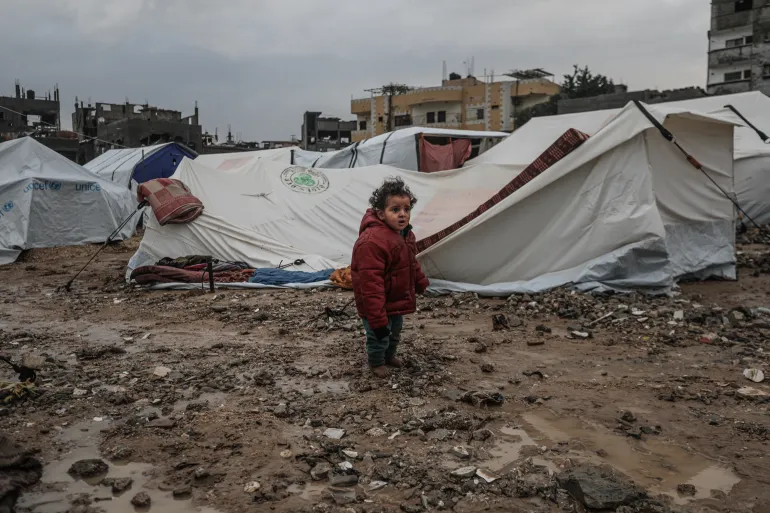
A winter storm that battered the Gaza Strip over the past few days has worsened an already dire humanitarian situation, killing additional people and exacerbating the impact of Israeli strikes, Palestinian officials said, as diplomatic efforts over the territory’s future gain momentum.
Ismail Al-Thawabta, director general of Gaza’s Government Media Office, described the three-day weather system as creating a “compound humanitarian disaster” on top of the devastation caused by Israeli military operations. Speaking at a news conference at Al-Aqsa Martyrs Hospital in central Gaza on Saturday, he reported 11 deaths and one missing person after buildings previously damaged by bombardment collapsed under harsh weather conditions.
Al-Thawabta said government teams had documented the collapse of at least 13 homes, all hit earlier by Israeli strikes. More than 27,000 tents sheltering displaced people were swept away or flooded, while a total of over 53,000 tents suffered full or partial damage, leaving hundreds of thousands exposed to the elements.
Separately, Gaza’s Health Ministry reported that three Palestinians were killed by Israeli fire over the past 48 hours, with 16 wounded admitted to hospitals during the same period. Since a ceasefire took effect on October 10, the ministry said the death toll has reached 386, with 1,018 people injured.
On the military front, The Israeli occupation army’s radio reported an airstrike in Gaza City targeting what it described as Hamas’s second-in-command, Raed Saad, claiming he had been involved in rebuilding the group’s capabilities and weapons production. Hamas did not immediately comment.
US media have reported that Bulgarian diplomat Nikolay Mladenov is a potential candidate to represent a proposed “Peace Council” backed by the United States and endorsed by the UN Security Council to oversee Gaza in a future phase, following Arab objections to the nomination of former British Prime Minister Tony Blair. Neither nomination has been officially confirmed.
Turkish President Tayyip Erdogan said any peace council must address what he described as the security problem posed by Israel. Speaking after a visit to Turkmenistan, Erdogan emphasised that Israel must honour its commitments and fully adhere to the ceasefire to allow life in Gaza to return to normal.
Humanitarian crisis
At the United Nations, Rick Peeperkorn, WHO representative in the occupied Palestinian territories, said approximately 1,092 patients in Gaza had died while awaiting medical evacuation between July 2024 and November 28, 2025. He warned that the figure is likely an underestimate. Peeperkorn added that 18 of Gaza’s 36 hospitals and 43% of primary healthcare centres were only partially functioning amid severe shortages of essential medicines and medical supplies. While some improvement has been seen in aid delivery approvals, the process of bringing medical equipment and drugs into Gaza remains “slow and unnecessarily complex.”
UNICEF warned of a severe health crisis, noting that malnourished pregnant women are giving birth to underweight and premature babies, many of whom are dying in neonatal intensive care or facing lifelong medical complications.
Two US officials said that US Central Command will host a conference in Doha on December 16 with partner nations to develop a plan for an international force to stabilise Gaza. More than 25 countries are expected to send representatives to discuss command structures and operational frameworks.
In New York, the UN General Assembly adopted a resolution urging Israel to allow full humanitarian access to Gaza, stop obstructing UN agencies and comply with international law. The Popular Front for the Liberation of Palestine welcomed the vote but said it lacked enforcement mechanisms and called for binding measures under Chapter Seven of the UN Charter to ensure aid delivery and halt what it described as an ongoing campaign of extermination and starvation.


