

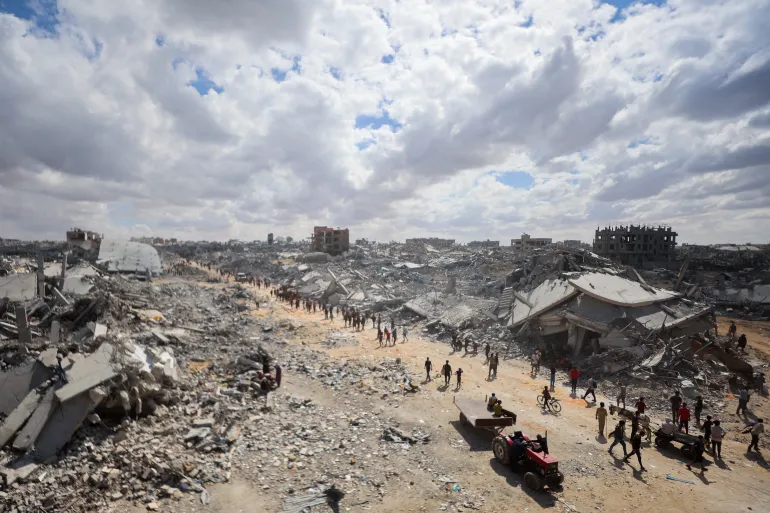
Egypt and Qatar, the two main mediators, alongside the United States, in securing the Gaza ceasefire, urged on Sunday the withdrawal of Israeli forces from the Strip and the deployment of an international stabilization force. Both steps, they said, are essential for fully implementing the agreement amid mounting concerns over daily violations and the fragility of the truce.
Speaking at the Doha Forum, Qatari Prime Minister and Foreign Minister Mohammed bin Abdulrahman Al Thani said the conflict had reached “a critical moment,” stressing that “a ceasefire cannot be considered complete without a full Israeli withdrawal and the restoration of stability in Gaza.” He cautioned that the crisis would escalate if left unresolved, reiterating that Qatar would not fund the reconstruction of destruction caused by the war and that any Qatari financial support would “remain directed to the Palestinian people.”
Al Thani noted that Qatar’s engagement with Hamas began 13 years ago at the request of the United States, and that communication with the group was instrumental in reaching the recent ceasefire and prisoner-release agreements. He rejected accusations that Doha finances Hamas, calling them “baseless,” and said Qatar’s mediation efforts had faced “unethical attacks,” including an Israeli strike on Doha as it was working to persuade Hamas to accept the ceasefire terms.
Egyptian Foreign Minister Badr Abdelatty echoed the call for the swift deployment of an international stabilization force to ensure compliance with the truce, stating that “one party—Israel—is violating the agreement daily.” He emphasized that the second phase of the ceasefire process depends on an Israeli withdrawal and reiterated that Egypt will not allow the Rafah crossing to be used as a channel for the displacement of Palestinians. The crossing, he said, will be reserved for humanitarian aid and the evacuation of urgent medical cases.
Abdelatty added that Cairo is engaged in discussions with Israel on reopening the crossing, highlighting the need for a unified Palestinian authority and for all weapons to be brought under a single legitimate framework to eliminate Israel’s security pretexts.
Norwegian Foreign Minister Espen Barth Eide underlined that future governance of Gaza “must be fully Palestinian,” and said international support for a Palestinian state “has never been stronger.” He described the current moment as “difficult but an opportunity to lay the foundations for a lasting solution,” while warning of the risks posed by continued Israeli operations. He also noted that Norway does not invest in companies exporting weapons used in the West Bank and reaffirmed that the occupation is “illegal in all its forms,” as stated by the International Court of Justice.
Amid a deepening humanitarian crisis, the UNRWA Director of External Relations and Communications said the flow of aid “does not meet the level of need,” and that the agency is facing severe funding shortages that have forced it to scale back services. She said camps in northern West Bank areas have been emptied following forced displacement, and that more than 508 children in Gaza have been diagnosed with acute malnutrition.
Meanwhile, Israeli Prime Minister Benjamin Netanyahu said Israel is “close to completing the first phase” of the ceasefire agreement and expects the second phase to be “more difficult,” as it will focus on disarming Gaza and Hamas. He said he looks forward to discussing the next steps with U.S. President Donald Trump, adding that he would not retire from political life in exchange for a pardon and noting that an International Criminal Court decision prevents him from visiting Germany.
In a related development, South Africa revoked visa exemptions for Palestinian passport holders following the arrival in Johannesburg of a controversial flight from Israeli airports carrying 153 Palestinians without official Israeli exit documents. Authorities said the incident raised suspicions of Israeli involvement in what they described as a “systematic displacement scheme.”
