

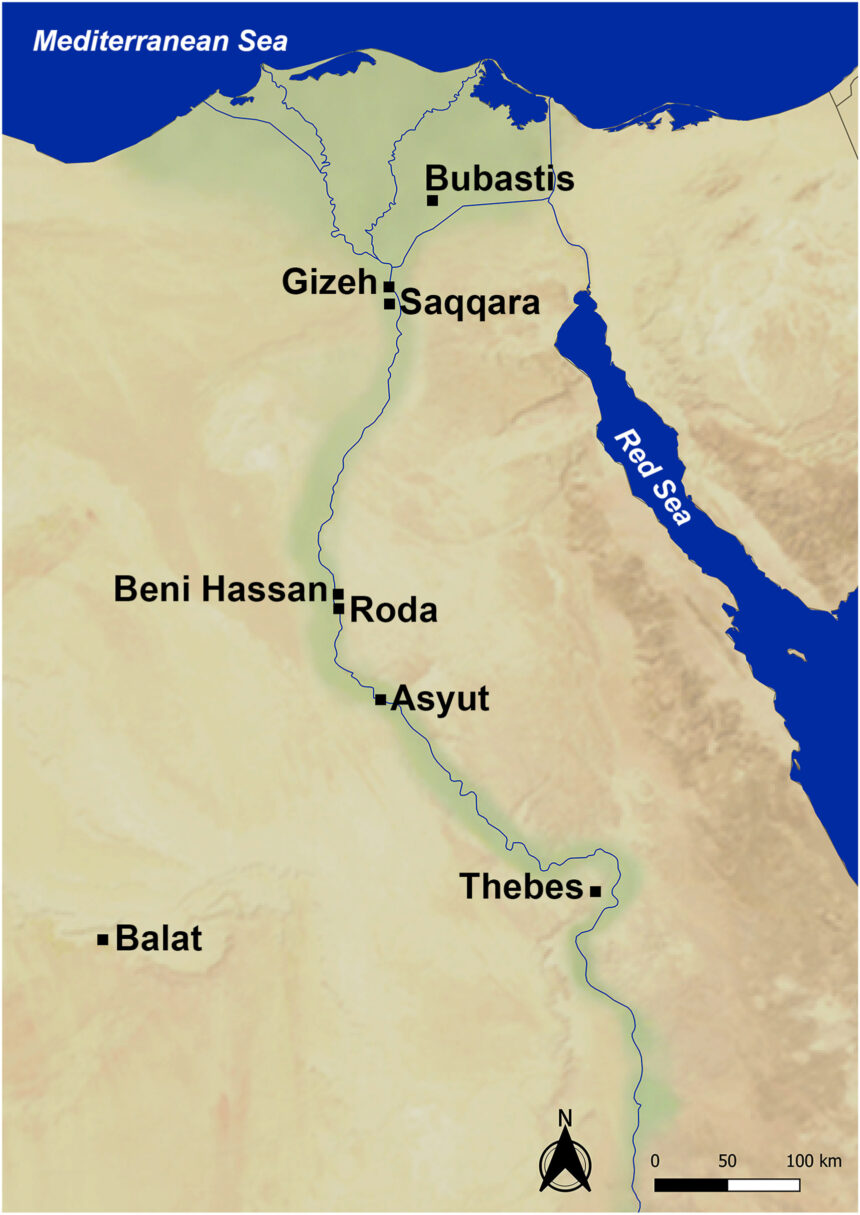
More than two thousand years ago, cats destined to become sacred offerings were kept near the ancient Egyptian cemetery of Beni Hassan. Some appear to have fought one another. Others suffered from disease, broken bones or violent blows from humans. And at least some of the animals may not have been bred there at all, but captured from the wild.
That picture emerges from a new study of 131 cat skulls preserved at the Natural History Museum in Vienna. The collection, taken from mummified animals at Beni Hassan in the 19th century, offers an unusual window into what happened to cats before they were wrapped and deposited as votive offerings.
The study was published in the Journal of Archaeological Science.
Animal mummification was widespread in ancient Egypt, and archaeologists know of around 20 cat cemeteries. Beni Hassan was among the largest: early accounts described pits packed with layers of mummified cats. Yet researchers still know surprisingly little about how such enormous numbers of animals were obtained, raised and housed before death.
“We wanted to understand not just which cats were present, but what their bones could tell us about how they lived,” said Wim Van Neer, senior scientist at the Royal Belgian Institute of Natural Sciences and professor at KU Leuven, and lead author of the study. Van Neer specialises in archaeozoology, the study of relationships between people and animals in the past.
The researchers measured the skulls and teeth to estimate species and age, recorded injuries and signs of disease, radiocarbon-dated nine animals, and analysed carbon and nitrogen signatures in the bones of 16 cats to investigate their diets and environments.
Seven skulls could confidently be identified as jungle cats, a wild species larger than the domestic cat. Most of the others were probably domestic cats, although African wildcats and hybrids may also be represented. The bones alone could not resolve every identification.
The cats’ health provided the most striking evidence.
Of the 131 animals, 81 – about 62% – showed at least one pathological condition. Researchers found periodontal disease, missing teeth, damaged skull surfaces and other abnormalities. Six of the seven jungle cats were affected. The authors say the pattern suggests that wild and domestic animals were probably kept under broadly similar captive conditions.
Fourteen skulls also carried traumatic injuries. Some punctures appear consistent with bites from other cats. Other damage, including cuts and fractures, points to humans. Some wounds had healed, meaning the animals survived the violence; others had not. In several cases, the researchers believe deliberate blows probably killed cats that were then mummified as offerings.
However, the evidence cannot reveal exactly how the cats were housed. Because only skulls survive, some diseases are impossible to diagnose confidently. The collection is also dominated by adults, which account for 86% of the sample, unlike other mummy collections in which juveniles predominate. The researchers suspect that 19th-century collectors may simply have preferred larger, intact adult skulls, meaning the Vienna collection may not represent the original cemetery population.
Another clue came from diet. Jungle cats carried a different carbon signature from presumed domestic cats, consistent with an earlier life in wetlands or river environments. According to Van Neer and his colleagues, this suggests the jungle cats were probably caught in the wild rather than bred alongside domestic cats, then held in captivity for too short a time for their bone chemistry to lose the imprint of their previous diet.
Radiocarbon dating placed most of the animals between roughly 380 and 40 BC, around the end of Egypt’s Late Period and the beginning of the Ptolemaic era, although one cat was several centuries older.
For Van Neer, the importance of the collection lies in recovering the lives hidden beneath the ritual. The mummies were not merely religious objects; they were once living animals caught up in a large system supplying temples with offerings.
The skulls suggest that this system could involve capturing wild cats, keeping many animals in confined and stressful conditions, and sometimes deliberately killing them for mummification. What remains uncertain is exactly how organised those facilities were, and how widespread such practices were across ancient Egypt.


