

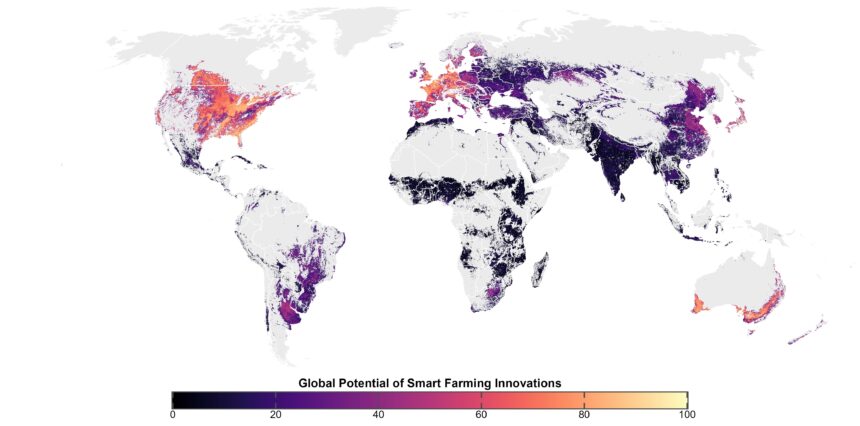
Drones that detect crop pests, robots that remove weeds and artificial intelligence (AI) systems that determine where to apply water and fertilizer are becoming increasingly common on farms. These technologies promise to cut costs and reduce environmental damage, but their economic benefits vary widely. Where does investing in smart farming actually pay off?
A new international study led by researchers at the University of Bonn in Germany finds that smart farming technologies are already economically viable on around 42% of the world’s cropland. That share could rise to 50% over the next two decades and reach 75% if countries strengthen their environmental regulations. If governments weaken those rules, however, the proportion could fall to just 31%.
Published on 19 October in the Proceedings of the National Academy of Sciences (PNAS), the study provides a global assessment of where smart farming technologies can be profitable. It also identifies regions where their adoption could help address pressing environmental challenges, including water scarcity and excessive fertilizer use.
“These smart farming technologies have the potential to make crop farming more sustainable and environmentally friendly,” says David Wuepper, a professor at the University of Bonn and one of the study’s lead researchers.
However, he cautions that adopting these technologies does not automatically make financial sense for every farm. High upfront costs and the technical expertise required to operate the equipment can make investment difficult, particularly in the short term.
Where does smart farming pay off?
Across Europe and North America, farmers are increasingly using drones to detect pest infestations and target pesticide applications more precisely. Robots can remove weeds before they spread, while automated irrigation systems monitor soil moisture and direct water to where it is needed.
By reducing unnecessary applications of water, fertilizers and pesticides, these technologies can lower operating costs and limit environmental harm. Their economic value, however, depends on local conditions, including farm size, labour costs, education levels and environmental regulations.
To assess these differences, the researchers consulted more than 8,000 smart farming experts worldwide, asking them to identify locations where these technologies were already being used profitably. They also reviewed scientific studies documenting real-world applications.
The team compiled data from more than 4,000 locations where technologies such as automated irrigation, weeding robots and drone-based monitoring were in use. They then applied machine-learning methods to identify the factors associated with profitable adoption.
The results point to the strongest economic potential in regions with higher incomes, better education systems, larger farms and stricter environmental regulations. These include Western Europe, the United States, Canada and Australia.
Shahrear Roman, a doctoral researcher in Wuepper’s group, explains that farms in these regions often use substantial quantities of fertilizers and pesticides. Precision technologies can help farmers cut costs by applying these products only where they are needed.
Higher labour costs also make automation more attractive, improving the financial case for investing in robots and automated machinery.
The outlook is different in sub-Saharan Africa, where the economic potential of smart farming remains comparatively limited, despite the need to improve agricultural productivity and resource management.
One major obstacle, Wuepper says, is that many existing technologies have been designed for large, capital-intensive farms in Europe and North America. As a result, they may be poorly suited to smaller agricultural operations.
“At the moment, the equipment is being developed with a focus on large, capital-intensive operations in North America and Europe,” he says.
Wuepper argues that agricultural research and development should place greater emphasis on affordable technologies tailored to smallholder farmers. Such innovations could help extend the benefits of smart farming beyond wealthier agricultural regions.
Environmental policies could reshape the market
One of the study’s most striking findings is the role of environmental governance in determining where smart farming becomes profitable.
The researchers found that the strength of environmental regulations was the most important predictor of profitability in their models, outweighing the other factors they examined.
“We found that smart farming already pays off where environmental governance is strongest. It is by far the most important predictor in our models,” Roman says.
Combining these findings with regional economic forecasts, the team developed a global assessment of where smart farming technologies could become economically viable over the coming decades.
The analysis covered five technology categories: automated irrigation systems; weeding robots; drones and other field-monitoring tools; machinery that automatically adjusts fertilizer and pesticide applications; and GPS-guided equipment that reduces overlapping passes across fields.
The researchers also examined where profitable adoption could coincide with substantial environmental benefits, identifying regions where the economic case for smart farming overlaps with pressing ecological challenges.
Smart irrigation, for example, was often found to be economically attractive in areas facing growing water shortages. This suggests that farmers in these regions could potentially reduce water use while improving their financial performance.
The findings also highlight how policy choices could influence investment. Stronger environmental regulations could expand the share of global cropland where smart farming is profitable, while weaker rules could undermine incentives to adopt the technologies.
These figures are scenario-based estimates, not guaranteed forecasts. The actual expansion of smart farming will depend on economic development, government policies, access to technology and farmers’ ability to finance new equipment.
“Ecological and economic benefits often go hand in hand. But they do not arrive on their own: without policy, most of the environmental gain stays on the table,” Wuepper says.
Ultimately, the future of smart farming will depend on more than advances in robotics, drones and AI. It will also hinge on whether governments, researchers and technology developers can make these tools affordable and practical for a wider range of farmers. That challenge is particularly important for smallholders, who often face limited access to finance and technology even as they contend with water scarcity, rising input costs and pressure to improve productivity.


