

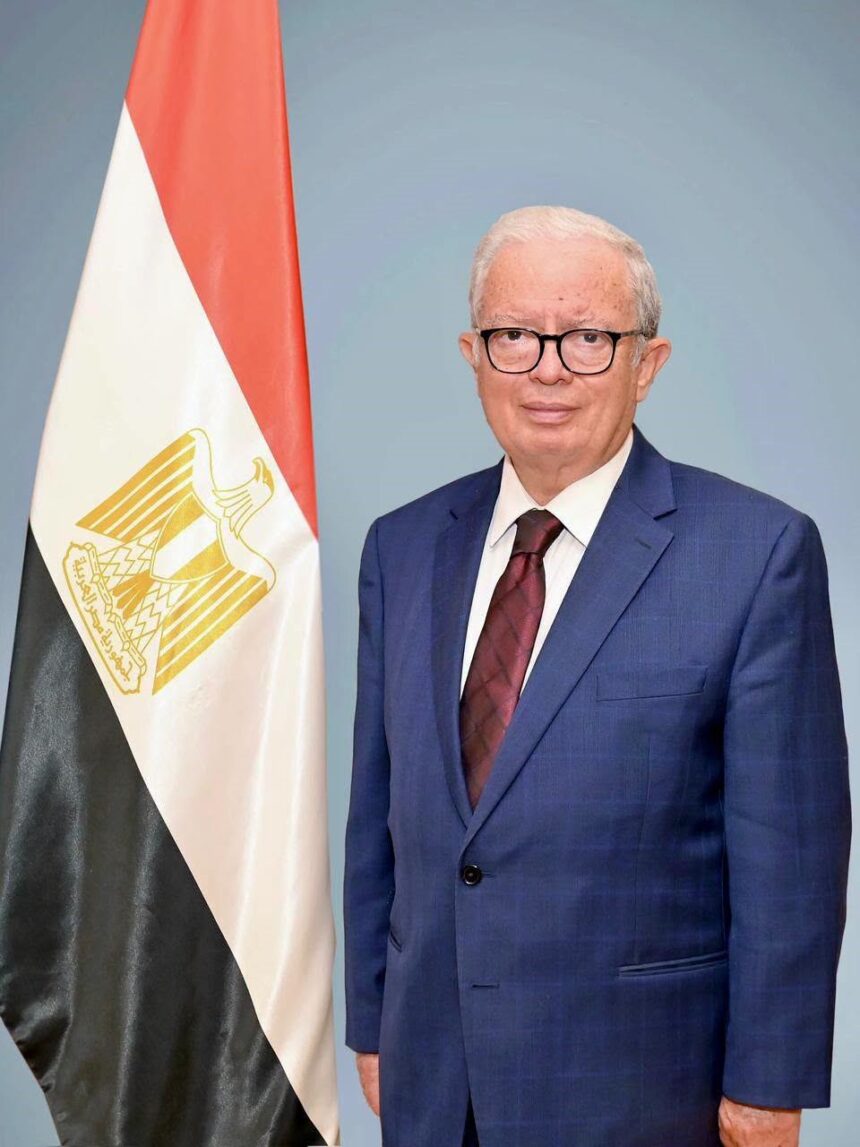
Egypt’s Deputy Prime Minister for Economic Affairs Hussein Issa arrived in the Kyrgyz capital Bishkek on Monday to participate in the 2026 Shanghai Cooperation Organisation (SCO) summit, representing President Abdel Fattah al-Sisi.
Issa was received upon arrival by the Deputy Minister of Foreign Affairs of the Kyrgyz Republic, Sitek Jumakadyrovich Jumakadyr uulu, and the Chargé d’Affaires of the Egyptian Mission to the Republics of Kazakhstan and Kyrgyzstan, Ibrahim Hamza.
The deputy prime minister is scheduled to deliver Egypt’s address at the two-day summit and hold a series of high-level bilateral meetings with officials from participating countries and representatives of international organisations.
The summit, which kicked off on Monday under the motto “Together for Sustainable Peace, Development and Prosperity”, marks the 25th anniversary of the SCO’s establishment. The gathering convenes at a time when the world is grappling with the ongoing Russia-Ukraine war and the aftermath of the U.S.-Israel war on Iran, which has upended global energy and financial markets.
Chinese President Xi Jinping, Russian President Vladimir Putin, and Indian Prime Minister Narendra Modi have arrived in Bishkek for the summit, alongside Iranian President Masoud Pezeshkian. On the sidelines of the event, Xi held a meeting with Putin.
The summit is also attended by the leaders of Pakistan, Uzbekistan, Belarus, and Kazakhstan. Furthermore, Turkish President Recep Tayyip Erdogan, United Nations Secretary-General Antonio Guterres, and Association of Southeast Asian Nations (ASEAN) Secretary-General Kao Kim Hourn are expected to attend.
The SCO started in 1996 as a security bloc dubbed the “Shanghai Five”, formed by China, Russia, Kazakhstan, Kyrgyzstan, and Tajikistan to settle border disputes following the end of the Cold War and the collapse of the Soviet Union.
In June 2001, the Beijing-headquartered grouping evolved into the SCO, expanding to include Uzbekistan. The bloc expanded again to include India and Pakistan in 2017, followed by Iran and Belarus as full members in 2023 and 2024, respectively. In addition to its full members, the organisation has 14 key dialogue partners, including Egypt, Saudi Arabia, Qatar, Turkiye, Myanmar, Sri Lanka, and Cambodia.


