

The Makkah Joint Defence Agreement signed by Saudi Arabia, Türkiye and Pakistan on 7 August 2026 marks an important development in the evolution of a regional security order. Its significance, however, may have less to do with the three countries that signed it than with the fourth country that did not. For Egypt, the question is not simply whether to join a new defence arrangement, but how Cairo can best use its political weight and strategic position to shape the emerging regional framework while protecting its national interests, constitutional requirements and freedom of action. This imperative is particularly important now that the Makkah Agreement has been signed amid an unsettled regional environment shaped by the 2026 US-Israel-Iran conflict, attacks involving Iran and Gulf states, threats to infrastructure and shipping and uncertainty over the future role of the United States.
Notably brief, the public statement establishing the pact says that Saudi Arabia, Türkiye and Pakistan agreed to strengthen collective security, deterrence and defence cooperation, with the central provision that an armed attack against one would be regarded as an attack against all three. This establishes a clear political commitment but leaves substantive operational questions unanswered. Reports indicate that a committee of ministers and a general secretariat based in Saudi Arabia will oversee operational details, suggesting that an institutional framework for implementation is already taking shape. Yet the publicly released text does not specify the contributions each country would make, establish an integrated command or standing force, identify a common military budget or provide detailed procedures for activating collective defence. While the signatories have clarified that the arrangement is not directed against any particular state, uncertainty remains over how an armed attack or an imminent threat would be defined, who would determine whether the commitment should be triggered, what form assistance would take and how much discretion each government would retain.
Turkish Foreign Minister Hakan Fidan has likened the provision to NATO’s Article 5, while stressing that the practical response would depend on the circumstances and the assistance requested by the state under attack. The comparison captures the principle of collective defence but does not make Makkah conceptually or institutionally equivalent to NATO. En l’état, the pact is an important strategic commitment whose operational credibility remains to be demonstrated through military coordination, joint exercises, intelligence sharing and defence-industrial collaboration. Erdoğan has also said that other countries seeking regional peace and stability could participate, making the prospect of future membership highly relevant.
Reactions to the pact’s announcement have been nuanced. Iran has responded cautiously with Foreign Minister Abbas Araghchi welcoming the emphasis on Muslim cooperation and adding that Iran’s armed forces had demonstrated their “readiness, capability and might”. An Iranian parliamentary media official reportedly said Tehran had received an invitation, although Foreign Ministry spokesman Esmaeil Baghaei later said that no official invitation had been received. If Iran were to join, it would fundamentally alter the pact’s character. A structure partly interpreted as a response to Iranian power would instead have Iran inside it. Iranian analysts have consequently offered opposing assessments, with some warning that membership would be a strategic mistake and others arguing that it could transform Makkah into a broader Muslim collective-security framework.
Israel has focused particularly on Türkiye and the possibility of Egyptian accession. A senior Israeli official said the agreement “worries us” and indicated that Israel would not be surprised if Egypt joined. The issue is less necessarily about an imminent conventional conflict than about the emergence of a regional security structure involving Türkiye, whose policies increasingly diverge from Israel’s. Israeli analyst Ofir Winter has identified Türkiye as the principal concern, citing Erdoğan’s rhetoric and Ankara’s regional policies. Egyptian participation would add another dimension because Egypt has a formal peace treaty with Israel while potentially entering the same collective-defence structure as Türkiye, Saudi Arabia and Pakistan.
India has said that it is assessing the agreement and its implications for national security and regional stability. Foreign Minister S. Jaishankar subsequently challenged its practical significance, asking: “There are live military situations which each of the signatories face, what has the Makkah pact done in response to that?” His remarks suggest that the country is focused on whether the agreement translates into meaningful military commitments. At the same time, the government has sought to emphasise the importance of its relationship with Saudi Arabia, while Riyadh has signalled that it will remain attentive to its partner’s priorities. New Delhi’s broader concern is that closer Saudi-Turkish defence cooperation could enhance Pakistan’s strategic position, particularly if the Makkah framework develops beyond its current trilateral configuration.
The UAE and Greece are watching for different reasons. Emirati strategic commentary has questioned Pakistan’s role in defending Saudi Arabia, while Athens is focused on Türkiye’s expanding regional role and its implications for the eastern Mediterranean. For Egypt, both reactions matter because Cairo maintains important strategic relationships with the UAE, Greece and Cyprus alongside those with Saudi Arabia, Türkiye, Pakistan and others.

Washington, meanwhile, has been broadly supportive. On 17 August, President Donald Trump welcomed the Makkah Joint Defence Agreement. He noted that the Middle East is coming together to defend itself “in a more meaningful way.” This response indicates that the administration does not view the pact as aimed at Israel or inherently incompatible with American interests and regional stability. Instead, the White House can encourage regional burden-sharing while fully maintaining its own military and strategic presence.
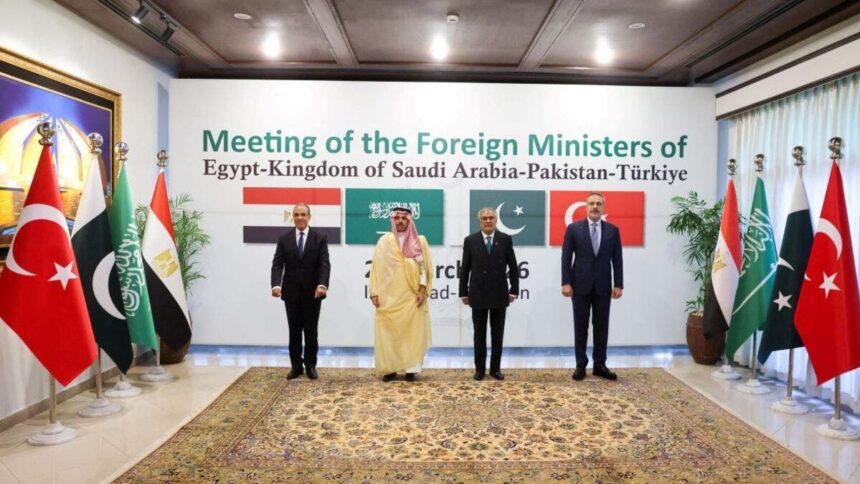
The Makkah agreement did not emerge in isolation: Egypt, Saudi Arabia, Türkiye and Pakistan had already established the R4 as a four-country consultative mechanism. On 21 June, Egypt hosted the fourth meeting of the foreign ministers. On 5 August, only two days before the Makkah summit, the four ministers met again in Amman to discuss regional developments, de-escalation and issues including freedom of navigation in the Strait of Hormuz.
The Pact comes at a particularly consequential moment for the R4. Three members have now developed a deeper defence relationship, raising questions about the future of the two mechanisms. The R4 could provide a broader political and diplomatic framework while Makkah develops more specialised defence cooperation. Alternatively, Egypt could negotiate conditions for joining the defence component or continue to promote close military cooperation bilaterally with each of the three countries. A third possibility is that Makkah becomes the principal strategic framework for Saudi Arabia, Türkiye and Pakistan at the expense of the R4. The most constructive outcome would be for the two mechanisms to reinforce rather than fragment one another: Makkah providing deeper defence cooperation while the R4, preferably with additional members, provides a broader political framework in which Egypt remains central.
Hakan Fidan has said he expects Egypt to join and described Cairo as a natural partner, characterising the remaining obstacles as “technical issues”. Egypt has taken a more measured position, with Foreign Minister Badr Abdelatty explaining that “when it comes to co-operation in the field of defence and when there are associated commitments, then it’s natural that the matter requires deep studies in the light of Egypt’s constitution and legal commitments.”
Article 151 of the Egyptian Constitution requires treaties concluded by the president to receive approval from the House of Representatives, while treaties concerning peace, alliance or sovereign rights require a referendum. Article 152 also places conditions on declaring war and deploying Egyptian armed forces on combat missions outside Egypt.
Egypt must also consider its obligations under the 1979 peace treaty with Israel. Article III establishes the fundamental relationship between the two countries, including recognition of sovereignty and territorial integrity and an undertaking to refrain from the threat or use of force. Article VI requires the parties to fulfil their treaty obligations in good faith and not enter into obligations conflicting with the peace treaty. This does not mean Egyptian membership in Makkah would necessarily conflict with the treaty, but that Cairo would need to establish how collective-defence obligations would operate in any future crisis involving Israel. That assessment is part of Egypt’s sovereign responsibility in determining the terms of any future participation.
Egypt’s strategic position makes the calculation still more complex. Cairo leads support for Gaza and the Palestinian cause while maintaining relationships with the United States, Israel, Saudi Arabia, the UAE, Greece, Cyprus, Türkiye, India and Pakistan and facing security challenges distinct from those of the other Makkah signatories, including the Red Sea, Suez Canal, Sudan, Libya, maritime and water security. Cairo has strong reasons to support greater regional deterrence while ensuring that any collective-defence commitment does not constrain its ability to respond to individual crises in accordance with Egyptian interests, as it has done before. Egypt would not simply be another participant; its inclusion would give the arrangement a much broader regional character while giving Cairo considerable influence over its terms and future direction. This is why the issue should not be framed simply as whether Egypt will join. The more important matter is under what conditions participation would strengthen Egypt’s security and influence while preserving the freedom of action necessary to protect its interests.
Three factors will ultimately determine the pact’s future. First is institutionalisation: can the three states develop effective mechanisms for military coordination, intelligence sharing, joint exercises and defence-industrial collaboration? Second is crisis credibility: if one member faces a serious security crisis, will the collective-defence commitment produce meaningful deterrence and support? Third is expansion: can additional countries join without creating such divergent threat perceptions and obligations that collective decision-making becomes difficult?
Beyond a careful analysis of the agreement itself, attention must be paid to how its main parties operationalise the pact to prove its seriousness, how other regional actors receive it and the unique challenge it presents for Egypt. The announcement has already set in motion a series of developments across the region, with external parties either testing the signatories’ true intentions—as illustrated by Israel’s military escalation in Syria and its increasingly explicit red lines over Türkiye’s expanding military presence there—or recalibrating their alliances to respond to this new reality, as reflected in Greece’s deepening defence cooperation with Israel.
One may conclude, as anticipated in my June article, The Helsinki Mirage, that countries of the region are not necessarily in favour of establishing a new and comprehensive peace and security umbrella. Instead, they may opt for ad hoc bilateral and regional arrangements that provide temporary assurances in the turbulent and unpredictable environment they face. The Makkah agreement, alongside the R4, represents less a step towards a single regional security umbrella than part of the gradual development of a more fragmented but potentially more pragmatic security architecture based on variable geometry.
For Egypt, this makes the present moment particularly important. Do the Pact’s objectives and tools provide the most suitable response to Cairo’s actual strategic challenges? Will the Pact reduce the relevance of the R4 as a regional political framework for consultation and coordination and diminish its prospects of attracting additional members? Will the region face further turbulence in the months ahead, requiring a further reassessment and adaptation of the regional structures now taking shape? The forthcoming high-level segment of the UNGA should provide an opportunity for substantive consultations and greater clarity on positions. Until then, the most prudent course of action may be to wait and see.
Nadine Loza is a development strategist, opinion columnist, and Founding Director of the Egypt Diaspora Initiative.
