

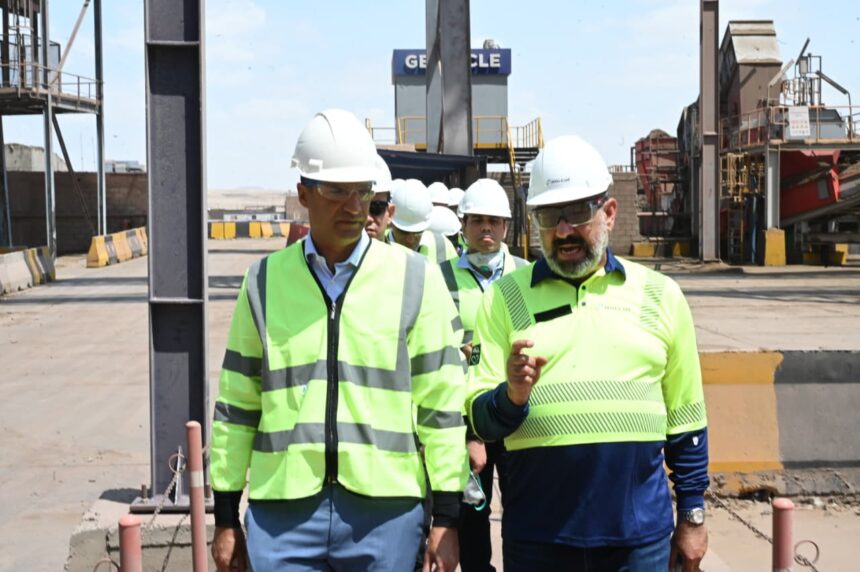
Egypt’s Minister of Industry Khaled Hashem inspected Holcim Egypt’s cement plant in Ain Sokhna, formerly Lafarge Egypt, as part of a tour of major heavy industrial facilities in Suez.
The plant, which covers 1.08 million square metres, is one of Holcim Egypt’s key assets, with the company’s investment portfolio exceeding EGP 8bn since it began operations in Egypt in 1997, becoming one of the first private-sector companies to operate in the cement industry.
The Ain Sokhna facility has an annual production capacity of around 9.5 million tonnes and a local component ratio of 95%. The company exported approximately 1.5 million tonnes of clinker last year and provides around 2,000 direct and indirect job opportunities.
Hashem was accompanied during the visit by Mohamed Zada, Assistant Minister of Industry for Strategic Industries, Nahid Youssef, Chairperson of the Industrial Development Authority, and other ministry officials.
The minister toured the plant’s production lines, quarry, waste sorting and processing platform, central laboratories and main control room.
During the visit, Hashem reviewed Holcim Egypt’s operations as one of the leading providers of innovative and sustainable building materials and solutions. The company operates one of the largest cement plants in the Middle East and Africa, alongside seven ready-mix concrete plants and the Geocycle platform for waste management and supporting the circular economy.
Holcim Egypt provides an integrated portfolio of construction solutions, including cement, ready-mix concrete and low-carbon, environmentally friendly products. The company has also contributed to several major urban development and infrastructure projects across Egypt.
Among its flagship projects is the Grand Egyptian Museum, where the company supplied more than 320,000 cubic metres of low-carbon, environmentally friendly concrete and 600,000 square metres of ready-mix mortar solutions. According to the company, these solutions contributed to reducing carbon emissions by more than 30%.
The company also processes around 650,000 tonnes of alternative fuel derived from waste annually and plans to expand its operations to approximately 1 million tonnes of alternative fuel per year by 2030.
These efforts align with Holcim Group’s global strategy to expand the use of innovation and low-carbon technologies in the construction sector, while supporting Egypt’s sustainable urban development plans and Vision 2030 objectives.
During the tour, Hashem stressed that the cement industry is one of the key pillars of Egyptian manufacturing, given its role in meeting the needs of urban development and infrastructure projects, while also offering significant potential to increase industrial exports and generate greater added value for the national economy.
He noted that the sector has witnessed substantial development in production capacities and technologies in recent years, enabling Egyptian companies to compete in regional and international markets and opening new opportunities for cement and related product exports.
The Minister of Industry said the government is placing particular emphasis on enhancing the competitiveness of the cement sector by supporting production continuity, ensuring the stability of supply chains, and improving the efficient use of resources and energy.
Hashem concluded that the ministry is also working to encourage expansion in supporting industries and deepen local manufacturing, with the aim of increasing value addition and strengthening the export capabilities of Egypt’s cement industry.


