The Central Bank of Egypt (CBE) has said the persistence of the Iran-US conflict continues to weigh on the global and domestic economies, with lingering effects on economic activity, foreign investment, and domestic inflation.
The CBE added in its recently issued Monetary Policy Report (MPR) that recent favourable macroeconomic developments, attributed to the temporary ceasefire agreement and better-than-expected inflation outturns, led it to slightly revise its baseline inflation forecast downward in the short term.
Accordingly, the Monetary Policy Committee (MPC) decided at its May and July 2026 meetings to keep key policy rates unchanged, maintaining an adequately tight monetary policy stance to anchor inflation expectations and support the disinflation path towards its target level by the second half (H2) of 2027.
Global situation
Globally, growth among Egypt’s trading partners slowed slightly to an average of 2.2% in the second quarter (Q2) of 2026, down from 2.3% in Q1, as spillovers from the Iran-US conflict weighed on economic activity.
Import-weighted inflation among Egypt’s trading partners accelerated from an average of 3.9% in Q1 2026 to 4.5% in Q2, amid persistent external price pressures and renewed geopolitical tensions.
Meanwhile, global commodity prices remained high despite a temporary softening in June, while global financial conditions stabilised as capital flows and sovereign spreads improved during the de-escalation period.
Nevertheless, the appreciation of the US dollar and the resurgence of geopolitical tensions towards the end of the quarter renewed risks surrounding global inflation, commodity markets, and external financial conditions.
Annual headline inflation
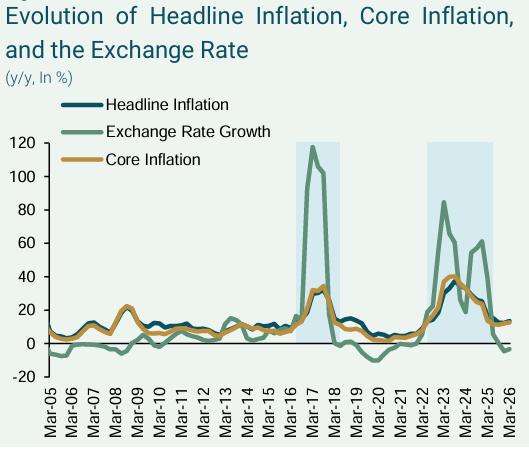
Domestically, annual headline inflation rose to an average of 14.6% in Q2 2026, up from 13.5% in Q1, reflecting temporary domestic seasonal factors, adjustments to regulated energy and transportation prices, as well as the pass-through of global shocks and regional geopolitical developments.
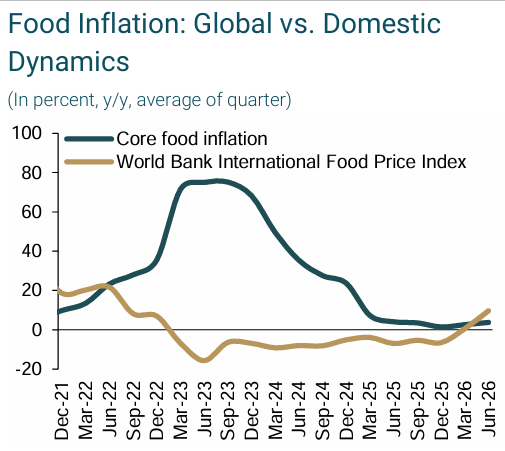
Annual food inflation rose to 6.6% in Q2 2026, compared with 4.1% in the previous quarter, while annual non-food inflation remained broadly stable at 19.7%, reflecting the relatively persistent nature of inflation across non-food goods, particularly services.
Nevertheless, quarterly developments (y-o-y) mask the positive monthly inflation dynamics throughout Q2 2026, reflected in the diffusion index declining to its lowest reading since mid-2025, registering 9.4% in June 2026.
Real GDP growth
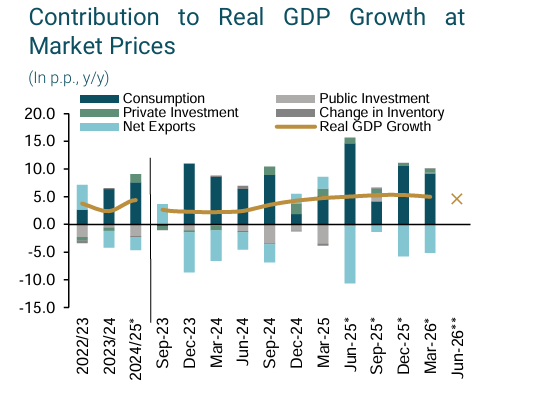
The CBE now casts real GDP growth in Q2 2026 at approximately 4.5%, mainly driven by non-petroleum manufacturing, communications, and trade activities.
Regarding actual developments, real GDP growth at market prices recorded 5% in Q1 2026, compared with 4.8% in Q1 2025, signalling robust growth in economic activity, primarily driven by consumption and private investment.
With respect to the labour market, the unemployment rate declined to 6.0% in Q1 2026, against 6.3% in the corresponding quarter of 2025, while real wage growth decelerated notably to 1.3% in Q1 2026, down from 11% a year earlier, due to slower nominal wage growth and an uptick in inflation.
Egypt’s external position
Egypt’s external position remained resilient in Q1 2026 against the repercussions of the regional conflict, with the balance of payments recording a marginal surplus of $0.3bn.
On the one hand, the current account deficit more than doubled compared with Q1 2025 to stand at $5.1bn, equivalent to 1.2% of GDP. This was driven by a larger trade deficit and a decline in the net investment income balance, which were partially offset by higher remittances and receipts from tourism and the Suez Canal.
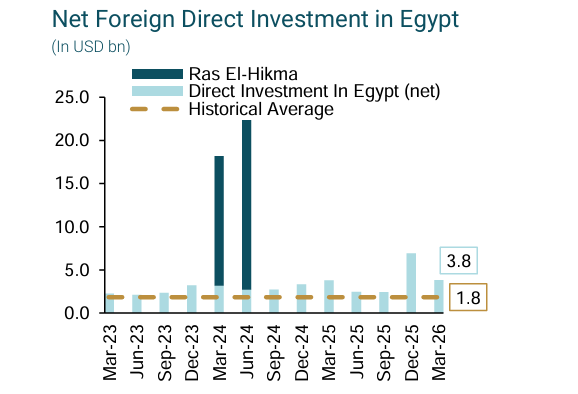
On the other hand, the capital and financial account recorded a net inflow of $3.4bn in Q1 2026, supported by FDI inflows, medium- and long-term loan disbursements, and a drawdown of commercial banks’ foreign assets following considerable net portfolio outflows triggered by the outbreak of the regional conflict.
Net international reserves
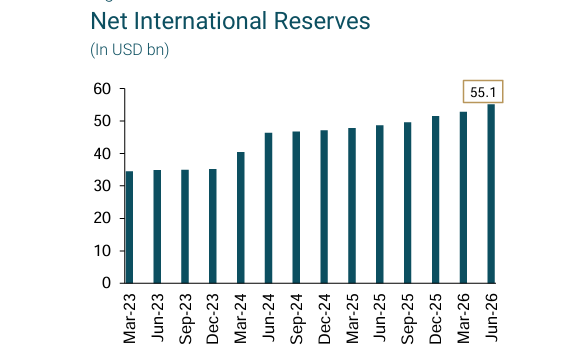
Nonetheless, during Q2 2026, following the easing of regional tensions and the gradual recovery in investor sentiment, net international reserves increased to $55.1bn in June 2026, compared with $52.8bn in March 2026.
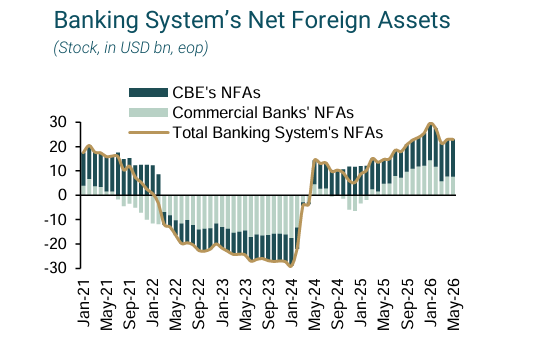
This was also consistent with the partial rebound in the banking system’s net foreign assets (NFAs) during Q2 2026, which reached $22.9bn in May 2026, up from $21.4bn in March, mainly driven by commercial banks’ NFAs.
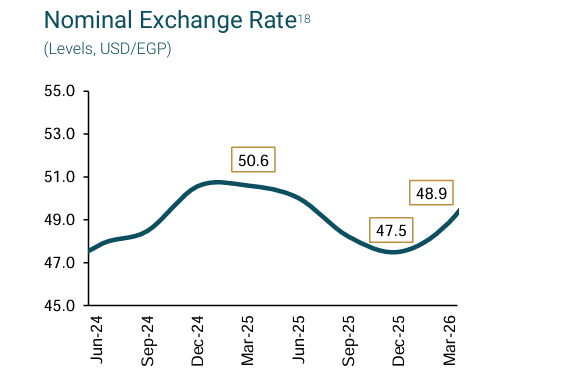
This was also reflected in the notable appreciation of the pound from EGP 54.6 to EGP 49.2 per USD between March and June 2026.
Financial conditions and domestic credit
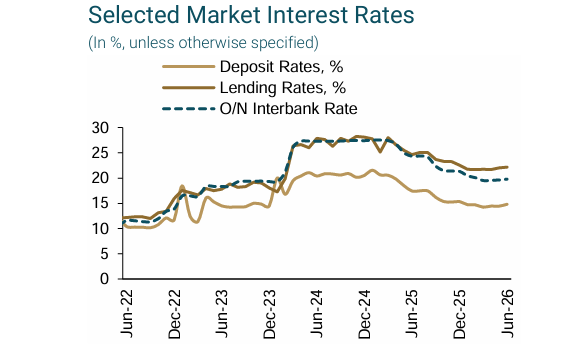
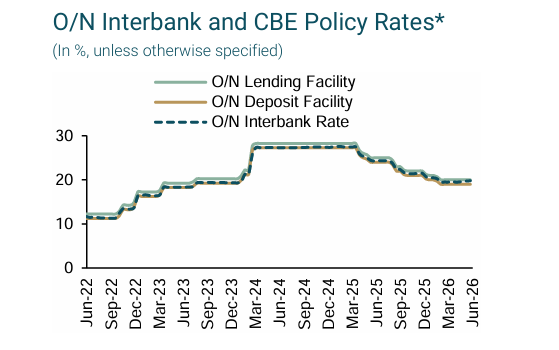
With respect to financial conditions and domestic credit, tighter liquidity conditions pushed the overnight interbank rate slightly above the policy rate, averaging 19.8% in June 2026, compared with 19.5% in March 2026.
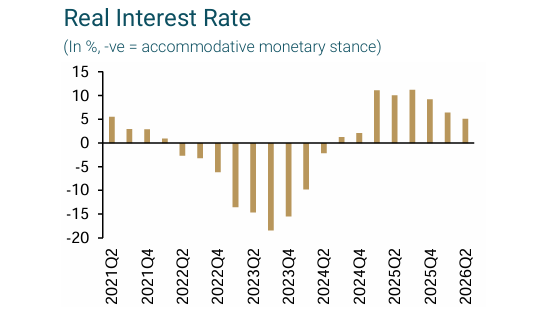
Nonetheless, it remained closely aligned with the policy rate, with approximately 93% of the policy rate cuts since April 2025 transmitted to the overnight interbank rate.
Similarly, around 75% of the decline in the overnight interbank rate since April 2025 passed through to average new deposit and lending rates by June 2026, indicating monetary policy transmission to the money market and financial conditions.
Meanwhile, real growth in local-currency (L/C) loans to the private sector registered an average of 7.3% in Q2 2026, supported by the continued provision of L/C loans to the private business sector, particularly in the industrial and services sectors.
Egyptian Eurobond
Egyptian Eurobond yields also declined by an average of 110 basis points across all tenors in Q2 2026, reflecting improved investor risk sentiment as regional tensions eased by the end of the quarter.
CBE inflation projections
Given the better-than-expected domestic economic developments, CBE inflation projections have been revised slightly downward in the near term, with average annual headline inflation still expected to temporarily accelerate in Q3 2026, partly due to unfavourable base effects, albeit at a more moderate pace than previously projected.
Thereafter, inflation is expected to gradually decline and reach single digits during H2 2027, aligning with the targeted level of 7% (±2%), supported by the prevailing tight monetary stance over the forecast horizon.
Nevertheless, the inflation outlook remains susceptible to risks, as reflected in two alternative scenarios: escalation and de-escalation. As such, annual headline inflation is expected to range between 15.2-17.8% and 7.7-8.3% on average in FYs 2026/27 and 2027/28, respectively, under different conflict scenarios, compared with an average of 13.3% in FY 2025/26.
CBE slightly revises real GDP growth forecast
With respect to output, the CBE slightly revised its real GDP growth forecasts to 5% and 4.9% for FYs 2025/26 and 2026/27, respectively, up by 0.1% for each fiscal year compared with the Q1 2026 MPR, while FY 2027/28 is projected to grow by 5.4% on average.
The upward revision for FYs 2025/26 and 2026/27 mainly reflects a stronger projected contribution from the Suez Canal than assumed in the previous MPR.
Additionally, growth forecasts for FYs 2026/27 and 2027/28 continue to be mainly driven by the manufacturing and services sectors, particularly tourism, with FY 2027/28 also supported by the projected normalisation of the monetary policy stance.
Nonetheless, estimates indicate that output remains below potential, though gradual convergence is expected by H1 2027, suggesting that demand-side inflationary pressures are projected to remain limited in the short term, supported by the currently tight monetary policy stance.