

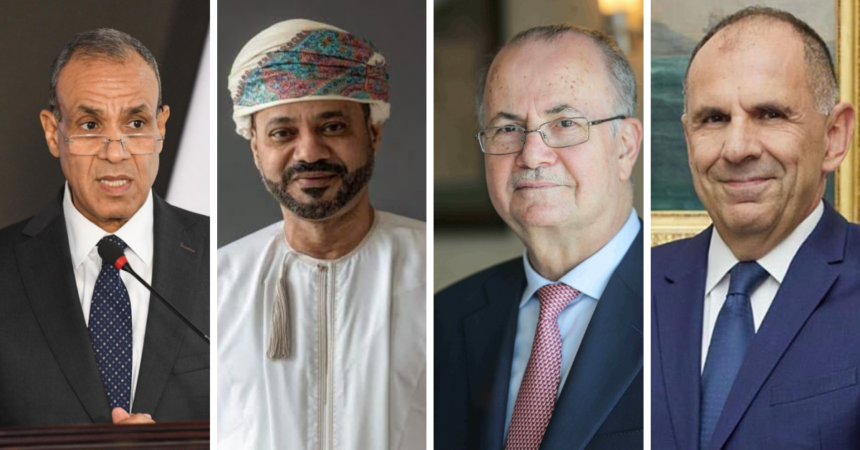
Egyptian Foreign Minister Badr Abdelatty discussed the deployment of an international stabilization force in Gaza and the implementation of President Trump’s peace plan during a series of regional diplomatic calls on Saturday aimed at containing Middle East tensions.
Speaking with Palestinian Prime Minister Mohammad Mustafa, Abdelatty detailed ongoing Egyptian efforts coordinated with mediators to advance a roadmap for the Gaza Strip. The discussions covered an anticipated Israeli withdrawal from the enclave, ensuring the flow of humanitarian aid, and initiating early recovery and reconstruction. Abdelatty emphasised the planned entry of the National Committee for the Administration of Gaza alongside an international stabilization force to establish security and prepare conditions for a comprehensive political solution.
During the call, Abdelatty reaffirmed Cairo’s complete support for empowering the Palestinian Authority to assume its responsibilities across both Gaza and the West Bank. He stated this is vital to preserving territorial integrity and backing aspirations for an independent state on the June 4, 1967 borders, with East Jerusalem as its capital.
Addressing the West Bank, the Egyptian minister condemned illegal settlement expansion and escalating settler violence against Palestinians and their property. He specifically warned against the E1 settlement project, describing it as a threat to Palestinian geographical contiguity that isolates East Jerusalem from its surroundings. Abdelatty reiterated Egypt’s categorical rejection of any attempts to annex land, displace Palestinians, or alter the demographic and legal reality of the occupied territories. In response, Mustafa expressed appreciation for Egypt’s steadfast defence of Palestinian rights and its support for national institutions, confirming a mutual desire to maintain close consultation.
In a separate telephone conversation with Omani Foreign Minister Badr Albusaidi, discussions focused heavily on regional security, particularly freedom of navigation in the Strait of Hormuz. Abdelatty stressed the critical need to restore normal maritime traffic and guarantee safe transit through the strait, citing direct impacts on the global economy, energy security, and international supply chains. He called for building on current diplomatic movements to de-escalate tensions and create conditions for a return to the memorandum of understanding between the United States and Iran, aiming to resume negotiations for a sustainable regional settlement. Both ministers agreed on the necessity of containing tensions and prioritising diplomatic solutions.
Broader regional de-escalation and maritime security were also central to a call received from Greek Foreign Minister Giorgos Gerapetritis. Both diplomats stressed the importance of prioritising diplomacy over military escalation to protect international navigation from the severe repercussions of current tensions on global trade and energy security.
Regarding Lebanon, Abdelatty affirmed Egypt’s support for Lebanese sovereignty, unity, and national institutions. He urged Israel to cease all military attacks and fully withdraw from Lebanese territory to prevent the expansion of regional conflict. On Sudan, Abdelatty reiterated Cairo’s backing for the country’s unity and institutions, stressing the importance of launching a comprehensive political track and securing unhindered humanitarian access in coordination with international partners.
The conversation with Gerapetritis concluded with discussions on expanding bilateral economic, investment, and energy cooperation. Both ministers praised the ongoing trilateral coordination mechanism between Egypt, Greece, and Cyprus, expressing a shared commitment to building upon the growing momentum in their strategic partnership.

