

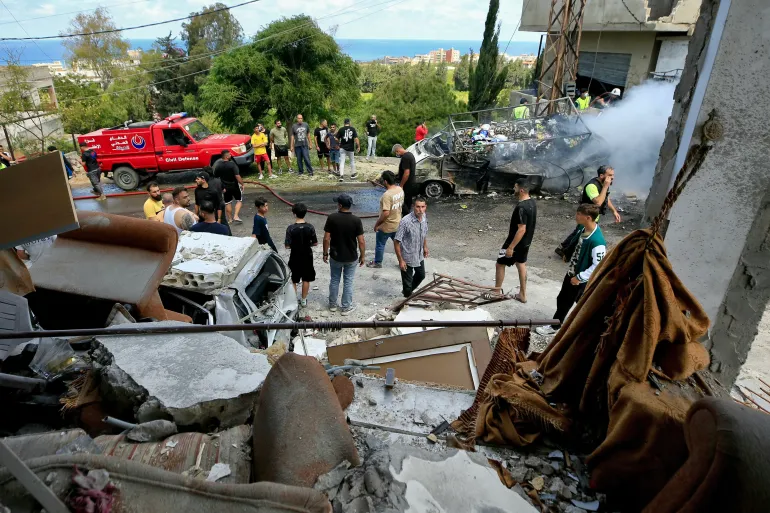
Egypt has strongly condemned an Israeli strike on a Lebanese army patrol in southern Lebanon that killed two officers and a soldier, describing the attack as a dangerous escalation and a violation of Lebanese sovereignty, international law, and international humanitarian law.
In a statement issued on Saturday, Egypt’s Ministry of Foreign Affairs called on the international community to take immediate action to halt repeated Israeli attacks on Lebanese territory and compel Israel to respect Lebanon’s sovereignty and territorial integrity.
Cairo warned that continued military escalation risks fuelling further tension, instability, and disorder across the region at a time when the Middle East is already facing multiple security challenges.
The Israeli military acknowledged carrying out the strike on a Lebanese army vehicle near the southern town of Tebnine. It said its forces had suspected the vehicle belonged to Hezbollah after detecting what it described as suspicious activity in an active combat zone.
The Israeli army added that the incident is under investigation and stressed that its military operations are directed against Hezbollah rather than the Lebanese Armed Forces.
The strike came amid renewed hostilities along the Lebanese-Israeli border. Hezbollah announced in a series of statements that it had targeted Israeli military positions and troop concentrations in southern Lebanon, including a drone attack on an artillery site in Odaisseh and rocket and artillery strikes near Tayr Harfa.
The group also claimed to have fired a surface-to-air missile at an Israeli military aircraft over Lebanon’s Zahrani coast.
Egypt reaffirmed its support for regional and international diplomatic efforts aimed at reducing tensions and preventing the conflict from expanding into a broader confrontation.
The Foreign Ministry reiterated Cairo’s firm rejection of any violation of Lebanese territory and reaffirmed Egypt’s support for Lebanon’s sovereignty, national institutions, unity, and territorial integrity.
Egypt also called for the immediate and complete withdrawal of Israeli forces from all Lebanese territory and urged the comprehensive and non-selective implementation of United Nations Security Council Resolution 1701, stressing that such steps are essential for preserving Lebanon’s sovereignty and restoring security and stability.
Separately, Saudi Arabia condemned an attack on a position belonging to the United Nations Interim Force in Lebanon (UNIFIL) that killed one peacekeeper and injured several others.
In a statement, the Saudi Ministry of Foreign Affairs said the kingdom categorically rejects attacks against peacekeeping forces and called for those responsible for assaults on personnel involved in peacekeeping, humanitarian, and relief missions to be held accountable.
The military escalation coincided with a rare public disagreement between Beirut and Tehran. Lebanese President Joseph Aoun and Prime Minister Nawaf Salam criticised what they described as Iranian interference in Lebanon’s affairs and rejected the use of the country as leverage in Tehran’s confrontation with Washington.
Iranian Foreign Minister Abbas Araghchi responded by asserting that Israel remains Lebanon’s principal enemy and denied claims that Lebanon serves as a bargaining chip in Iran’s regional calculations.
The developments come against the backdrop of wider regional tensions surrounding Iran. US President Donald Trump recently said Washington had reached a stage where the Iranian issue would be resolved “one way or another,” either through a negotiated agreement or through what he described as a more difficult alternative, raising concerns over the potential for further escalation across the region.

