

Kuwait escalated its diplomatic response to Iran on Wednesday, expelling two Iranian diplomats and summoning the acting head of the Iranian embassy after attacks that Kuwait and Bahrain said targeted civilian and critical facilities. The incidents have drawn widespread Arab condemnation and heightened concerns over a broader escalation across the Gulf.
Kuwait’s Ministry of Foreign Affairs said it had delivered a formal protest note to the Iranian chargé d’affaires over what it described as “continued Iranian attacks.” The ministry also informed the diplomat of Kuwait’s decision to reduce the size of the Iranian diplomatic mission and declared two embassy staff members persona non grata, ordering them to leave the country within 24 hours.
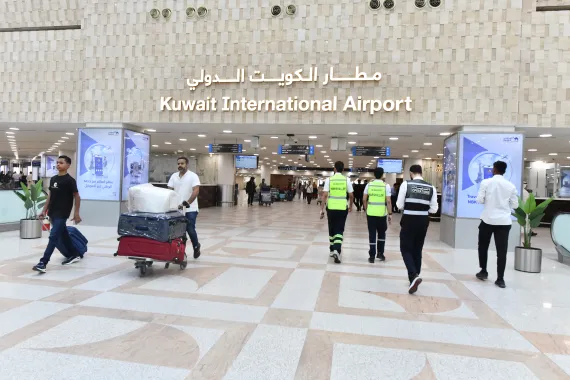
The diplomatic measures followed Kuwait’s announcement that one person had been killed and at least 63 others injured, including airport workers and passengers, in attacks on civilian and vital facilities. The strikes reportedly damaged Kuwait International Airport and forced a temporary suspension of air traffic.
In Bahrain, authorities said they intercepted and destroyed three Iranian missiles and drones targeting civilian sites. Manama also submitted letters to the UN Secretary-General and the President of the Security Council regarding what it described as an earlier Iranian drone attack on 5 April against facilities belonging to the Gulf Petrochemical Industries Company.
Bahrain said the attack constituted a clear violation of its sovereignty, territorial integrity and international law, adding that it breached UN Security Council Resolution 2817 of 2026, which called for an immediate halt to Iranian attacks.
The Gulf Cooperation Council (GCC) condemned the attacks on Kuwait and Bahrain, describing them as a dangerous escalation targeting civilian facilities, infrastructure and diplomatic missions. GCC Secretary-General Jasem Mohamed Albudaiwi stressed that the security of Kuwait and Bahrain is inseparable from Gulf security and called for a firm international response to what he characterised as Iranian aggression.
A wave of Arab condemnation followed, with Qatar, Saudi Arabia, the United Arab Emirates, Jordan, Egypt and Lebanon expressing solidarity with Kuwait and Bahrain and supporting measures taken by both countries to safeguard their sovereignty and security.
Qatar urged efforts to shield the region from the consequences of what it called “unjustified attacks” and called for de-escalation. Saudi Arabia said the attacks undermined international efforts to restore regional security and stability, while the UAE stressed that attacks on civilian facilities and diplomatic missions violated international law and the Vienna Convention on Diplomatic Relations.
Anwar Gargash, diplomatic adviser to the UAE president, called for a “firm, united and cohesive” Gulf response, arguing that the attacks were directed not at a single country but at the Gulf region as a whole, whose security and interests are closely interconnected.
Concerns have also grown over maritime security in the Strait of Hormuz. A document reviewed by Reuters showed that the European Union’s diplomatic service has proposed assigning the EU’s Aspides naval mission a leading role in future mine-clearing operations in the strategic waterway, once conditions permit, as part of a broader French-British initiative.
The proposal reflects mounting international concern over the security of one of the world’s most important energy transit routes. Iranian state television quoted the Revolutionary Guards Navy as saying that the “Iranian route is the only safe route” through the Strait of Hormuz and warned that vessels deviating from that route could be targeted.
The escalating military and diplomatic confrontation has further complicated efforts to revive US-Iran negotiations. Iran’s Tasnim news agency quoted an informed source as saying that Tehran had not responded in recent days to a proposed US text and that indirect exchanges through mediators had effectively stalled due to Israeli attacks in Lebanon.
Meanwhile, US President Donald Trump said Iran had agreed not to possess a nuclear weapon and indicated that he could meet Iran’s Supreme Leader in the future. ABC News reported that Washington is seeking written nuclear commitments from Tehran as part of an initial agreement aimed at breaking the diplomatic deadlock.
Israeli Prime Minister Benjamin Netanyahu said Israel and the United States remained prepared for further escalation if necessary, adding that military action to reopen the Strait of Hormuz remained an option. US Secretary of State Marco Rubio said Washington hoped negotiations would ultimately persuade Iran to abandon uranium enrichment and relinquish its stockpile of highly enriched uranium, while accusing Tehran of threatening regional security and supporting terrorism.


