

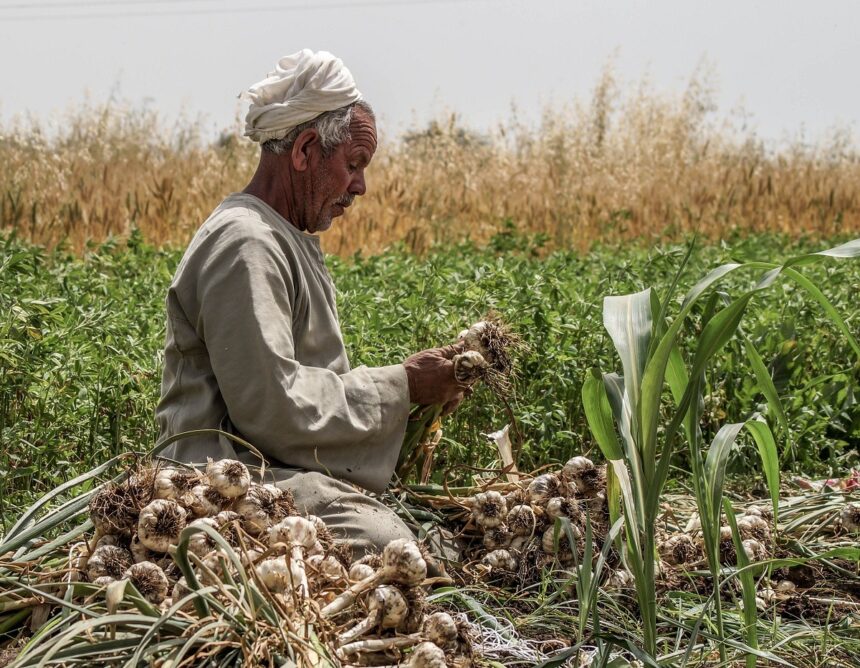
Egyptian garlic has become a growing concern for European producers after its exports to the European Union nearly doubled within one year.
The development comes as Spanish garlic producers described the Egyptian product as a “dangerous enemy” flooding European markets before the start of the local harvest season, benefiting from competitive prices and rising global demand.
In this regard, Spain’s ASAJA association said EU imports of Egyptian garlic rose to 19,555 tonnes in 2025, compared with around 9,655 tonnes in 2024, making Egypt the second-largest garlic supplier to Europe after China.
The association added that Egyptian garlic entered European markets this season at an average price of €1.5 per kilogram, down 20 cents from the previous year, putting pressure on the competitiveness of European products and contributing to lower prices in the market.
Sharp rise in Egyptian garlic exports to European markets
For example, Egyptian garlic exports to the Italian market jumped 55% year-on-year in 2025, reaching their highest level ever, in a sign of the product’s growing competitiveness in one of Europe’s largest consumer markets.
Egypt’s garlic exports to Spain also increased nearly fivefold during the first eight months of the year, driven by a shortage in local production in Madrid.
Demands for protective measures
In response to the rise in Egyptian garlic exports, Spanish producers called on the European Union to take protective measures. These include reviewing trade agreements with Egypt, studying the activation of safeguard clauses, updating deterrent customs duties imposed on Chinese imports since 2001, and tightening customs controls to prevent any illegal trade practices.
This escalation comes despite expectations of a recovery in Spanish garlic production this season. Estimates from Spain’s garlic sector indicate that production in the province of Córdoba could rise by between 40% and 50% compared with last year, supported by abundant winter rainfall.
Córdoba’s production is expected to reach around 11,100 tonnes in 2026, compared with just over 8,000 tonnes in the previous season. The wider Andalusia region is expected to produce around 37,800 tonnes, up 31.4% year-on-year. Total Spanish production is estimated at 237,800 tonnes, cultivated across 24,400 hectares.
However, Spanish producers say the improvement in the harvest does not remove concerns over losing markets to Egyptian garlic, especially as planted areas have continued to decline historically due to water shortages and high production costs, which range between €12,000 and €15,000 per hectare. These pressures have pushed some farmers to move their activities to other areas within Spain.
Strong performance for the Egyptian season
Meanwhile, Egypt’s garlic export season continues to deliver strong results, supported by increased demand from Europe, Brazil, and the United States.
Mohamed Maatouk, CEO of RM Fresh, said the season began relatively slowly before changing course in April, when purchase orders started flowing in from several import-dependent countries and markets facing supply shortages, led by Brazil.
Speaking to Economy Plus, Maatouk said Brazil still relies heavily on imports despite growth in its local production, while Egyptian garlic has proven its high quality and highly competitive prices.
He explained that Egyptian garlic prices started the current season at levels lower than last season, before beginning to rise rapidly. However, they remain below last year’s prices and continue to be globally competitive. He expects prices to keep increasing and approach last season’s levels.
Maatouk also noted that Egypt has become one of the fastest-growing countries in garlic production and exports globally in recent years, strengthening its position as a key supplier to Europe, Brazil, Africa, and increasingly the United States.
According to Maatouk, Egypt’s garlic production is currently approaching half a million tonnes annually, making it one of the world’s largest garlic sources outside China and India. Fresh garlic exports reached around $36.7m in 2023.
For his part, Ehab Samy, CEO of Noreen Food, told Economy Plus that most Egyptian garlic suppliers have already booked their full quantities for the current season, driven by strong demand from Europe, Brazil, and the United States for high-quality garlic.
“The season began with strong European demand and satisfactory prices for exporters, before a shortage in Brazil further boosted export momentum,” he said.
Samy noted that raw garlic prices in Egypt are rising almost daily, in parallel with higher export prices, adding that European buyers have already started adapting to mid-season price levels.
He also confirmed that strong demand for Egyptian garlic appears likely to continue, noting that early contract requests for next season have already started coming in, particularly for new varieties.


