

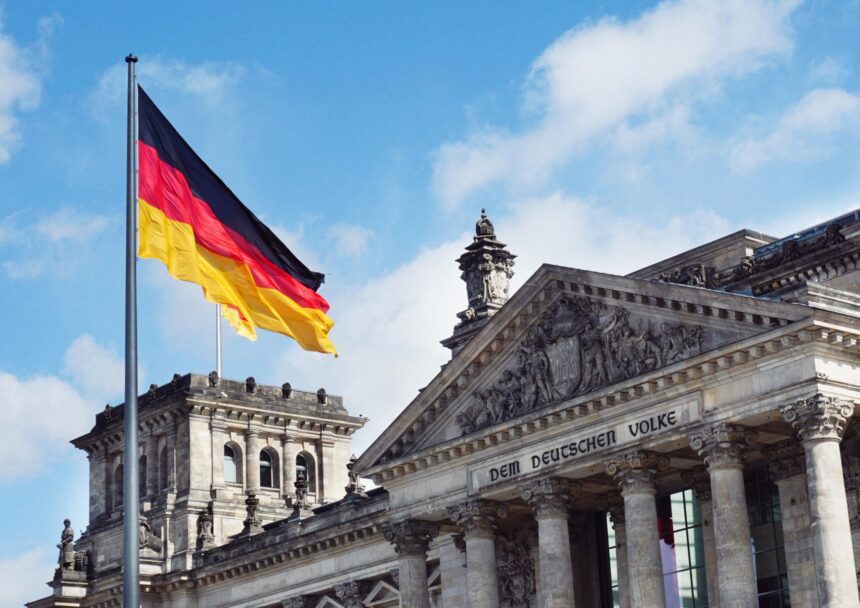
Hertie School in Berlin holds a special place in my heart, not only as a leading institution examining Germany’s political, social, and human dynamics, but also as a space where questions of state, society, and governance are confronted in their full complexity. My experience there, including a period of study at the School, shaped the way I approach contemporary transformations, not merely as policy challenges, but as deeper questions about how modern states sustain meaning, trust, and coherence under pressure.
Against this background, the recent *Youth in Germany 2025* study offers more than empirical insight; it opens a window into what I would describe as a deeper structural tension within the modern state. While the report itself is not an institutional publication of the Hertie School, it is closely connected to its intellectual environment through the contribution of Professor Klaus Hurrelmann, situating it within a broader tradition of rigorous, policy-relevant research.
At first glance, the findings are familiar: psychological strain, economic pressure, digital overuse, and rising openness to emigration. Yet the analytical value of the study lies not in these indicators individually, but in the paradox they collectively reveal. Young people remain willing to work, to contribute, and to assume responsibility. What is weakening is not motivation, but confidence in the system’s ability to translate effort into outcome.
This distinction is critical. It suggests that the issue is not one of performance failure, but of meaning failure. In other words, we are not simply observing a crisis of resources or policy effectiveness, but a disruption in the relationship between individual effort and its perceived fairness and purpose. What emerges here is not merely a descriptive crisis; it is an empirical manifestation of what I conceptualise as a crisis in the governance of meaning.
By governance of meaning, I refer to the capacity of the state to render its actions intelligible, coherent, and normatively justifiable to its citizens. Modern states do not rely on performance alone; they rely on the ability to explain that performance in ways that sustain trust. When this explanatory capacity weakens, legitimacy begins to erode, even when institutions continue to function effectively.
The study provides multiple indications of this shift. Expectations around economic security, housing, social justice, and political participation remain central to how young people evaluate the system. However, what appears to be declining is the credibility of the link between these expectations and actual outcomes. The issue is not that the system produces nothing, but that what it produces is no longer fully convincing.
This helps explain the volatility in political preferences. The fragmentation observed among young voters is not merely ideological polarisation; it reflects a search for meaning. Support moves across parties not because of stable conviction, but because no single narrative fully captures what fairness, security, and future prospects should look like. In this sense, the political field becomes a space of interpretive competition.
Migration intensifies this dynamic. The study shows diverging expectations, from calls for stricter control to support for openness and integration. Yet what matters analytically is not the divergence itself, but what it represents. Migration becomes a site where deeper questions about fairness, distribution, and belonging are negotiated. It is less a policy issue than a test of how meaning is constructed within the state.
This is why debates around migration often appear disproportionate to their immediate scope. They are not only about borders or integration, but about whether the system operates according to a logic that citizens can recognise as fair. When that logic becomes unclear, even coherent policies may lose their legitimacy.
What the study ultimately reveals, therefore, is not a society in collapse, but a society under interpretive strain. Germany remains institutionally strong and economically capable. Yet even within such a context, the alignment between performance and meaning is no longer guaranteed.
This insight extends beyond Germany. Across contemporary states, the challenge is shifting. It is no longer sufficient to design efficient policies; the central question is whether those policies can be embedded within a framework of meaning that citizens understand and accept. The problem is not only what the state does, but how what it does is perceived, interpreted, and justified.
This perspective reflects a broader line of research I have been developing on what I describe as the “governance of meaning,” where legitimacy depends not only on performance, but on the state’s capacity to render that performance intelligible and normatively credible to citizens.
From this vantage point, the study reads less as a warning of decline and more as an early signal of structural transformation. It suggests that the mechanisms through which trust is produced are under pressure, even in high-capacity states.
The implication is direct. Efficiency alone is no longer sufficient. A state must not only deliver outcomes; it must also sustain a shared understanding of why those outcomes are fair, necessary, and meaningful.
When a state fails to explain itself, it does not simply lose efficiency; it loses legitimacy itself. Because legitimacy, at its core, is not performance alone; it is the continuous ability to justify the meaning of that performance.
Dr Ramy Galal is a governance and institutional reform specialist focusing on state capacity, accountability, and the design of effective public institutions. His work examines how institutional arrangements shape policy outcomes and government performance, particularly in emerging and middle-income contexts. He also engages with the concept of governance of meaning as an analytical lens for understanding how authority, narratives, and interpretation influence policy environments.
He is an Assistant Professor and a former Senator, bringing a combination of academic expertise and hands-on experience across both legislative and executive domains. He previously served as an advisor and official spokesperson for Egypt’s Ministry of Planning and Economic Development, with direct involvement in policy design, government decision-making, and implementation processes at the centre of government.
He holds a PhD from Alexandria University, a master’s degree from the University of East London, and a diploma in public administration from the University of Chile.


