Japan and France agreed on Wednesday to coordinate closely on efforts to end the war in Iran and reopen the Strait of Hormuz to oil and gas tankers, as US President Donald Trump said Washington would play no role in securing the vital waterway.
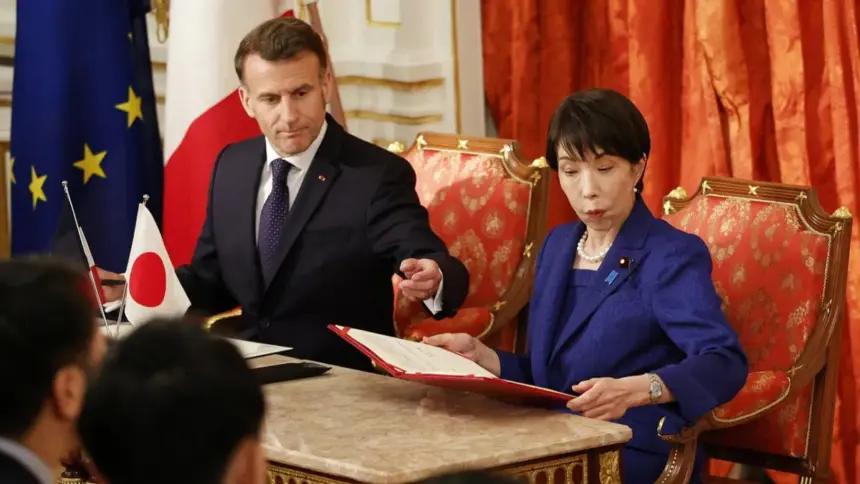
Japanese Prime Minister Sanae Takaichi said after talks with French President Emmanuel Macron in Tokyo that the two nations addressed security relations and industrial cooperation. “I believe it is extremely important for Tokyo and Paris, due to the challenging international situation, to consolidate personal ties and further strengthen the power of cooperation,” Takaichi said.
As the US-Israeli war on Iran enters its fifth week, Japan and France, like other nations, are suffering from the consequences of the conflict, including rising energy prices. The continued effective closure of the Strait of Hormuz to approximately 20% of global oil and liquefied natural gas (LNG) flows threatens a severe shortage of petroleum products.
Japan typically sources about 90% of its required oil from the Middle East and has begun withdrawing from its strategic reserves to mitigate the economic impact. Macron, speaking at a joint press conference with Takaichi, said he agreed with her regarding the need to restore freedom of navigation in the strait.
France has held talks with dozens of countries as it seeks proposals for a mission to reopen the strait once the war concludes. Japan stated it is prepared to discuss sending minesweepers, though the scope of any Japanese role or participation would be limited by its constitution, which prohibits involvement in military operations.
These developments follow remarks made by US President Donald Trump to reporters at the White House on Tuesday, in which he stressed that the United States “will have no role” regarding the Strait of Hormuz. Trump indicated that the responsibility for keeping the vital waterway open lies with the countries that depend on it.
“There is no reason for us to do this,” Trump said. “This is not our business; rather, it will be the responsibility of France or any party that uses the strait.”
The president’s comments came after he issued sharp criticism of Washington’s allies earlier on Tuesday, accusing them of not exerting sufficient effort to support US goals in the ongoing war with Iran.
European countries are currently in advanced discussions to develop plans for protecting navigation in the Strait of Hormuz after the war ends. These plans include deploying frigates to escort oil tankers and commercial ships, using ship-borne air defence systems to down Iranian drones and missiles when necessary, and conducting a show of force to reassure shipping and insurance companies.
On Tuesday, Iranian President Masoud Pezeshkian told European Council President Antonio Costa during a telephone call that the Strait of Hormuz is closed to “vessels and naval units belonging to aggressor parties and their supporters.” He warned that any external intervention in the war or the current regional situation, under any pretext, would have “serious consequences.”
Macron and Takaichi also noted they are seeking to strengthen security ties in the Indo-Pacific region. The two leaders signed cooperation agreements in the fields of rare earth element supply chains, civil nuclear energy technologies, and artificial intelligence.