

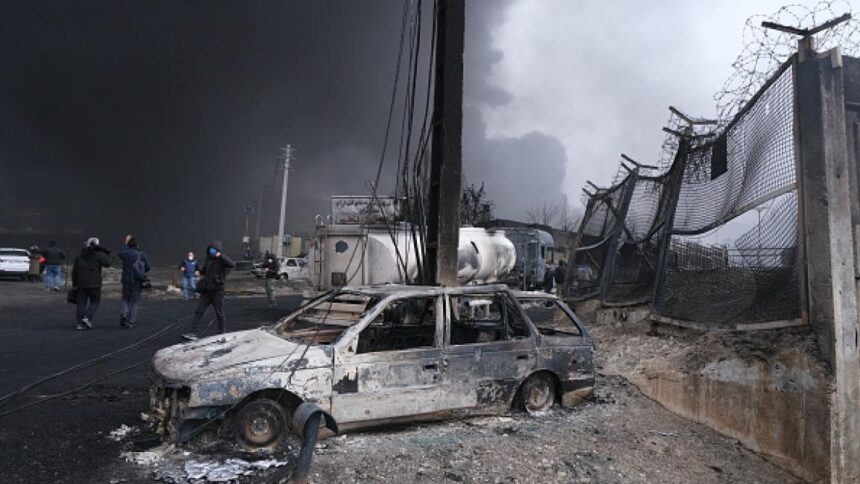
Military confrontations in the Middle East entered their tenth day as Iran continued exchanging strikes with the United States and Israel, while Tehran simultaneously witnessed a major political shift with the appointment of Mojtaba Khamenei as the country’s new Supreme Leader following the death of his father.
Iran’s Islamic Revolutionary Guard Corps (IRGC) announced its pledge of allegiance to the new leader, describing his selection as “a new dawn and the beginning of a new phase in the Islamic Republic.”
Ali Larijani, secretary of Iran’s Supreme National Security Council, said Mojtaba Khamenei possesses “the ability to lead the country under the current sensitive circumstances.”
Tehran announced on Sunday that Mojtaba Khamenei had assumed the position of Supreme Leader after his father, Ali Khamenei, was killed in a large-scale U.S.-Israeli strike on the Iranian capital in the early hours of February 28, marking a dramatic escalation in the ongoing conflict.
Reacting to the development, U.S. President Donald Trump told Fox News that he was “not happy” with the appointment of Iran’s new Supreme Leader, without elaborating further.
On the military front, Iran launched intensive missile barrages towards Israeli cities. Israel’s Maariv newspaper reported that an Iranian missile strike in central Israel killed two people. Israeli emergency services also said two people were seriously injured in the town of Yehud near Ben Gurion Airport, east of Tel Aviv.
In another development, United States Central Command (CENTCOM) said a U.S. soldier had died from severe injuries sustained during an Iranian attack on American forces in Kuwait earlier this month, bringing the number of U.S. military fatalities in the conflict to eight.
The escalation has spread across several countries in the region. Qatar’s Ministry of Defence said the country had been targeted by 17 ballistic missiles and six drones launched from Iran, adding that Qatari armed forces successfully intercepted all projectiles with no reported casualties.
Turkey said NATO air defences intercepted an Iranian ballistic missile, noting that debris fell in the southern province of Gaziantep Province.
In Kuwait, Iran’s Revolutionary Guard said it targeted the Al-Adiri helicopter base with suicide drones and cruise missiles. In a statement, the IRGC said the attack caused “significant damage” to facilities at the base, including fuel and gas storage sites, helicopter landing platforms, logistical support facilities and related infrastructure.
The statement said the operation targeted what it described as “American terrorists,” calling the strike an “important operational blow” that it claimed thwarted U.S. plans to strike eleven key targets inside the base.
Separately, the IRGC announced it had shot down three U.S. MQ-9 Reaper drones, two over Bushehr Province in southern Iran and a third over Tehran.
Elsewhere in the Gulf, the United Arab Emirates Ministry of Defence said two members of its armed forces were killed after a military helicopter crashed due to a technical malfunction during a mission inside the country.
Diplomatically, Russia moved at the United Nations Security Council to prepare a draft resolution calling for an end to military operations in the region. According to a source cited by Russia’s TASS news agency, the draft expresses “deep concern over the current military escalation in the Middle East and beyond” and mourns the loss of life in ongoing hostilities.
The draft resolution urges all parties to immediately cease military activities and refrain from further escalation, while encouraging a return to negotiations without delay and full use of political and diplomatic channels. It also stresses the importance of ensuring the security of all states in the Middle East and beyond.
Meanwhile, Larijani warned that the ongoing war could threaten shipping in one of the world’s most critical maritime corridors.
“It is unlikely that any level of security can be achieved in the Strait of Hormuz under the fires of war ignited by the United States and Israel,” he said.
The Strait of Hormuz is a vital chokepoint through which roughly one-fifth of global oil trade passes, meaning any disruption could trigger wider economic and security repercussions worldwide.


