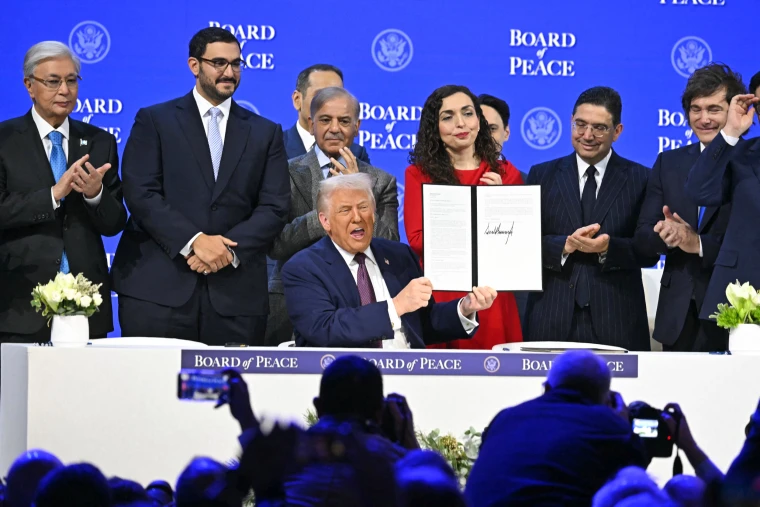
The recently launched “Board of Peace” is, at its core, a key pillar of U.S. President Donald Trump’s strategy to end the war in Gaza and oversee the second phase of his proposed plan — encompassing the reconstruction of the Gaza Strip and the disarmament of Hamas. Just days ago, during a White House press conference, Trump publicly suggested that the Board of Peace “could” replace the United Nations.
Even without this overt statement, the council’s draft charter delivers an unusually blunt critique of existing international institutions. It argues that “lasting peace requires practical governance, logical solutions, and the courage to abandon approaches and institutions that have frequently failed.” It further calls for “a more flexible and effective international peacebuilding body,” a thinly veiled reference to the United Nations. According to the charter, the council’s mission is to “promote stability, restore credible and lawful governance, and secure sustainable peace” in conflict zones, while developing global best practices.
Under the proposed structure, Donald Trump himself would serve as President of the Board of Peace. Although the document avoids explicitly using the term “president for life,” reports from CNN and Reuters indicate that Trump is expected to retain this position even after leaving office.
This arrangement would grant the president unprecedented authority. He alone would possess veto power, control invitations to member states, expel participants, set meeting agendas, and establish or dissolve subsidiary bodies at will. Removal would only be possible through voluntary resignation or a unanimous vote by the council’s executive committee declaring him unfit — a virtually insurmountable safeguard that entrenches personal dominance over collective governance.
Trump, who reportedly invited around 60 world leaders — nearly two-thirds of United Nations member states — to join the initiative, has approached the project with the instincts of a businessman rather than a statesman. In a striking move, he has reportedly set a price of $1bn for any country seeking a permanent seat on the council. Unsurprisingly, most governments have so far declined, citing legitimate fears that the body would undermine, marginalise, or even supplant the United Nations.
The UN, already weakened by structural paralysis and the dominance of the “Big Five,” has long struggled to act independently of major power politics. Ironically, it is the American veto itself that has contributed significantly to the erosion of the Security Council’s credibility. The proposed Board of Peace appears poised not to remedy these flaws, but to institutionalise them under a single leader’s control.
In effect, this council risks becoming Trump’s personal geopolitical instrument — designed to impose his vision, advance his ambitions, and enforce a form of political guardianship over states he deems strategically relevant. The precedent set in Venezuela, along with emerging signals regarding Greenland, suggests that this body could function as a private Security Council devoted less to international stability and more to the realisation of the American president’s personal agenda.
There appears to be little capable of restraining a leader intent on reshaping the global order. Even NATO allies now anxiously await Trump’s next move concerning the Danish island of Greenland, aware that their strongest possible response — should he resort to force — would amount to little more than cautious diplomatic condemnation. Europe today finds itself in its most precarious strategic position since the end of World War II.
Defying Trump’s wishes could weaken, or even fracture, NATO, while triggering economic retaliation in the form of sanctions, tariffs, and political pressure — as previously witnessed in U.S. relations with France. Conversely, acquiescence could leave Europe exposed to the ambitions of Russian President Vladimir Putin, who has not forgotten the West’s role in drawing Ukraine into a prolonged war of attrition under the banner of NATO expansion. The gravest European fear is the convergence of Putin’s desire for revenge with Trump’s apparent ambition to abandon NATO altogether — a scenario that could leave the continent dangerously vulnerable.
The proposed Board of Peace will likely not be the last of Trump’s bold — or erratic — experiments in global power projection. With striking audacity, he continues to pursue a vision of unilateral American dominance, presenting the United States as an unassailable global force — at least in his own imagination.
What Trump is attempting recalls William Shakespeare’s The Merchant of Venice, one of the playwright’s most celebrated tragicomedies, where romance intertwines with moral struggle. The story centres on Shylock, a ruthless moneylender who demands a pound of flesh as collateral for an unpaid debt.
By presiding over the Board of Peace and monopolising veto power, Trump is not merely attempting to reshape the international system — he is also seeking to legitimise the extraction and seizure of wealth and influence that belong to nations and future generations, without accountability or restraint.