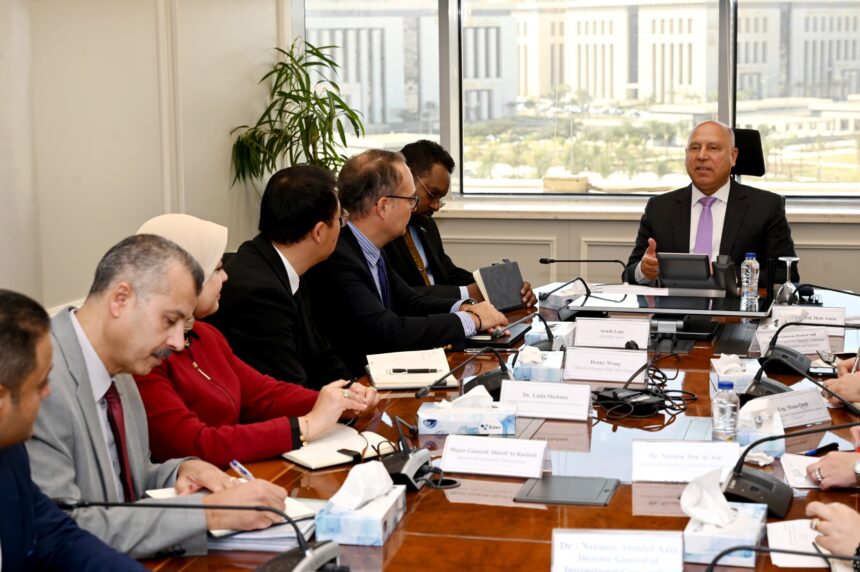
Deputy Prime Minister for Industrial Development and Minister of Industry and Transport Kamel Al-Wazir met with a delegation from EliTe Solar to discuss the company’s expansion plans in Egypt and ways to address key operational challenges, within the framework of the state’s strategy to localise renewable energy manufacturing.
The meeting was attended by senior officials from the Ministries of Industry and Transport and was led on the company’s side by Arndt Lutz, Chief Executive Officer of EliTe Solar. Discussions focused on expanding production capacity for the local market, increasing exports, and supporting Egypt’s drive to localise the manufacture of renewable energy components.
At the outset of the meeting, Al-Wazir expressed his pleasure at meeting the company’s leadership for the second time, following the inauguration of EliTe Solar’s industrial complex in the Sokhna Industrial Zone—affiliated with the Suez Canal Economic Zone—by Prime Minister Mostafa Madbouly in mid-January.
The facility manufactures solar cells and panels and forms part of broader government efforts to deepen local industrialisation of renewable energy components and accelerate the transition towards a green economy.
Al-Wazir stressed the importance of expanding production capacity and increasing the number of factories, while deepening local manufacturing by sourcing components and production inputs domestically. He encouraged the company to rely on local suppliers where possible, or to establish new factories to produce key inputs, thereby achieving industrial integration and supplying both EliTe Solar and other companies operating in the solar cell and panel industry.
The minister also highlighted the need for EliTe Solar to expand into new export markets by leveraging Egypt’s extensive network of free trade agreements, particularly with African countries, Arab markets, Europe, and the United States.
He noted that the Ministry of Industry gives preferential consideration to the use of new and renewable energy when evaluating applications from investors seeking to establish new factories, as part of efforts to reduce pressure on the national electricity grid.
Al-Wazir added that the Supreme Energy Council requires large industrial facilities—especially energy-intensive ones—to source a significant share of their energy needs from solar power as part of the approval process. He said the government is exerting strong efforts to encourage factories to rely on solar energy in production, in support of sustainability objectives and national energy targets.
In line with the Local Product Preference Law governing government procurement, Al-Wazir explained that the Ministry of Industry, through its Local Product Preference Unit, will notify entities establishing solar power plants in Egypt of the need to source solar cells and panels from the local market, provided that locally produced components are competitively priced and compliant with Egyptian standards.
On workforce development, the minister underscored the role of the Productivity and Vocational Training Authority in supporting the solar energy sector. He stressed the importance of leveraging the authority’s training services to upskill EliTe Solar’s workforce in advanced production technologies, as well as cooperating with the company to establish an industrial development school at its facilities or within the Suez Canal Economic Zone.
Such initiatives, he said, would serve the growing number of local and international companies operating in the solar energy industry.
For their part, EliTe Solar representatives outlined the company’s expansion strategy and highlighted challenges related to the need for a larger pool of skilled labour, as well as the local market’s reliance on imported solar cells and panels. Both sides agreed on the importance of continued coordination to support local manufacturing, boost exports, and strengthen Egypt’s position as a regional hub for renewable energy industries.