

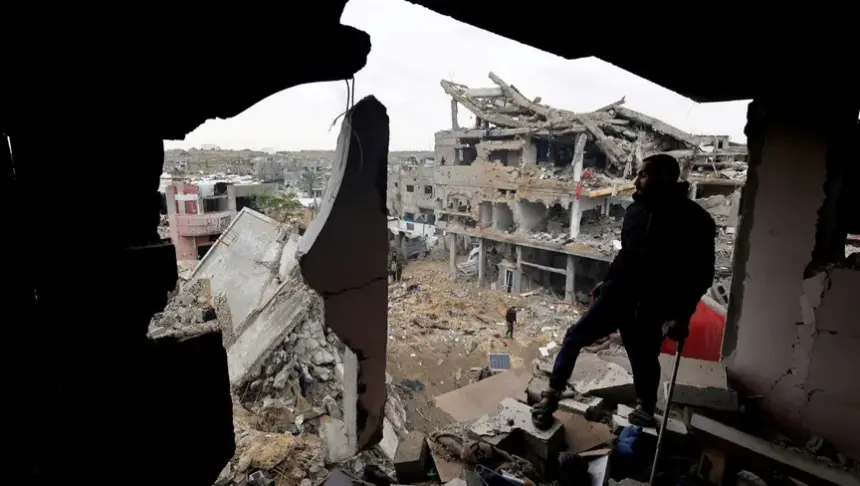
As the United States prepares to announce the transition to “Phase Two” of its Gaza peace plan this Wednesday, the focus of the conflict is shifting from the battlefield to the boardroom. In the meeting halls of Cairo, Palestinian factions are now reviewing a handpicked list of 15 technocrats set to form the National Committee for Administering Gaza (NCAG), a body tasked with the monumental challenge of governing a territory in ruins.
This move marks a pivotal moment in President Donald Trump’s 20-point peace initiative. By moving beyond the immediate ceasefire, Washington aims to establish a dual-layered leadership structure: a local Palestinian administration for daily services and an international “Peace Council” to oversee the billions of dollars required for reconstruction.
The transition, however, faces a fragile reality. While US officials view this as the opportune time for a shift toward “governance and reconstruction,” the plan must navigate a complex landscape of Israeli security concerns, funding gaps, and the delicate coordination of international leaders expected to gather at the World Economic Forum in Davos next week.
The Architecture of Governance
The proposed structure seeks to balance local autonomy with international oversight. The NCAG, likely to be led by former Palestinian Authority official Ali Shaath, will hold “day-to-day responsibility” for Gaza’s utilities, education, and civil services.
To ensure global accountability, the overarching Peace Council will be chaired by President Trump. According to US officials, Nikolay Mladenov, the former UN Middle East peace envoy, will be appointed as the High Representative. Mladenov will serve as the essential “link” between the Palestinian technocrats on the ground and the international power brokers in the Peace Council.
However, the rollout remains fluid. While US officials told the Wall Street Journal that the announcement of the 15-member committee is imminent, sources told the Financial Times that the formal unveiling of the full Peace Council may be delayed to ensure all diplomatic pieces are in place.
A Coalition in the Making
The international dimension of the plan is expected to crystallise next week in the Swiss Alps. British Prime Minister Keir Starmer is reportedly prepared to join the Peace Council, with a first meeting anticipated on the sidelines of the World Economic Forum in Davos, which runs from January 19 to 23.
“You take the most important leaders and the most important countries—that is the Peace Council,” Trump said on Sunday, outlining a vision where global powers provide “constant supervision and oversight” over a government of “qualified Palestinians and international experts.”
The White House has clarified that the Council’s primary mandate will be to “set the general framework and deal with the financing of Gaza’s redevelopment.” This includes the deployment of an “international stability force”—a move Palestinian Foreign Minister Varsen Aghabekian Shahin expressed hope would be announced in the coming days alongside the Council’s formation.
The Hurdles Ahead
Despite the diplomatic momentum, the path to Phase Two is littered with what officials describe as Israeli “obstacles.” Prime Minister Benjamin Netanyahu’s government remains resistant to a full military withdrawal and has raised significant concerns regarding the reconstruction process.
Funding also remains a critical sticking point. The sheer scale of the devastation requires a financial commitment that many nations are hesitant to make without ironclad guarantees of stability.
In Cairo, the stakes are visible. Hamas’s arrival, coordinated with mediators, is aimed at “accelerating the entry into the second phase,” according to a movement statement. Their presence underscores the complexity of the task: creating a technocratic administration that can function on the ground while the occupying forces begin a phased withdrawal.
A Twenty-Point Test
The US peace plan, which entered into force last October, is now facing its most rigorous test. Phase Two is not merely about maintaining a lull in fighting; it is an attempt to build a functioning state apparatus from the ground up while the ruins are still smouldering.
As the Davos summit approaches, the international community will be watching to see if the “Peace Council” can provide the political cover and financial muscle necessary to turn a 20-point document into a tangible reality for the people of Gaza.
“The preparations are underway,” Minister Shahin noted on Saturday, reflecting a cautious optimism that the new structure might finally offer a departure from the cycle of conflict. Whether the “National Committee” can exercise true authority, or if it will be hamstrung by the same geopolitical rifts that started the war, remains the central question of the coming weeks.
