


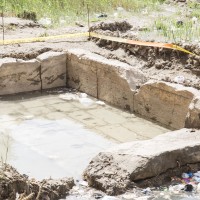


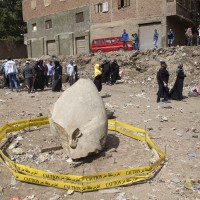


In one of the most important discoveries of Egypt’s recent history, archaeologists Thursday morning discovered two statues belonging to the 19th dynasty royal family of Ramses II. However, it did not take long before the great discovery turned into a controversial debate after people followed the Ministry of Antiquities’ extraction process of the statues’ parts.
After pictures of using heavy loaders to lift parts of Ramses II statue went viral, the Ministry of Antiquities faced a flurry of accusations of damaging the statues.
Defending the massive media attacks against the Ministry of Antiquities’ specialists for using heavy construction excavators to extract a statue of Ramses II, Zahi Hawas expressed his support for the “100% correct strategy” adopted by the ministry in extracting and transporting the statue’s parts, stating that all monuments in that area were destroyed during the age of Christianity in Egypt.
“All of the buildings and houses in the area [Matariya] are built over remains of historical temples and cemeteries,” Hawas told Daily News Egypt. “It is known for being a highly important archaeological location with treasures buried beneath it. However, all of the precious antiquities are covered with substantial amounts of underground water.”
In a statement published on the ministry’s official Facebook page, the archaeologist and former Minister of Antiquities clarified that the ministry’s solution of using loaders to extract the statue was the only available solution.
“This leaves the ministry with no other alternative but using excavators to dig for and move the statue from one place to another—a method that is being used in different archaeological locations all across the globe,” the statement reads, adding that “the excavator is normally used at all historical locations.”
As for the broken parts of the statue, which are the head—including a part of the crown and the eyes—as well as the bust, Hawas confirmed that there is no whole statue to ever be found in that location as “they were all smashed and totally destroyed during Egypt’s Christian ages, as they thought they are heathenism temples, closing and destroying them in order to use their stones for building churches and houses,” the statement reads.
However, this is not the way archaeologist Monica Hanna views the situation: “there were several other ways of lifting the statues even when they are buried beneath underground water,” Hanna told Daily News Egypt. “In similar situations, pumps are used to absorb the surrounding water before lifting the monuments using ropes.”
Hanna assured that she had talked to Minister of Antiquities Khaled El-Anany to discuss other options of extracting the statues, “yet he was more focused on the importance of the discovery itself rather than the method of extraction.”
Hawas’ statement added that Dietrich Raue, head of the expedition’s German team, assured in a personal call with him that the lifting process has been done in highly accurate steps, confirming that the process left the statue without a scratch except for the already shattered part.
The other remains of the statue, which weighs 4 tonnes, is to be extracted on Monday, according to Osama Heikal, the parliament’s head of the media and culture department.
Heikal also told Daily News Egypt that a committee member from the Ministry of Antiquities and the interior and religious endowments ministries—by the latter of which the land is currently owned—is discussing the most appropriate way of lifting the rest of the statues. Hawas assured in his statement that this will also happen with a loader and with the help of wooden lumbers as an only option: “if it’s not lifted that way, it will never be,” he stated.
Regarding another issue, Hanna states that the bigger problem is that the archaeological land was sold when Zahi Hawas was the Minster of Antiquities, after he allegedly claimed that it has no historic interest: “he gave it to the local municipality to build a new market for street vendors, so the land is no longer owned by the ministry,” she explained.
Hawas told Daily News Egypt that “the land is one of the most historical sites as it previously saw the discoveries of remains of Ikhnaton and Ramses II temples.” The 56 feddans historical land is currently considered to be evacuated for further digging procedures.
“The bigger scandal for me which should be spotlighted is that we’re talking about discoveries that suggest that there’s a huge temple beneath that land, yet the Ministry of Antiquities under the direct supervision of Zahi Hawas gave it away without any clear explanation,” Hanna added.
After being fully extracted and restored, the statues are set to be displayed at the Grand Egyptian Museum.
Ramses II ruled over Egypt for about 68 years and was one of Egypt’s longest-serving pharaohs, believed to have lived up to 90 years. His reign marked the last peak of Egypt’s imperial power.
Known as “Ramses the Great,” he is believed to be the pharaoh mentioned in the biblical story of Moses. The great king led a period of military expansion in Egypt.
His tireless and continuous efforts of constructing palaces and temples, including the well known Abu Simbel temple in the far south, were the most notable in Egyptian history.
His mummy was found in 1881 and was moved to Cairo’s Egyptian Museum, where it quickly became one the biggest tourist attractions of the country. Other monuments found at the site include a huge temple for Bastet and large groups of mudbrick structures from the 26th Dynasty, which were used for the burial of mummified cats.
In 2008, Egyptian archaeologists announced the discovery of parts of a colossal statue, believed to belong to the king, in Tell Basta. Furthermore, in 2006, a colossal 100-tonne, 11-metre-high pink-granite statue of Ramses II was moved from the polluted city to a spot near the pyramids and closer to its original site.
Numerous temples dedicated to Egypt’s sun gods, particularly the chief god Ra, were built in ancient Heliopolis. But little remains of what were once the ancient Egyptians most sacred cities since much of the stone used in the construction of the temples was later plundered. The area, close to the modern districts of Ain Shams and Matariya, is now covered with residential neighbourhoods.
Egypt’s heritage sites have been plagued by looters and encroachment from local communities. Matariya is known for witnessing illegal excavations and treasure hunting. Dozens of incidents have been reported where workers had been found dead due to them digging in their backyards and falling victim to accidents.
In 2013, the United Nations Economic Scientific Cultural Organisation (UNESCO) threatened to declassify six archaeological sites in Egypt quoting a lack of experts in Egypt managing the sites as the reason. The sites included the Great Pyramids of Giza, the Karnak Temple in Luxor, the temples of Abu Simbel, Saint Catherine’s Monastery, Saint Mina’s Monastery, and Islamic Cairo.
Photos By Asmaa Gamal


